


On a Thursday morning in early September, in a small city that still carries the scars of one of the most violent tornadoes ever recorded in Alabama, a meteorologist will stand before a room full of neighbors and teach them something deceptively simple: how to hear a storm that they cannot hear, and how to see a danger that they cannot see.
The Weather Safety Workshop, hosted by the National Weather Service's Huntsville office in partnership with the Alabama Institute for the Deaf and Blind, takes place September 10, 2026, from 11 a.m. to 1 p.m. at the Northeast Alabama Community College Entrepreneurial Center on McCurdy Avenue in Rainsville. It is open to any citizen, though it is designed with a particular audience in mind: the deaf and blind communities of North Alabama, for whom the familiar rituals of severe weather preparedness — the wail of a siren, the urgent voice on the radio, the crackle of a NOAA Weather Radio alert — are often simply inaudible or invisible.
September is National Deaf Awareness Month, and the timing is deliberate. So is the location. Rainsville, a community in the NWS Huntsville forecast area, learned the stakes of weather communication the hard way. On April 27, 2011, one of the deadliest tornado outbreaks in American history tore across the Southeast. In the Huntsville forecast area alone, 39 tornadoes touched down, and the outbreak produced more strong to violent tornadoes than the historic 1974 outbreak. Across Alabama, 248 people lost their lives. The memory of that day hangs over everything the National Weather Service does in this region, and it is the reason this workshop exists.
Meteorologist Jennifer Saari, who works out of the NWS office in Huntsville, has spent years thinking about how weather warnings reach — or fail to reach — people with sensory disabilities. The April 27 outbreak, she has said, made the need for better accessibility in weather education painfully clear. "I worked together with some people to try to develop a class, special presentations, and really make sure that everyone has the proper accessibility," Saari told WHNT.
Her interest in the subject was sparked even earlier, at a weather radio event in 2012, and it has grown into a national mission. Saari came up with the slogan 'See a Flash, Dash Inside' to remind everyone that when you see lightning, move indoors.
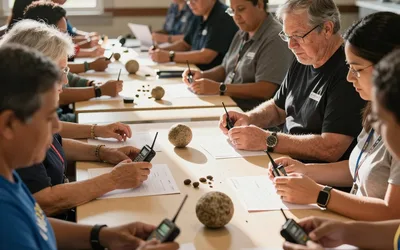
That philosophy is at the heart of the Rainsville workshop. The program includes hands-on activities about hail and hail development, giving participants a tactile, visual understanding of a weather phenomenon that is often described only in words and numbers. There will also be instruction on how to program a NOAA Weather Radio. "We're going to have some hands-on activities about hail and hail development and also how to program a weather radio," Saari said. "Then we also want to make sure that everyone knows their own individual way about how to receive warnings that are most effective for them."
The emphasis on individual solutions is deliberate. There is no single way to stay weather-aware; the right answer depends on a person's abilities, technology, and circumstances. Some people rely on weather apps on their phones, some on flashing alert lights, some on vibrating devices, some on a trusted neighbor. The workshop is designed to help each attendee figure out what works for them, and to make sure they leave with the tools to do it.
The DeKalb County Emergency Management Agency will be on hand giving away a limited number of free weather alert radios on a first-come, first-served basis. Sign-language interpreters will be present, and refreshments will be served. The event is a collaboration that reaches across several organizations: the National Weather Service, the Alabama Institute for the Deaf and Blind, the DeKalb County EMA, and the Alabama Department of Rehabilitation Services, whose Director of Special Programs, Bedarius Bell, has partnered with Saari and others who work with the deaf and hard of hearing community to make such events possible.
The choice of the Alabama Institute for the Deaf and Blind as a partner is fitting, given the institution's deep roots in the state. That the institute would join forces with the National Weather Service to teach weather safety is a natural extension of its founding mission: to ensure that no Alabamian is left without access to the knowledge and tools they need to live full, safe lives.
The workshop also arrives at a meaningful moment in the weather calendar. The South experiences two distinct severe weather seasons — spring and fall — and September sits on the threshold of the second one. As summer heat gives way to the volatile storms of autumn, the National Weather Service is using the occasion to remind everyone, regardless of ability, that preparation is the best defense. The event is being held "ahead of the second severe weather season," as the agency put it, a chance for residents to get their radios programmed, their plans in place, and their questions answered before the first fall storm rolls across the region.
For the people of Rainsville, the stakes are personal. This is a community that has rebuilt once from the unimaginable, and it knows better than most that the difference between a warning heard and a warning missed can be measured in lives. The Weather Safety Workshop is, in a sense, an act of remembrance and a promise: that the lessons of April 27, 2011, will not be forgotten, and that the next time the sky turns green and the sirens begin to sound, everyone — every single person — will know what to do.