


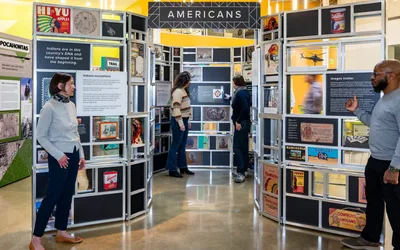
For nearly a century, the Strand Theater on Main Street in Atmore, Alabama, showed first-run movies to generations of small-town audiences. It opened on July 5, 1923, with 792 seats, and for decades it ran continuously, eventually earning a reputation as the longest continuously operating cinema in the state. When it closed in November 2013 after ninety years, locals mourned the loss of a downtown anchor. But a community group called Pride of Atmore refused to let the old building fade, and by the summer of 2025, the theater had been painstakingly restored and reborn as Encore at the Strand, a performing arts center and cultural hub in the heart of town.
This fall, that lovingly revived venue will host something its original builders could never have imagined: a Smithsonian traveling exhibition. From September 16 through November 4, 2026, Encore at the Strand will present “Americans,” a nationally touring exhibition developed by the Smithsonian’s National Museum of the American Indian and brought to rural communities through the Institution’s Museum on Main Street program. Admission is free.
The choice of location is anything but arbitrary. Atmore sits just eight miles from the Poarch Creek Indian Reservation, home of the Poarch Band of Creek Indians, Alabama’s only federally recognized tribe. The exhibition is presented through a partnership between Pride of Atmore and the Poarch Creek Indians, with support from the Alabama Humanities Alliance, and it arrives as part of Alabama’s America at 250 commemorations. The opening reception is set for September 15, the evening before the exhibition opens to the public.
“Americans” asks a deceptively simple question: How is it that American Indians—about 2 percent of the U.S. population—are so present and yet so absent in American life? The exhibition’s answer is a sweeping, sometimes uncomfortable tour through the images, names, and stories that have surrounded Americans since before the country existed. Commercial products, sports mascots, street names, classic Westerns, episodes of Seinfeld and South Park, even the Tomahawk missile—Indian imagery is everywhere. The show explores how those pervasive, powerful, at times demeaning representations reveal a deep, complicated connection between Americans and American Indians.
Developed by the National Museum of the American Indian, “Americans” reframes four of the most familiar Native stories in U.S. history. Thanksgiving, the exhibition suggests, was a modern invention. Pocahontas was a key figure in the country’s founding. The Trail of Tears was not a single tragic event but a vast national project that reshaped the entire country. And the Battle of Little Bighorn—where some 200 American soldiers were killed—was the moment Indians became the nation’s unofficial mascots. Through photographs, objects, videos, and interactive experiences, the exhibition invites visitors to look beyond those familiar narratives and consider how Native American history and representation have shaped American identity, popular culture, and the very idea of who counts as American.
The exhibition’s curators, Paul Chaat Smith, a Comanche writer and scholar, and Cécile Ganteaume, have said the show deliberately turns the usual museum approach inside out. Rather than asking visitors to engage with a purely Native-centered story, “Americans” meets them where they already are—in the sports arenas, living rooms, and classrooms where Indian images have been embedded for generations—and shows how connected every American is to that imagery and those names.
For a small town like Atmore, hosting a Smithsonian exhibition is a rare coup. Pride of Atmore volunteer Dale Ash put it plainly: “This is an amazing opportunity for those like me who have never visited the Smithsonian in Washington, D.C. Having an actual Smithsonian exhibit come to the Encore at the Strand on Main Street in a small town like Atmore, Alabama, is truly a ‘big deal.’” Ash added that the local Poarch Creek Indian exhibit will bring the national narrative home to Native soil. Visitors will also have the chance to view “Forgotten Creeks,” an Emmy Award-winning documentary tracing the tribe’s history from Spanish contact in the 1500s through the Indian Removal Act of 1830 and the Trail of Tears, to its federal recognition in 1984 and modern success as a sovereign nation. Film screenings are available by request.
The Poarch Creek story is itself a remarkable chapter in American history. Unlike most Southeastern tribes, the Poarch Creeks avoided forced removal. Descendants of a segment of the original Creek Nation that once covered nearly all of Alabama and Georgia, they remained in the Tensaw district of Alabama after the removals of the 1830s, living together for almost 200 years on and around land near the small community of Poarch. They organized politically in the 1940s, fought for decades for recognition, and finally achieved federal status in 1984. Today the tribe is a prosperous, self-governing nation, and its leaders see the “Americans” exhibition as a chance to share that story with a wider audience.
“This exhibition gives our community an important opportunity to explore the stories, images, and traditions that have shaped how American Indians are understood across our nation,” said Poarch Creek Indians Tribal Vice Chair and Chief Governmental Affairs Officer Robbie McGhee. “As Alabama’s only federally recognized tribe, we are proud to partner with Pride of Atmore to bring the Smithsonian’s ‘Americans’ exhibition to our community.” McGhee also thanked the Alabama Humanities Alliance for making the exhibit possible and for its commitment to bringing meaningful humanities programming to communities across the state.
Museum on Main Street, the Smithsonian Institution Traveling Exhibition Service program that makes all this possible, was designed specifically to bring high-quality Smithsonian exhibitions to rural and small-town communities that might otherwise never see them. The “Americans” exhibition is a national, state, and local partnership, and Atmore is just the first stop on an Alabama tour that will also travel to Wetumpka, Florence, Scottsboro, and Foley through June 2027. The partnership aims to make the Atmore presentation a regional attraction, drawing visitors from beyond Escambia County and sparking conversations about Native American history, culture, and representation.
For the people of Atmore, the exhibition represents something more than a museum display in a restored movie palace. It is a homecoming of sorts—a national conversation about Native identity landing in a town where that identity has lived and endured for generations. Exhibit hours are 10 a.m. to 5 p.m. Monday, Wednesday, and Friday, and 5 to 7 p.m. Tuesday and Thursday. Weekend visits are available by appointment. To book a group or get more information, call Encore at the Strand at 251-237-1112.