


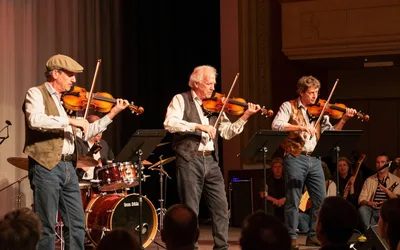
The first thing to understand about the Tennessee Valley Old Time Fiddlers Convention is that it did not begin in 1967, when the modern event was founded. It began in 1924, in a school auditorium in Athens, Alabama, where a principal named W. H. Johnson decided his students and their neighbors ought to have a proper fiddle contest.
That older convention, held at the old Agricultural High School on a site that is now Athens Middle School, ran annually until about 1936. Area newspapers covered it in detail, reporting that the auditorium was packed and that many would-be listeners had to be turned away. More than 150 musicians might compete in the course of a single evening. The contests drew crowds from across North Alabama and southern Middle Tennessee, and they were not merely entertainment. They were, in a region settled largely by yeoman farmers who had migrated down from the mountains of the upper South, a continuation of a folk tradition carried over from the British Isles. Limestone County, as the convention's own historians put it, had been a hotbed of old-time music since its frontier days.
What happened in that auditorium in 1930 changed country music. Two brothers from the red clay hills of northern Alabama, Alton and Rabon Delmore, took first prize in their category at the Athens Fiddlers Convention. The win gave them the confidence to seek an audition with Columbia Records. Columbia accepted them, and the brothers went on to join the Grand Ole Opry, becoming nationally known radio and recording stars. Alton Delmore had written "Brown's Ferry Blues" specifically to be played at country fiddle contests, and it became the song that earned the duo their recording contract. Their soft, pliant harmony and inventive guitar work made them, by 1936, the most popular act on the Opry by the show's own reckoning. Songs like "Gonna Lay Down My Old Guitar" and "Blues Stay Away from Me" became standards still heard today.
When Johnson left the Agricultural High School in the mid-1930s, the Depression and the loss of his personal dedication combined to kill the convention. Fiddle contests and public old-time music went into what one account calls almost total eclipse from the late 1930s into the mid-1960s.
The revival came in the summer of 1967, when the Tennessee Valley Old Time Fiddlers Association was formed with two stated goals: to sponsor an annual fiddlers' convention and contests, and to publish a newsletter on a regular basis. Bill Harrison founded the association and launched the first convention that November. It opened on Saturday, November 4, 1967, in the big Athens College gym, kicked off by an anvil shoot. The weekend brought torrential rain, and by Saturday night the temperature had plummeted to 24 degrees. The event survived anyway, and it became a model for other fiddle contests across the South.
Nearly six decades later, the convention is still held on the campus of what is now Athens State University, and it still carries the DNA of that 1924 schoolhouse contest. In 2024 the university marked the 100th anniversary of the very first Athens Fiddle Contest, a reminder that the modern gathering is less an invention than a renewal. The event has historically drawn more than 15,000 people, with more than 200 musicians competing.
The 2026 edition, the 59th annual, runs Wednesday, September 30 through Saturday, October 3. It opens with a free preview night gospel concert at 7:30 p.m. Wednesday featuring The Larry Sparks Show. No admission ticket is required for that evening, which makes it the easiest possible entry point for anyone curious about what the convention is.
From there the weekend builds. Thursday at 7:00 p.m. brings Mike Compton and Andy Todd performing a special Delmore Brothers tribute, a booking that lands with particular weight given that the Delmores' career effectively began on this ground. Dale Ann Bradley follows at 8:00 p.m. Friday at 6:00 p.m. features The Isaacs, and Saturday at 7:30 p.m. closes the run with The Del McCoury Band. All concerts take place on the Main Stage at Founders Hall, and access to the entire entertainment lineup is included with an admission wristband.
Admission is $20 per adult for single-day tickets on Thursday, Friday, or Saturday, or $30 per adult for a festival pass covering all three days. Children under 12 are admitted free with a paid adult.
The competitions are the heart of the thing, and they are not a side attraction. The convention bills itself as the home of 14 state championships, spanning harmonica, mandolin, bluegrass banjo, dobro, dulcimer, old-time singing, guitar fingerpicking, old-time banjo, classic old-time fiddler, guitar flatpicking, senior fiddler, bluegrass band, old-time string band, and the Tennessee Valley Fiddle Champion. Total cash prizes come to $47,350, with the top eight contestants in each category receiving prize money.
Competition is spread across multiple stages. Friday's slate begins with in-person registration at 10:00 a.m., then moves to the Founders Hall Main Stage at 3:00 p.m. for harmonica and dulcimer, and at 8:00 p.m. for mandolin, bluegrass banjo, and dobro. Old-time singing runs at 8:00 p.m. on the McCandless Hall Delmore Brothers Stage, named for the brothers whose career the convention helped make. Saturday starts early, with in-person registration at 7:30 a.m. and competitions on the Founders Hall stage from 8:30 a.m. through the finals of old-time string band, bluegrass band, and the Tennessee Valley Fiddle Champion. Brown Hall hosts the youth and specialty categories beginning at 8:30 a.m., including beginner divisions for guitar, mandolin, banjo, and fiddle for children 12 and under, apprentice fiddle for ages 11 to 15, senior fiddle for ages 55 and up, classic old-time fiddle, Appalachian buck dancing, and both guitar fingerpicking and flatpicking.
There are rules, as befits a contest with this much history behind it. Fiddle contestants may enter only one fiddle category. Once a beginner competitor has moved up to the apprentice or general category, they cannot return to a beginner category in later years.
The proceeds go somewhere specific: the convention funds student scholarships and other university projects throughout the year. It is supported in part by funding from the Muscle Shoals National Heritage Area, and sponsored by a roster of local businesses including Pettus Plumbing & Piping, Redstone Federal Credit Union, Bryant Bank, Martin & Cobey, Nanny's Old Fashion Lemonade, Pepsi, TriGreen Equipment, and Bank Independent.
There is also a museum dimension. In 2008, Debby Delmore donated an extensive personal collection to the convention, including photographs, original records, a 2007 Grammy, sheet music, and family memorabilia. It is a physical record of the thread running from a 1930 schoolhouse prize to a stage in Nashville.
What the convention offers, in the end, is something increasingly rare: a genuine, long-running tradition that anyone can walk up to. The grounds are open general admission. The preview night is free. The competitions are open to register for online or in person. And the music being played is the same music that has been played in this corner of Alabama since before the Civil War, carried forward by a line of people who decided, in 1967, that it was worth reviving.
Tickets and competition registration are available at athensfiddlers.org.