


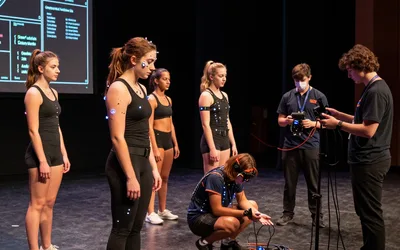
On the afternoon of October 7, 2026, the Marentes Stage inside Auburn's Gogue Performing Arts Center will host something that rarely happens in a theater: a science experiment performed in public, on acrobats, in real time.
The event is called The Science of Movement: AUBE Lab Workshop, and it is exactly what the title promises. Students from the Auburn University Biomechanical Engineering Lab, known as the AUBE Lab, will team up with performers from the Australian circus company Gravity & Other Myths to demonstrate how engineers measure, visualize, and analyze the motion of elite acrobats. Attendees will watch as performers are fitted with reflective markers and wearable sensors, and then see the resulting movement data captured and rendered live on screen. The workshop runs from 2 to 5 p.m., it is free, and it is open to the public, though space is limited and registration is required.
To understand why this pairing makes sense, it helps to know a little about both halves of it.
The AUBE Lab sits in Wiggins Hall, home of the Department of Mechanical Engineering in Auburn's Samuel Ginn College of Engineering. Its stated mission is to identify, study, and help solve complex biomechanical problems, with a focus on human performance and injury prevention. Its work spans ACL injury prevention, exoskeleton technology, prosthetics and orthotics, and more. The lab is led by Dr. Michael Zabala. His research centers on the biomechanics of human motion, performance, and injury prevention, and he has extensive experience using motion capture technology, electromyography, and pressure sensors to assess tasks like walking, jogging, stair navigation, and the run-to-cut maneuver that athletes perform when changing direction.
In other words, Zabala's lab spends its days figuring out how human bodies move and how they break. That is precisely the question a circus performer's body answers, at the highest level, every night.
Gravity & Other Myths was founded in Adelaide, Australia, in 2009 by a group of young artists with a shared passion for circus and physical performance. Over roughly a decade and a half, the company has grown into one of the most acclaimed contemporary circus ensembles in the world, known for combining extraordinary acrobatic skill with playful humor and an honest, unadorned approach to performance that emphasizes human connection. Its directors include co-founders Jascha Boyce, Jacob Randell, Lachlan Binns, Martin Schreiber, and Elliott Zoerner, along with artistic director Darcy Grant. The company has built a reputation for ensemble work that pushes at the boundaries of what new circus can be, and it has drawn consistent critical praise for the sheer level of skill on display.
The production the company is bringing to Auburn is called Ten Thousand Hours, and its subject matter makes the workshop pairing feel almost inevitable. The show is built around a single question: what does ten thousand hours of practice actually look like? Eight world-class acrobats, accompanied by a live percussionist, investigate physical skill, how it is obtained, how it is perfected, and how it can transform a life. The performance is, in the company's own words, a love letter to the human body and the amazing things it lets us do every day, and an invitation to watch them work. By revealing the precision and complexity behind high-level acrobatics, the show asks audiences to appreciate the countless hours of repetition and dedication that precede each breathtaking feat.
That is the same thing a biomechanics lab does, just with different instruments. Where an audience sees a flawless handstand or a perfectly timed catch, Zabala's students see joint angles, center-of-mass trajectories, muscle activation patterns, and loading forces. Where a performer feels a movement, the lab measures it. The workshop is essentially a chance to put those two ways of knowing the same body side by side, on the same stage, at the same time.
The mechanics of the demonstration are part of the appeal. Optical motion capture typically works by attaching small reflective markers to a performer's body and tracking them with a ring of specialized cameras; software then reconstructs the movement as a three-dimensional skeleton. Wearable systems, by contrast, use inertial sensors to capture motion outside the confines of a lab, which is a crucial capability when the subject is an acrobat who needs to fly through the air rather than walk across a capture volume. Attendees at the workshop will see performers prepared with markers and sensors and will watch movement data being captured in real time, which means the audience gets to see the unglamorous, technical, and genuinely fascinating process that usually happens behind closed doors.
It is worth noting how unusual this kind of public demonstration is. Motion capture is ordinarily a laboratory procedure, conducted with trained subjects performing controlled tasks while researchers watch from behind monitors. Bringing it into a performing arts center, applying it to elite acrobats, and inviting the general public to watch is a genuinely uncommon collision of disciplines. It also reflects something distinctive about the Gogue Center's programming philosophy. The center has invested heavily in educational and community programming, including a K-12 School Performance Series supported by study guides developed with Alabama teachers, and it has been expanding its physical footprint with a new studio theatre and a reinvigorated Ham Amphitheatre. A free, hands-on engineering workshop staged in partnership with a visiting circus company fits that mission neatly.
The workshop is scheduled for the day after Gravity & Other Myths performs Ten Thousand Hours in the Gogue Center's Woltosz Theatre on October 6, which means the acrobats will still be in town and, presumably, still sore. That timing is not incidental. A residency model, in which a touring company spends extra time in a community and engages with local institutions, is how collaborations like this one become possible. The performers give the engineers a rare population of subjects whose movement is far outside the range of ordinary laboratory volunteers. The engineers give the performers and the audience a new way of seeing what those bodies are actually doing.
For anyone in the Auburn area, the practical details are simple. The workshop takes place Wednesday, October 7, 2026, from 2 to 5 p.m. at the Gogue Performing Arts Center, 910 South College Street. Admission is free. Because space is limited, registration is required, and it can be completed at aub.ie/gpac-gom. Additional information is available from Ashley Pope, the center's campus and community programs coordinator, at [email protected].
What attendees will take away is harder to specify in advance, which is part of the point. They will see markers and sensors applied to bodies trained to do things most bodies cannot. They will watch data appear on a screen in the same instant the movement that produced it is still hanging in the air. And they will get a rare look at the meeting point between two disciplines that, on the surface, have nothing in common: an engineering lab that studies how to keep people from getting hurt, and a circus company that has built a career on doing things that look, to any reasonable observer, extremely dangerous. Both are, in the end, in the business of understanding exactly what the human body can be trusted to do.