


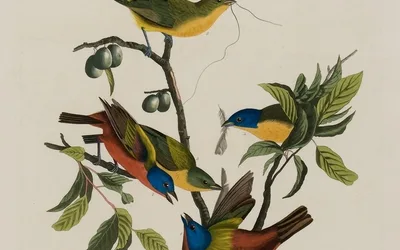
The Jule Collins Smith Museum of Fine Art has spent years hanging the birds of John James Audubon on its walls. On the evening of November 5, 2026, it will hand the microphone to a scientist who has spent nearly four decades asking a question Audubon could paint but never fully answer: why are birds the colors they are?
Dr. Geoffrey E. Hill, Auburn University's curator of birds and a leading ornithologist, will give a talk titled "Birds, Color By Color" from 5:30 to 6:30 p.m. at the museum, 901 South College Street in Auburn. The program is built around the museum's organizing theme of color and its Audubon holdings, and it is aimed squarely at a general audience — students, birders and lifelong learners alike.
Hill's Auburn biography describes a research program focused on the function, evolution and production of coloration in feathers and bare parts, and he has published seven books and more than three hundred technical articles in scientific journals.
Among those books is National Geographic Bird Coloration, a volume written for a popular readership. Reviewers at the time described it as a book conceived in the spirit of a field guide but devoted to everything else a reader might want to know about feathers. Hill also co-edited a two-volume scholarly synthesis, Bird Coloration, with Kevin McGraw, published by Harvard University Press, which pulled together the world's leading researchers on how birds perceive, produce and control color.
The house finch work is the thread that runs through much of it. Male house finches carry carotenoid pigments in the feathers of their heads, breasts and rumps, and the color ranges from dull yellow through orange to brilliant red. Hill's research has argued that this redness is not decoration but an honest signal — a visible advertisement of an individual's condition. His lab has linked carotenoid coloration to resistance to parasites, to escape performance, and, in a 2019 paper, to mitochondrial function. The plain-language version is the one likely to fill the museum's auditorium: the reddest male is telling a prospective mate something true about himself.
That work earned Hill the American Ornithological Society's William Brewster Memorial Award, known as the Brewster Medal, in 2014, for lifetime achievement in ornithology. The society's announcement called him, without much hedging, one of the most prolific, influential and successful scientists who has ever worked on bird plumage coloration and the evolution of animal signals. He is also an elected fellow of both the American Association for the Advancement of Science and the American Ornithological Society.
The setting for the talk is unusually apt. The Jule opened on October 3, 2003, and is the only university art museum in Alabama, with six galleries across 40,000 square feet, a 127-seat auditorium and ten acres of grounds that include a lake and a walking path. Its Audubon story reaches back further than the building. In 1992 Auburn acquired a large group of Audubon prints from philanthropist Susan Phillips; two years later Phillips and her brother Allen donated $1 million for galleries dedicated to the continuous display of selections from the Louise Hauss and David Brent Miller Audubon Collection. In early 1998 Albert Smith, a 1947 Auburn graduate, committed $3 million as a gift to his wife, Jule Collins Smith, for their 50th wedding anniversary, and the university's trustees resolved to name the museum for her.
The Miller collection itself is one of the Southeast's largest groupings of Audubon prints, more than a hundred of his most important works, and it is especially rich in Birds of America. It was assembled by David Brent Miller, born in Century, Alabama, who spent much of his life in Brewton running his family's lumber business, T. R. Miller Mill Company; after his death his wife, Louise Hauss, continued to add to it. The Encyclopedia of Alabama puts the collection at 114 prints.
There is a pleasing symmetry in pairing that collection with Hill. Audubon's prints were celebrated in his own time as some of the earliest and most accurate records of American wildlife, and later generations tended to see him as a wildlife illustrator rather than an artist — a reputation that historians have since worked to correct, now counting his prints among the finest artistic achievements of the nineteenth century. Hill occupies a comparable borderland from the other direction: a working scientist whose subject is beauty, and whose best-known book was written for the birdwatchers and natural history readers rather than for the journals.
What the audience will get is not a taxonomy lecture. The event description promises vivid examples and accessible storytelling, an account of how birds produce their remarkable colors, what those colors communicate, and what they reveal about evolution, behavior and survival — the everyday birds in an Auburn backyard explained through the same research that fills scientific journals. It is a chance to look at the Audubon prints on the walls and then walk out into the museum's grounds with a different set of questions.
The museum is at 901 South College Street in Auburn. The talk runs from 5:30 to 6:30 p.m. on Thursday, November 5, 2026; the museum's general admission is free, and the program is open to the public. Details are posted on the Auburn University events calendar.