


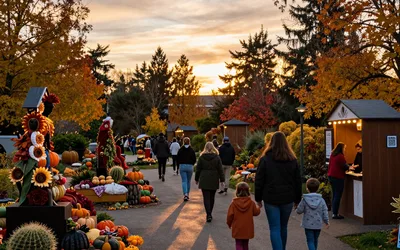
For a few weeks each autumn, the Alaska Botanical Garden trades its usual quiet for something a little more mischievous. The half-mile paved loop that winds through the boreal forest on Anchorage's Campbell Airstrip Road fills with scarecrows, fairy houses, and families in costume as the garden hosts its annual Alaska BOOtanical Garden celebration. From September 11 through October 18, 2026, the grounds open on Fridays, Saturdays, and Sundays from 11 a.m. to 6 p.m. for a "spooky stroll" through harvest-themed displays, whimsical photo opportunities, and festive programming designed for every age. Costumes are encouraged, and admission is a modest $8 per person, free for garden members and children six and under.
The event is the garden's way of marking the turn of the season in a place where autumn arrives with unusual urgency. Anchorage sits at the edge of the Chugach Mountains, and by late September the birch and cottonwood leaves are already turning gold against a sky that grows darker by the day. BOOtanical leans into that transition, transforming the garden's cultivated beds and forest trails into a playful landscape of pumpkins, gourds, and hand-built scarecrows. Local businesses can even sponsor a scarecrow of their own, planting a bit of their branding among the foliage.
But the real draw is the rotating slate of workshops and performances that unfold each weekend. Families can build fairy houses from natural materials, and there are storytime sessions for the youngest visitors, pumpkin-carving workshops where participants transform ordinary gourds into miniature houses with windows, doors, and porches, and marionette puppet shows. Other harvest-themed programs round out the calendar, giving visitors a reason to return weekend after weekend.
The setting itself is worth the trip. The Alaska Botanical Garden occupies 110 acres of land that has been home to many stewards over the centuries. It sits on the traditional territory of the Upper Cook Inlet Dena'ina Athabascans, near what the Dena'ina called Qin Cheghitnu, "Crying Ridge Creek," now known as Campbell Creek. In the 1940s and 1950s, the U.S. Army used the area for training maneuvers, and the trails that still thread through the property were once part of the "Bull Dog Trail" network that connected Fort Richardson to the Army Air Corps' Campbell Airstrip. Today the garden acknowledges that layered history in its land acknowledgment, honoring the Dena'ina as the land's original and continuing stewards.
The garden itself was a long time coming. The idea took root in 1983, when members of the Alaska Horticultural Association began talking about creating an arboretum for Anchorage. The organization incorporated as an Alaska nonprofit in 1986 and spent years developing a master plan before signing a land-use agreement with the Municipality of Anchorage in 1990. The first gardens were planted, and the grand opening finally took place on July 25, 1993—a decade after the original spark. The master plan kept most of the site in its natural state, with individual gardens interconnected by trails through the boreal forest. Today the grounds include two hardy perennial gardens, an herb garden, the Anchorage Heritage Garden, a rock garden, a shade garden, a wildflower trail, and the Lowenfels-Hoersting Family Nature Trail, all woven together by that accessible paved loop.
BOOtanical is one of several seasonal events the garden uses to keep its doors open through Alaska's long, dark months. In winter, the same paths are illuminated for Brighter Winter Nights, a light display that draws families out into the cold. BOOtanical plays a similar role in the fall, drawing crowds before the snow flies and giving the garden a chance to celebrate the harvest it has spent all summer growing.
For visitors, the experience is deliberately low-key and family-friendly. The garden is an all-outdoor facility, so guests are advised to dress for the weather, and staff are trained for the occasional bear sighting in the surrounding Campbell Tract. Food is limited to the front plaza as a bear-safety precaution, and only trained service animals are allowed inside the moose fence. But those practicalities are part of what makes the place feel authentic—a real working garden, not a theme park, where the scarecrows stand among actual beds of late-season flowers and the fairy houses nestle into real moss and ferns.
The Alaska Botanical Garden describes itself as an independent nonprofit museum of plants and art, with a mission to showcase the beauty and value of Alaska's gardens and natural areas through science, education, and recreation using organic and sustainable practices. BOOtanical embodies that mission in its most playful form, inviting families to see the garden not just as a place of quiet contemplation but as a stage for imagination. For a few golden weeks each fall, the forest paths that once carried soldiers and, long before that, Dena'ina travelers, fill instead with the laughter of children in costume, the scent of pumpkin, and the gentle spectacle of a garden celebrating its own abundance before the long winter settles in.