


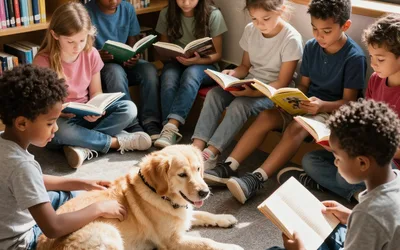
On a Thursday afternoon in October, a child in Anchorage will sit down in a library meeting room, open a book, and begin reading aloud to a dog. The dog will not correct the pronunciation. It will not sigh at a stumble over a multisyllabic word. It will simply listen, and in that small act of patience, something quietly important happens.
PAWSitive Reading, held at the Z.J. Loussac Library at 3600 Denali Street, is one of the Anchorage Public Library's most unusual and quietly beloved programs. On October 8, 2026, from 4 to 5 p.m., children in kindergarten through fourth grade can sign up — in person, on the day of the event — for a reading session with a therapy dog. It is free, and it works on a first-come, first-served basis.
The premise sounds whimsical, but it rests on a real and well-documented insight about how children learn to read. The barrier for a struggling reader is rarely the words themselves; it is the audience. Reading aloud in a classroom means risking embarrassment in front of peers and a teacher who is, however gently, evaluating. A dog offers none of that. The animal is a listener without judgment, and that changes everything about how a child approaches the page.
That idea has a specific origin. In 1999, a Utah nonprofit called Intermountain Therapy Animals launched the Reading Education Assistance Dogs program — R.E.A.D. — a literacy program built around the simple, appealing notion of children reading to dogs. R.E.A.D. teams of registered therapy animals and their handlers began visiting schools and libraries, and the model spread. The Anchorage program is a descendant of that movement, adapted to the particular character of the city.
The local version is a partnership between the Anchorage Public Library and Midnight Sun Service Dogs, an Anchorage organization that trains and provides service dogs and therapy dogs, with a long-standing focus on veterans living with post-traumatic stress disorder. The dogs that come to the library are therapy animals — trained and tested for health, safety, temperament, and the composure required to sit still while a seven-year-old works through a difficult paragraph.
Midnight Sun Service Dogs was founded by April Gettys, whose own history shaped the organization's mission. Gettys has spoken publicly about living with PTSD from a violent relationship and chronic health problems, and about how dogs helped her re-engage with the world. Under her leadership, the group has placed service dogs with people with special needs and trained dogs that have accompanied Alaska Air National Guard members on deployment. The library program is a gentler extension of the same philosophy: that a dog's steady, uncritical presence can open a door for a person who is struggling.
The setting for all this is itself a piece of Anchorage history. The Z.J. Loussac Library opened in 1986 in midtown Anchorage, a building that also houses the Anchorage Assembly Chambers and the Wilda Marston Theatre and shares a campus with Cuddy Family Park. It is named for Zachariah Joshua Loussac, a Russian immigrant who fled Tsarist Russia, arrived in Alaska in 1907, and settled in Anchorage in 1916. Loussac ran a drugstore on Fourth Avenue until 1942 and served as mayor of Anchorage from 1948 to 1951. His philanthropy led to the construction of a library on Fifth Avenue and F Street that opened in 1955 and bore his name; that building was demolished in 1981 to make way for the Egan Convention Center, and the current midtown library carries the name forward.
So the program takes place in a room named for a man who believed a city should have a place where anyone could come and learn — a fitting venue for an hour in which children are given the space to practice something difficult without fear.
The mechanics are deliberately simple. Sessions are short enough to hold a young reader's attention and to keep the dogs from tiring. Sign-up opens in person on the day of the event, and there is no registration in advance, no fee, and no requirement beyond showing up. The program is designed for children in kindergarten through fourth grade.
What children take away, according to the library, is a new association: reading as a positive experience rather than a test. Over repeated visits, that association builds confidence, and confidence is the thing that turns a hesitant reader into a fluent one. The dog, meanwhile, gets a quiet hour of attention and, presumably, a few crumbs of the story.
For families in Anchorage, the appeal is easy to understand. It is a free, low-pressure activity that meets children where they are, in a city where winter arrives early and indoor options matter. And it offers something increasingly rare in childhood: an audience that will never interrupt, never correct, and never make a child feel small for not knowing a word.
The dogs, after all, cannot read. That is precisely the point. They only listen — and for a child learning to trust their own voice, that turns out to be enough.