


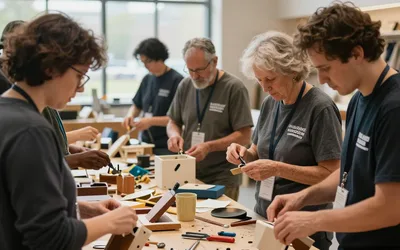
On October 17, 2026, the Anchorage Museum will host a different kind of gathering: not an exhibition opening or a lecture, but a room full of people taking apart broken toasters, re-stitching torn jeans, and tightening the wobbly legs of end tables. The International Repair Day Fix-It Clinic is free, drop-in, and open to anyone who shows up carrying something that no longer works.
The premise is simple and slightly radical. Bring your broken item. Volunteer coaches — people with practical knowledge of electronics, sewing, woodworking, and small appliances — will help you assess whether it can be fixed, and if it can, guide you through repairing it on the spot. The organizers provide the workspace, the tools, and the troubleshooting help. What they don't do is take the item away and hand it back later. The point is that you stay at the table, learn how the thing was made and how it functions, and leave more capable of fixing the next one yourself.
The clinic is hosted by three Alaska organizations: the Alaska Environment Research & Policy Center, SILO², and the Anchorage Tool Library. It is one of many events happening worldwide as part of International Repair Day, an annual celebration coordinated by The Restart Project in collaboration with partner networks around the globe. The 2026 edition falls on October 17, and its theme is how repair brings people together.
That theme is not just a slogan. International Repair Day grew out of a loose alliance of repair organizations — The Restart Project in the UK, the Repair Café Foundation in the Netherlands, Germany's Anstiftung Foundation, the U.S.-based Fixit Clinic, and the tool company iFixit — who came together as the Open Repair Alliance to push for products that are more durable and easier to fix. The day itself is the public-facing side of that advocacy: a global argument, made through screwdrivers and soldering irons, that the fastest-growing waste stream in the world is largely preventable.
In Anchorage, that argument has been building for years. The Alaska Environment Research & Policy Center has made right to repair one of its core campaigns, framing repair as the first line of defense against electronic waste. The group's Alaska chapter has published on the subject, toured the city's Central Transfer Station, and organized repair events before. This spring, for Earth Day, it hosted a fix-it clinic with SILO² and the museum's SEED Lab that drew a handful of volunteer coaches — including Charity Lovelace of Frippery Studio, Katia Lundell, Justin Castle of Eagle River Electronics, Darcy Moxon, and Brandon Thomas — who helped participants repair more than 25 items that would otherwise have gone to the landfill. The haul ranged from rainboots to vacuum cleaners to end tables and jeans. Coaches and participants alike enjoyed it enough that they started talking about making it a recurring event. The October clinic is, in effect, that aspiration made real.
The venue fits the mission. SEED Lab — Solutions for Energy and Equity through Design — is the Anchorage Museum's space for programming, residencies, and community exchange around people, place, planet, and potential. It sits at 111 W. 6th Ave., across from the museum at the corner of 6th Avenue and A Street, in a building whose façade and interior feature murals by local artists. SEED Lab was one of five winners of the 2018 Bloomberg Philanthropies Public Art Challenge, which brought a $1 million grant to Anchorage. When the award was announced at the museum in November 2018, then-mayor Ethan Berkowitz and Michael Bloomberg were both on hand. Museum director Julie Decker described the project as a meeting place for artists, designers, engineers, and community members — a space, she said, where different sectors could come together to talk about the future. The building had previously housed insurance offices and was leased from JL Properties. Thirty-six artists used the space in its first two years, and its programming has since ranged across climate, food, transportation, housing, and migration.
A repair clinic is a natural extension of that brief. So is the involvement of the Anchorage Tool Library, which operates out of Anchorage Community House and is the only lending library of its kind in the city. Founded by Meg Zaletel, who bought a house across the street from her own to create it, the Community House was built around the idea of a neighborhood gathering place that promotes belonging and access. Its tool library holds more than 170 tools, from lawn and construction equipment to kitchen and gardening gear, and has grown to include some genuinely unexpected items: food dehydrators, chain saws, sanders, a small fleet of red saucer sleds, wine glasses for parties and weddings, novelty cake pans shaped like Winnie the Pooh and Hello Kitty, and a turkey fryer that looks brand new. The logic behind a tool library is the same logic behind a fix-it clinic: most of us need a specific thing only once, or once a year, and buying it — or replacing it — is not always the answer.
SILO², the third host, describes itself as a social intelligence and systems innovation organization that connects those most in need with those most equipped to support them, working on community resilience and harm reduction. Its involvement reflects the broader framing of repair as a community service rather than a hobby.
The clinic runs on the premise that almost nothing is truly unfixable, and that the barrier is usually knowledge rather than parts. Participants are told plainly that they may not succeed — some items will turn out to be beyond saving — but that they will still leave knowing more about how their possessions are built and how they fail. That knowledge is the actual product. A repaired lamp is a bonus.
The event is free, and registration is recommended though not required. There is no ticket price and no capacity limit, which means the room will fill with whatever Anchorage decides to carry through the door: a dead blender, a lamp with a frayed cord, a jacket missing a button, a chair that has been wobbling for three years. Someone will be there with a multimeter and an opinion about how to open it up.
For a city at the edge of the country, where shipping in replacements is expensive and the landfill fills regardless, that is a practical kind of optimism. The clinic asks participants to bring the thing they were about to throw away, and to sit with it for an afternoon instead.