


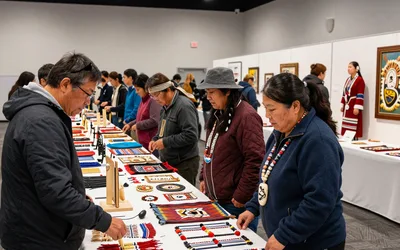
Every October, the Dena'ina Civic and Convention Center in downtown Anchorage becomes something more than a conference venue. For three days, its first and second floors turn into a marketplace of masks, baskets, parkas, ivory carvings, quillwork and paintings, as more than 170 Alaska Native and Native American artists and artisans set up tables for the Alaska Native Customary Art Fair. The 2026 edition runs October 22 through 24, alongside the Alaska Federation of Natives Annual Convention, and like the convention itself, the fair is free and open to the public.
The fair is the cultural and commercial heart of the convention. AFN describes it as one of the best places anywhere to find Alaska Native and American Indian artwork, and the range on display bears that out: hand-sewn fur parkas, malagayaq hats, mittens and gloves; ivory earrings, miniature carvings and porcupine quill jewelry; objects made from seal skin, grass and wood, including paddle oars, masks and baskets; and original paintings, sculptures and mixed-media work. Visitors buy directly from the people who made the pieces, which means the money stays with artists and their families rather than passing through a gallery or a reseller.
That directness is part of the point. Miranda Petruska, a Dichinanek' Athabascan artist who grew up in the village of Nikolai in the Upper Kuskokwim and now lives in Washington, told Visit Anchorage that Alaska Native artwork is about preserving traditions "especially in a time and place where we're losing our traditions." When she sets up at the convention, she brings materials harvested by her own family, including moose antler from her brother's hunt and salmon vertebrae from her cousins. "When an Indigenous person creates, it's like a tangible embodiment of centuries of deep-rooted heritage," she said. "Alaska Native artwork is a form of active perseverance, and I feel like that's important for visitors and locals alike to think about."
The fair's setting gives it a reach that a standalone craft show could not match. AFN is the largest statewide Native organization in Alaska, representing more than 140,000 Alaska Native people, roughly one in five residents of the state. Its convention is described by AFN as the largest representative annual gathering of Native peoples in the United States, convening thousands of official delegates and participants from membership organizations across Alaska. The proceedings are webcast well beyond the state. The fair draws artists from Alaska and the Lower 48 alike, and in recent years it has spread across two floors of the Dena'ina Center to accommodate them.
The 2026 convention is a milestone: it marks sixty years since AFN was founded in October 1966. The organization's mission is to enhance and promote the cultural, economic and political voice of the entire Alaska Native community, work it pursues through legal and legislative processes. This year's theme, "Rooted in Land and Tradition, Rising in Our Voices," speaks to both the history and the future AFN is marking. The keynote speaker is Dr. Rosita Worl, a Tlingit anthropologist, educator, author and Alaska Native rights advocate. Delegates will debate resolutions that set AFN's priorities for the year ahead, covering subjects from education and subsistence to health and safety.
For visitors, the fair is the most accessible doorway into that world. Many convention sessions are open to observers, but the art fair requires nothing of a guest except curiosity. The first day tends to be exploratory, as attendees walk the aisles and figure out which artists' work speaks to them; the pace picks up as the weekend approaches. Tables are organized in aisles that wind past corporate and nonprofit exhibitors before opening into the artist sections, and the crowd is a mix of delegates, dancers, families reuniting after a year apart, and Anchorage residents who come downtown every fall for exactly this.
The fair also sits alongside one of the convention's most beloved traditions. Quyana Alaska, first introduced at the 1982 convention as a thank-you from AFN to Alaskans statewide for supporting the Native community in a pro-subsistence vote, was designed to restore traditional dances and ensure they were passed on to future generations. "Quyana" means "thank you" in Yup'ik. What began as a single evening has grown into two sold-out nights featuring groups from across the state; more than 200 different dance groups have performed over the years, and the cultural revival it helped spark has spread across rural Alaska. The 2026 lineup includes Alutiiq, Tlingit, Haida, Tsimshian, Yup'ik, Cupik, Iñupiaq, Unangax̂ and Athabascan performers, from the Kasukuak Dancers and the Barrow Dancers to Chevak Tanqik Dancers and Tikigaq Traditional Dancers.
Artists' tables for 2026 have sold out, a sign of how firmly the fair has become a fixture on the Indigenous art calendar. For anyone in Anchorage during the convention, that means three days of browsing work that carries centuries behind it, made by people who often harvested the materials themselves. The Dena'ina Civic and Convention Center is at 600 W. Seventh Ave. The fair runs October 22 through 24, 2026, and admission is free.