


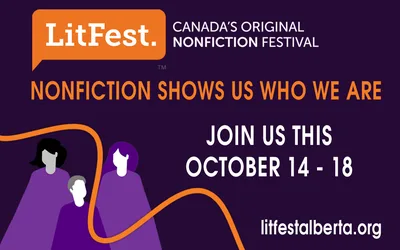
Every October, Edmonton becomes a city that talks about true stories. For five days, stages across downtown fill with authors reading from memoirs, journalists explaining what they found, and poets and playwrights arguing about how real life gets turned into art. This year, from October 14 to 18, LitFest celebrates its 20th anniversary as Canada's first and only nonfiction festival, built around the theme "Nonfiction shows us who we are."
The festival's origin is modest and a little accidental. In 2002, a few thought leaders formed the Alberta Book Fair Society and held a book fair. It was a gathering of readers and writers, not yet a festival. Four years later, in 2006, that fair became a three-day nonfiction festival, and LitFest was born. From those beginnings it expanded into a multi-venue event that now spreads through downtown Edmonton, and occasionally into Old Strathcona, with panels, readings, performances, and workshops. The organization behind it still describes itself as a "moveable feast of nonfiction," a phrase that captures both its roaming nature and its appetite for ideas.
What makes LitFest unusual is its narrowness of focus. Most literary festivals celebrate fiction, poetry, and memoir together, treating nonfiction as one genre among many. LitFest inverts that. It is devoted entirely to true stories, to books about climate and money, gender and colonization, food and play, grief and joy. The festival's own framing is that these conversations all need to take place, and that LitFest makes sure they can. It is a festival where writers share what they know and challenge audiences with their ideas, and where the subject matter ranges from the deeply personal to the broadly political.
The 2026 edition is anchored by a lineup of authors whose work circles the question of identity. Vivek Shraya and Kai Cheng Thom headline a double book launch. The event, presented in partnership with MacEwan's Centre for Sexual and Gender Diversity and its library, celebrates the release of two novels, Shraya's The Hystericals and Thom's The Shapeshifter's Guide to Gym Class. Both works imagine dystopian and utopian worlds that are frightening, fantastical, and not so far from our own. The festival describes them as novels written in answer to the needs of trans and gender diverse communities facing ongoing social, political, economic, and environmental crises, stories that question power, call in the truth, and invite the courage it takes to heal and transform the systems we live in. The evening includes readings, discussion, and a book signing, and the festival makes clear that trans and queer communities will be celebrated and all allies and book lovers are welcome.
Another highlight turns to the country's legal foundations. Author Aaron W. Hughes discusses his new book, Our Rights and Freedoms, with Senator Paula Simons. The book recounts the history of Canada's Charter of Rights and Freedoms, tracing its inspiration, creation, contestation, and adaptation, and arguing that the Charter is a living text whose course has shaped and defined modern Canada, sometimes in unexpected ways. The conversation is hosted by Evan Osenton of Alberta Views magazine, and the event is free and open to all. The book carries a blurb from Michael Ignatieff, who calls it an approachable and reliable guide that rescues a vital document from lawyers and politicians so citizens can understand their rights and use the Charter to defend their freedoms. The event will be recorded.
The festival opens on Wednesday, October 14 with an evening at the Citadel Theatre. Doors open at 6:00 pm and the program begins at 7:00 pm, with a reception featuring light refreshments, musical guests Mikayla Bortscher and Rabbits Three Cultural Connections, and a spoken word performance. The featured author is Trina Moyles, in conversation with Conor Kerr, discussing her new memoir Black Bear: A Story of Siblinghood and Survival. The book is a meditation on coexistence with bears in the boreal forest and on the loss of a sibling. Moyles grew up in Peace River, where her father, a wildlife biologist known locally as "the bear guy," once brought home an orphaned black bear cub for a night before sending it to the Calgary Zoo. That encounter sparked a lifelong fascination with Ursus americanus, the most populous bear on the northern landscape and often dismissed as a nuisance. Growing up during the oil boom of the 1990s, Moyles and her older brother roamed the shores of the Peace, and the threats in their hard-drinking resource town were more human than animal, eventually dividing them from each other and from a reverence for the land. The opening night event is ticketed at $25, with a $10 rate for students and low-income attendees.
The lineup also includes Richard Kelly Kemick, Rachel Phan, Yasuko Thanh, Will Ferguson, Alice Major, Evelyn Lau, Therese Estacion, Patrick Lennox, Nisha Patel, Kathryn Lennon, Richard Harrison, and Lisa Martin, among others. The festival runs workshops as well as talks, including a session with Richard Harrison titled "Scribo ergo sum: I write, therefore I am (what I write)," in which participants use writing to discover and create themselves, and a masterclass on the zuihitsu form with Catherine Owen. Rachel Phan leads a workshop called "Too Much: Writing the Parts of Yourself You Were Told to Hide." There is also a dedicated panel on nonfiction storytelling in theatre and playwriting, and showcases highlighting local independent publishers including Laberinto Press, The Polyglot, and Agatha Press.
Much of the festival is free to attend, including the Milner Library events, and the festival positions itself as open to everyone regardless of experience or skill level. That openness is part of its design. LitFest pays every author and presenter who takes part, engaging more than fifty writers each year, and it relies on donations from individual readers and organizations to keep its programming timely and relevant. The organization also acknowledges that it gathers on Treaty 6 territory, a meeting place and home to many Indigenous nations including the Cree, Nakota-Sioux, Tsuut'ina, Blackfoot, and Métis, and it commits to cultural equity in its programming and operations.
Twenty years in, the festival's bet is still the same one it made in 2006: that true stories, told well and argued over in public, are worth gathering for. The 2026 edition runs October 14 to 18 at venues across downtown Edmonton, with the Muttart Theatre at the EPL Stanley Milner Library and the Citadel Theatre among the anchors. A full schedule and tickets are available through the festival's website.