


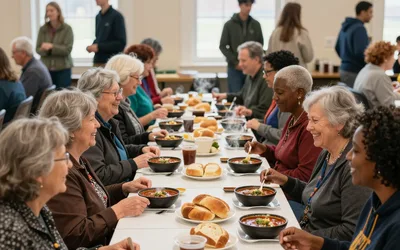
The lineup at Gaetz Memorial United Church on Ross Street on Oct. 21 will look like any church-hall lunch: a pot of chili, a tray of homemade buns, a plate of pumpkin cupcakes, an urn of coffee. The difference is what the chili comes in. Every bowl at GrammaLink-Africa's Chili for a Cause is handmade pottery, and every bowl goes home with the person who bought the lunch. Twenty dollars buys the meal and the bowl, and the money goes to the Stephen Lewis Foundation.
The event runs from 11:30 a.m. until the chili runs out, which is the honest way the organizers have always advertised it. Tickets are sold at the door. The venue, Gaetz Memorial United Church at 4758 Ross Street, has been the lunch's home for years, and the church has hosted a long list of GrammaLink fundraisers besides this one.
GrammaLink-Africa describes itself as a group of Red Deer and area grandmothers and "Grandothers" — the group's own term for members who are not yet grandmothers — who raise money for grandmothers in Africa who have lost family members to HIV and AIDS. The group is part of the Grandmothers to Grandmothers Campaign, which the Stephen Lewis Foundation launched on International Women's Day in 2006. Stephen Lewis announced the campaign alongside actress and activist Shirley Douglas, former Governor General Adrienne Clarkson, and South African grandmothers Rose Letabwa and Lucia Mazibuko. The premise was simple and a little audacious: Canadian grandmothers would organize in solidarity with African grandmothers who, in the middle of a pandemic that had killed a generation of parents, had stepped in to raise their grandchildren.
The campaign's own history puts the scale of that crisis plainly. In 2006, AIDS was ravaging the continent and the survival of whole communities was under threat, leaving millions of children without parents. Grandmothers took them in. The Canadian campaign that grew out of that moment has since raised more than $40 million for the grandmothers movement, money that has helped African grandmothers move from securing basic needs to running their own programs for childcare, income generation and support networks.
Red Deer's contribution to that movement started small and local. According to Todayville's coverage of the lunch's tenth anniversary, a group of Red Deer grandmothers headed by Shirley Challoner held the first Chili for a Cause in 2008 and raised $2,200. By 2017 the same lunch was bringing in $8,000. The group's own records show the event has kept going through years when gathering was not possible: the gallery on GrammaLink-Africa's website lists a "Chili for a Cause with a Difference" in 2020, alongside a virtual macaroni-and-cheese fundraiser that delivered 193 boxes of macaroni and cheese to the Red Deer Food Bank from what the group called a "cheeseless, calorie-free" event. The chili lunch has otherwise appeared nearly every year since 2016, and the group has filled out its calendar with rhubarb teas, fabric sales, Scrabble nights, a quirky climate change fashion show and a quilt marking the campaign's twentieth anniversary.
The pottery is where the lunch gets its character. GrammaLink-Africa has publicly thanked the Red Deer Pottery Club and a member named Maureen Lewis for the bowls, which turn a bowl of chili into something a person keeps on a kitchen shelf for years. It is a small stroke of fundraising design: the donor gets a useful, handmade object rather than a receipt, and the group gets a reason for people to come back year after year and compare bowls. The most recent lunch, held in October 2025, raised more than $7,100, all of it donated to the Stephen Lewis Foundation.
The 2026 edition falls in a milestone year for the campaign, which turns twenty and is marking the anniversary with events including a celebration in Ottawa in early October. For anyone in central Alberta who cannot make it to Ottawa, the Red Deer version is considerably cheaper and comes with lunch. The format has barely changed in eighteen years: show up, pay at the door, eat chili, take home a bowl, and send the money to grandmothers on the other side of the world who are raising children on their own. The group's advertising this year is characteristically blunt about the supply: 11:30 until the chili runs out.