


For most of the year, the white cane is a practical object: a lightweight length of fiberglass or aluminum, tapped and swept along sidewalks and curbs, that tells a person who cannot see what lies ahead and tells everyone else to give way. On White Cane Day, it becomes something else -- a banner, a reason to gather, and a reminder of a long argument about independence that blind people have been making for more than half a century.
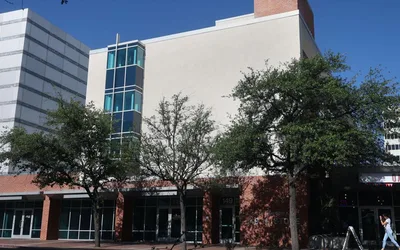
This year the Tucson School for the Blind and Saavi Services for the Blind are marking the occasion on Friday, Oct. 23, from 10 a.m. to 2 p.m. at the Main Library in downtown Tucson, 101 N. Stone Ave. The event is free and open to the public. Its activities are built to be handled rather than merely watched: a Braille scavenger hunt, adaptive games, and art and Braille literacy stations. Families, students, educators and anyone curious about visual impairment and accessibility are invited to drop in.
The date is a little off the official one. White Cane Safety Day is observed annually on Oct. 15, a date fixed by proclamation in 1964, when President Lyndon Johnson called on the nation to recognize the cane and the people who use it. Tucson's celebration lands on a Friday a week later, which in practice means a weekday crowd of school groups, families and agency staff rather than a weekend festival.
The cane itself has a longer and messier history than the observance. A commonly repeated account credits James Biggs, a photographer in Bristol, England, who lost his sight after an accident in 1921 and painted his walking stick white so that the traffic around his home would notice him. A decade later, in 1930, George A. Bonham, president of the Peoria Lions Club in Illinois, promoted the white cane with a red band as a mobility aid, and the Lions clubs carried the idea across the country. What began as a visibility trick became a legal instrument: the model white cane law, drafted by the blind jurist and scholar Jacobus tenBroek, established that a person carrying a white cane has the right of way in traffic, and a version of it is now law in all fifty states.
The National Federation of the Blind, which pushed for the national observance, has always been careful about what the day is for. In a 1978 article reprinted by the federation, its president Marc Maurer quoted a young blind woman who complained that strangers "bless me, extol my independence, call me brave and courageous, and thoroughly miss the boat as to what the real significance of the white cane is." The cane, in that view, is not a plea for help. It is a tool of competence -- the thing that lets a person walk to the store, catch a bus, and arrive on their own terms.
That argument is the thread running through both of the organizations putting on the Tucson event, and both have recent histories that give the day some weight.
Saavi Services for the Blind, legally the Southern Arizona Association for the Visually Impaired, was founded in Tucson in 1964 -- the same year as the first presidential proclamation -- by two blind sisters, starting out as a social club. It has since grown into a training agency with centers in Tucson and Phoenix, teaching nonvisual skills to children, working-age adults and older adults who are losing their sight. Its shorthand for the philosophy is blunt: it is not what you can see that matters, it is what you can do.
The Tucson School for the Blind is far newer, and its founding is bound up with a disruption in the state's own system. For years, blind and visually impaired students in Southern Arizona were served by the Tucson campus of the Arizona State Schools for the Deaf and the Blind. When ASDB announced it would move its deaf and hard-of-hearing programs to a new campus in Oro Valley and integrate blind students into local public school districts, a group of former ASDB educators decided the specialized option should not disappear. Kate Scally, who had taught music at ASDB for 15 years, began researching the idea early in the year. "I just fell in love with my students," she told the Arizona Daily Star. "I told one of my good friends who was kind of helping me out that I was just going to keep going until somebody stopped me, and nobody stopped me."
The school opened at 149 N. Stone Ave. -- a short walk up the same downtown street from the Main Library -- with classes beginning Aug. 3, the same day ASDB's new Oro Valley campus opened. It started with roughly 15 students, nearly all of them former ASDB students, in a 4,200-square-foot building, funded through Arizona's Empowerment Scholarship Account voucher program. In late August, the state certified the school to take in students who are enrolled in public schools, either part-time for specific services or full-time without tuition, which widened its reach to visually impaired children in districts that are not built around their needs.
Scally Howell, as she is now known, described the point of that small community in terms that sound like a description of the White Cane Day program itself. "Being in the community of blind peers where you're not the weirdo, everybody's using a cane, everybody's learning Braille -- that is really the piece that's so important, that social-emotional piece," she told AZPM.
The Main Library setting fits the same logic. Public libraries have been among the more serious institutional investors in accessibility -- large-print and Braille collections, audiobooks, screen-reader-equipped computers -- and a scavenger hunt built around Braille turns the reading system into a game rather than a lesson. Braille, after all, is not a language but a code: six raised dots in a cell, sixty-three possible combinations, invented by a blind French teenager, Louis Braille, in the 1820s and slow to be adopted even in his own country. Learning to read it by touch takes years of deliberate practice, which is why the certified teachers of the visually impaired who provide "Braille minutes" are a specific and scarce credential -- one of the services the Tucson School for the Blind advertises in-house, alongside orientation and mobility instruction, occupational therapy and speech therapy.
The adaptive games are likely to be the part that surprises visitors most. Blind sport has its own long tradition -- goalball, invented after World War II for blinded veterans, in which a ball with bells inside is rolled across a court while defenders lie across the goal line and listen -- and beep baseball, played with a sounding ball and bases. Games built for players who cannot see tend to be louder and more tactile than the versions most people know, and they tend to require everyone in the room to pay attention in a different way.
That is roughly the spirit the organizers are aiming for: not a demonstration put on for a sighted audience, but a few hours in which the ordinary assumptions of a public space are rearranged. The event runs from 10 a.m. to 2 p.m. at 101 N. Stone Ave. and is free, with no ticket required. For families with a child who is losing vision, or for anyone who has wondered what the long white cane is actually for, the doors are open.