


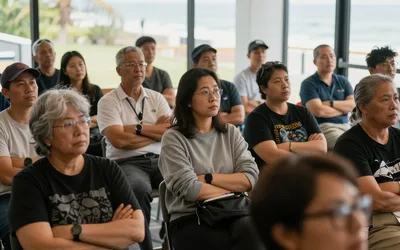
On the third Sunday of October, a low white building beside a small white church in Northwest Cove, Nova Scotia, will host a question that has occupied some of the world's most powerful capitals for the better part of a decade: what does NATO become now?
The Athenæum Society of Nova Scotia has booked Susan Pond, a former senior Canadian official on the International Staff at NATO headquarters in Brussels, to deliver a talk titled "After 77 years – a new NATO?" The presentation begins at 2:30 p.m. at the Ocean Swells Community Centre, 2724 Highway 329, and is free and open to all. The society's own listing describes the subject plainly: for seven decades the United States played a key leadership role in the Alliance, and while recent summits have reaffirmed commitment to Article 5, they have also focused on Ukraine, on five per cent defence spending, and on building a new defence industrial base. The question Pond poses is whether current American policy will force a new NATO approach to meet emerging security risks.
It is a weighty topic for a fishing village on the Aspotogan Peninsula, but that is precisely the point of the Athenæum Society. Founded in January 2007 by a small group of local residents, the society was built on the observation that the area held a deep pool of knowledgeable and talented people who had no regular forum in which to share what they knew. The founders borrowed their model from the Athenæum Club in London, established in 1824 as a "Club for Literary and Scientific men and followers of the Fine Arts," whose past members included Charles Darwin, Charles Dickens, Joseph Conrad, Thomas Huxley, Rudyard Kipling and John Ruskin. The Nova Scotia version keeps the spirit and drops the formality: membership dues are twenty dollars a year, there is no charge for attending the presentations, and audiences typically run around fifty people. Over the years the society's membership has included more than 350 people.
Meetings are held at 2:30 p.m. on the third Sunday of each month, with the exceptions of July, August and December, and the society strives to have speakers and topics identified at least three months in advance. It also maintains a weather policy suited to a coastal Nova Scotia winter: if a talk must be postponed or cancelled, notice goes up on the website and out by email by 9 a.m. on the day of the presentation.
Pond is not a casual guest. Her career with the North Atlantic Treaty Organisation spans more than two decades, and she is the recipient of Canada's Meritorious Service Cross. She served as a senior officer and head of NATO's Building Integrity Programme, based in the Partnerships and Cooperation Directorate within the Political Affairs and Security Policy Division at NATO headquarters. In that role she was the public face of an initiative that NATO itself describes as promoting good governance, transparency and accountability in the defence and security sector — work grounded in the recognition that poor governance and corruption increase the security challenges facing allies and partners alike, and can directly or indirectly create conditions that extremism and terrorism exploit.
The Building Integrity policy was endorsed by heads of state and government at the 2016 Warsaw Summit, and it was folded into NATO's three core tasks: collective defence, crisis management and cooperative security. What distinguished the programme, as analysts have noted, was that its activities were open not only to partner nations but to NATO allies themselves — an acknowledgment that improving defence institutions is not a project reserved for countries with fragile governments. Pond presented on the programme at NATO gatherings including a seminar supported by the Joint Analysis and Lessons Learned Centre, and she has been listed among the speakers at the Centre for Integrity in the Defence Sector's conferences in Norway. Her writing appears in defence-integrity publications, including a piece titled "NATO and the Evolution of the Building Integrity Initiative."
Her experience extends beyond Brussels. She has more than thirty years of work with international organisations and the Canadian government, and in 2002 she was awarded the Queen Elizabeth II Golden Jubilee Medal for outstanding public service. She has since been listed as a senior fellow at the Glendon School of Public and International Affairs at York University, where her biography notes that her NATO career gives her a unique vantage on the peace and security challenges of the twenty-first century. She has also lectured in a master's programme in leadership, and her professional profile places her in Lunenburg, Nova Scotia — a short drive from Northwest Cove, and part of the reason a society built on local talent can land a speaker of this kind.
The title of the talk carries its own arithmetic. NATO was founded with the signing of the North Atlantic Treaty in Washington on 4 April 1949. Seventy-seven years later, the alliance is contending with questions its founders could not have imagined: whether American leadership of the alliance remains a constant, how Ukraine's defence is sustained, whether allies will actually reach the five per cent defence spending threshold discussed at recent summits, and how a defence industrial base can be rebuilt after decades of relative peace in Europe.
Those are the questions Pond will take up in a community hall that, by the society's own directions, sits just past a steep hill as you leave Northwest Cove, next to the small white church of St Cuthbert's, with ample parking in front. The society notes that its events are third-party listings and are not verified by the Municipality of the District of Chester, which posts them as a service to the community.
For anyone on the South Shore who has followed the alliance's transformation from a distance, the afternoon offers something rare: a first-hand account, in plain language, from someone who spent two decades inside the institution as it changed. Admission is free, the doors are open to all, and the talk begins at 2:30 p.m.