


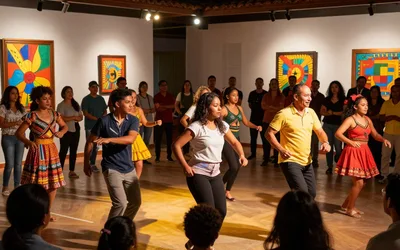
On Friday, October 16, 2026, the Humboldt Cultural Center on Chicago's West Side opens its doors for a free evening that asks visitors to travel through Latin America without leaving the neighborhood. The Hispanic Heritage Celebration at Humboldt runs from 5 to 9 p.m., and it is built as a slow reveal rather than a single stage show: at 5 p.m. guests wander art installations representing different Latin American countries, learning about their cultures, traditions, and heritage; at 7 p.m. the live park performances begin; and at 8 p.m. the night lands on a special Afro-Puerto Rican Bomba performance by Los Médicos.
It costs nothing, it is open to all ages, and it is part of the Chicago Park District's Night Out in the Parks series, which since its inception in 2013 has provided free arts programming in neighborhood parks. The event also sits under the umbrella of Hispanic Heritage Month, which nationally runs from September 15 to October 15 -- a window chosen because it brackets the independence days of several Latin American nations. This celebration lands just after that official close, extending the observance by a night.
That the party happens at Humboldt is not incidental. The park itself is one of the largest on the West Side, a 207-acre expanse that opened in 1877 and was shaped by designers including Jens Jensen. It was named for the naturalist Alexander von Humboldt, and it is listed on the National Register of Historic Places. The fieldhouse where the evening unfolds -- the Humboldt Cultural Center -- is a historic public recreation and community building in the park.
The surrounding neighborhood carries its own story. By the 1960s, Puerto Rican families displaced from other parts of the city had moved northwest into Humboldt Park, and the community took root. In 1995, the city installed two 59-foot steel Puerto Rican flags at either end of Division Street. The flags were dedicated on January 6, 1995, Three Kings Day, and they honor the generations of Puerto Ricans who worked in the steel mills. They mark the gateway to Paseo Boricua, the stretch of Division Street between Western and California avenues that functions as a microcosm of the Puerto Rican community, lined with businesses named after Puerto Rican towns and a walk of fame honoring notable Puerto Ricans.
So a Bomba performance at the end of this particular evening carries more than entertainment value. Bomba is the island's oldest musical tradition, developed by enslaved Africans and their descendants on sugar plantations in Puerto Rico. It is a syncretic form: it folds in Taíno instruments such as maracas, echoes of European dances like the rigadoon, quadrille, and mazurka, and drum ensembles whose call-and-response between drummer and dancer closely resemble African traditions. The dance is a conversation -- the dancer's movements signal the drummer, who answers. Bomba has long been described as music born of resistance, and in recent years it has resurfaced at Black Lives Matter protests, a reminder that its roots as a music of resilience never really went away.
That is the arc the evening traces: a tour of many Latin American countries through art, then live performance, then a deep dive into one specific Afro-Puerto Rican tradition, staged in a neighborhood where that tradition has a home. It is a one-night showcase rather than a sprawling street festival, with no ticket and no capacity barrier -- you simply show up at the Humboldt Cultural Center between 5 and 9 p.m. on Friday, October 16, 2026.