


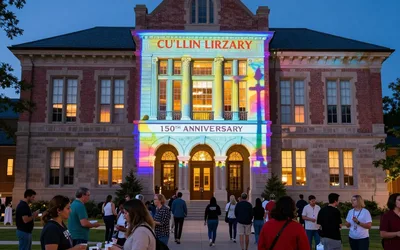
On the evening of Thursday, October 1, the west face of Norlin Library will stop being a wall and start being a screen. As dusk settles over Boulder, a large-scale projection-mapping show will wash across the sandstone of CU Boulder's central library, turning the building into a canvas for 150 years of university history. The occasion is Shine on Norlin, the signature event of CU Boulder's sesquicentennial, and it is billed as the debut of a visual storytelling experience that will keep running nightly through October.
The evening begins at 4 p.m. on Norlin Quad, the grassy heart of the historic campus, with free food (in limited quantity), interactive activities, performances, and remarks from university leadership. The projection itself premieres at dusk, and organizers describe it as a communal act of storytelling: student artwork, historic imagery, video, music, research, and innovation woven together to highlight the people, moments, discoveries, and traditions that shaped the university — while, in the words of the university's own announcement, "looking boldly toward its future." After the debut, the projections continue nightly at dusk throughout October, roughly 6 to 9 p.m. The event is free and open to faculty, staff, students, and the wider Boulder community, with registration encouraged.
What makes the setting resonant is the building itself. Norlin Library is named for George Norlin, who taught Greek language and literature at CU beginning in 1899, became acting president in 1917, and led the university from 1919 until his retirement in 1939. His tenure was not a quiet one. Norlin oversaw architect Charles Klauder's redesign of the Boulder campus, steered the university through the hard years of the Depression, and — according to the university libraries' own history — stood up to the Ku Klux Klan when it was a powerful force in Colorado politics, refusing a Klan-backed governor's offer of legislative support in exchange for firing Jewish and Catholic faculty. After a year lecturing in Berlin in 1933, he returned to warn publicly about the rise of Nazism and antisemitism, telling a journalist that Hitler was not someone with whom you could go fishing. Enrollment tripled to roughly 4,500 students during his presidency, and by 1939 he had lifted the university into the ranks of the nation's strongest mid-sized institutions.
Norlin's most visible legacy is the library that carries his name. He envisioned a building that would be the largest library between Chicago and the West Coast, and when its doors opened on January 6, 1940, it was. Designed by Charles Klauder in the architect's own "Italian rural" or Tuscan vernacular style — local pink sandstone walls, off-white limestone trim, red tile roofs — it became the centerpiece of the campus aesthetic that still defines CU Boulder. The library has since grown through two additions, in 1964 and 1976, and it remains a central building on campus.
There is a particular irony, and a particular aptness, in projecting the university's story onto the library's west face. Above the west entrance is an inscription written by Norlin himself and inspired by Cicero: "Who knows only his own generation remains always a child." A light show that gathers 150 years of photographs, research, music, and student art onto that same wall is, in a sense, an answer to the line — an argument that the university intends to know more than its own generation.
The 150th anniversary the show celebrates traces to 1876, the year Colorado became a state and the University of Colorado was founded. The sesquicentennial has been building across 2026 through a documentary film, a Sesquicentennial Scholars program honoring undergraduate leaders, faculty lecture events, and a 150th Initiative Fund that seeded community-created projects and displays. Shine on Norlin is the centerpiece of that year, and the university has treated it as a genuinely collaborative production: faculty, staff, and students were invited to submit historic photos, research breakthroughs, alumni stories, and creative ideas for possible inclusion in the projection, to host tables on the quad, or to perform in the evening program.
For Boulder residents, the appeal is straightforward. This is a free, open, one-time campus spectacle with no ticket required, set on one of the most photographed quads in Colorado, in front of a building whose architect helped invent the look of the place. And for anyone who misses the October 1 premiere, the show isn't a single night's wonder — the projections return at dusk every evening through the end of the month, turning a library wall into a month-long retrospective of a university that has been at it since 1876.