


The animals that sell Colorado postcards are easy to name. Elk bugling in a frost-bitten meadow. A golden eagle riding a thermal above a hogback. A yellow-bellied marmot whistling from a granite boulder. Quaking aspens turning gold in September, ponderosa pines smelling of vanilla and butterscotch. These are the state's celebrity species, and they have earned their fame.
Kevin Cook wants to talk about everyone else.
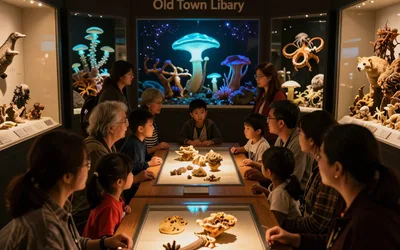
On October 13, 2026, from 1 to 2 p.m., Cook brings his program "Colorado Creatures" to the Old Town Library at 201 Peterson St. in Fort Collins. The talk is free, drop-in, and sponsored by the Poudre River Friends of the Library. It is part of a series Cook has been delivering across northern Colorado libraries under the banner "Creatures You Never Knew Live in Colorado" -- a title that doubles as a thesis. The premise is simple and a little subversive: the wildlife that gets the calendars and the brewery logos is a tiny fraction of what actually lives here, and the rest of it is stranger than anything on a postcard.
The description for the program lays out the bait. Yes, animals eat plants -- that part everyone knows. But Colorado also has plants that eat animals. Six of them, by Cook's count, along with some mushrooms that have turned the arrangement around. There are wildflowers here that temporarily trap the pollinators they depend on, holding them just long enough to ensure a pollen delivery before letting them go. There are animals that hitchhike on other animals. There are fungi bulging from the sides of aspen trunks and arachnids so small they look like scorpions that misplaced their tails.
That last detail is not filler. At an earlier installment of the series, held at the Loveland Public Library, Cook's subject was "Tiny Flowers, Fairy Fingers, Mites and Pseudoscorpions" -- a lineup that gives a fair sense of where his curiosity lives. Pseudoscorpions are arachnids, cousins of spiders and scorpions, usually only a few millimeters long. They have the pincers of a scorpion and none of the tail, and they get around by grabbing onto the legs of flies, beetles, and other larger insects, riding them from place to place. It is a real and widespread strategy, and almost nobody has heard of it. That, in miniature, is the whole point of the series.
Cook is well suited to the role of guide to the overlooked. He moved from Iowa to Colorado in 1974, earned a bachelor's degree in biology from Western State College in Gunnison, and then a master's in wildlife biology from Colorado State University in Fort Collins. He spent five seasons as an interpretive naturalist with the National Park Service, four of them at Curecanti National Recreation Area on the Gunnison River and one at Everglades National Park in Florida. He also put in a summer as a wildlife technician for the Colorado Division of Wildlife, the agency now known as Colorado Parks and Wildlife.
Then, in 1981, he made a decision that shaped the next four-plus decades: he went to work full time as a self-employed writer-naturalist. The career has included writing, editing, speaking, consulting, teaching, and guiding, nearly all of it rooted in Colorado's landscapes and the things that live in them. For a long stretch he wrote a weekly nature column for the Fort Collins Coloradoan, filed under the heading "Views and Vistas," in which he ranged across subjects as varied as the social standing of foxes and corgis, the timing of wildflower blooms along the Front Range, and the uncomfortable fact that what is good for one species is often bad for another. His columns carried a recurring note of restraint and attention: not all wildlife announces itself, and the findable things are there to give you the energy to keep looking for the elusive ones.
That sensibility runs straight through the library talks. The series is built around the wildlife that does not make it onto brewery logos -- the small, the hidden, the easily missed. Cook has taught for Colorado State University's Osher Lifelong Learning Institute as well, and his public programs tend to blend the rigor of a trained wildlife biologist with the storytelling instincts of someone who has spent decades trying to get other people to look closer.
The Old Town Library setting fits. The building sits in the heart of Fort Collins, a short walk from the city's historic downtown, and the program is one of a regular slate of nature and environment offerings that the Poudre River Friends of the Library help fund. There is no ticket, no registration requirement, and no capacity limit mentioned -- the format is the old-fashioned one, a room, a speaker, and whoever shows up.
What they will get is a tour of Colorado's second string, which turns out to be a first string in disguise. The state's carnivorous plants are a good example of how the ordinary assumptions break down. Colorado is not generally thought of as carnivorous-plant country; that reputation belongs to the bogs of the Southeast and the cloud forests of Borneo. But sundews, with their glistening glandular hairs, and bladderworts, with their tiny underwater suction traps, do grow here, and Cook counts six animal-eating plants in the state. The mushrooms that eat animals -- fungi that capture and consume nematodes and other microscopic prey -- are a further wrinkle, a reminder that "plant" and "animal" are categories humans invented and nature only loosely honors.
Then there are the wildflowers that trap their pollinators. The mechanism is temporary and, from the plant's point of view, purposeful: a flower that briefly holds a visiting insect can control where that insect goes next, improving the odds that pollen lands where it needs to. It is not malice. It is a negotiation, conducted in milliseconds and millimeters, that most of us walk past without noticing.
And there are the hitchhikers -- animals that travel by clinging to other animals, a behavior called phoresy when it involves mites and their relatives. Pseudoscorpions do it. So do certain mites, beetles, and flies. The strategy is ancient and efficient: rather than spend energy crossing a landscape, find someone who is already going your way.
Cook's gift, judging by the series' framing, is not novelty for its own sake. It is the argument that paying attention to the small and strange is a way of paying attention to where you actually live. The celebrities -- the elk, the eagles, the marmots -- are worth their fame. But they are also, in a sense, a distraction, the bright objects that keep the eye from settling on the aspen trunk, the boggy seep, the patch of gravel where something tiny is quietly doing something no one has bothered to name.
A free hour in a library meeting room is a reasonable place to start correcting that. Cook's talk is scheduled for October 13, 2026, at 1 p.m. at the Old Town Library, 201 Peterson St., Fort Collins. It is open to anyone who walks in.