


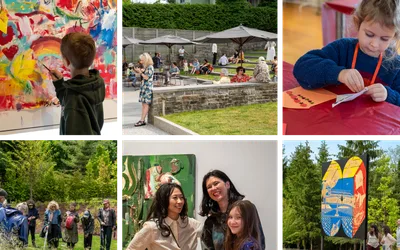
On Saturday, October 17, 2026, The Aldrich Contemporary Art Museum in Ridgefield will throw the doors open and charge nothing. Community Day runs from 10:30 a.m. to 5 p.m. across the museum's galleries and its Sculpture Garden, with guided tours, hands-on art making, a scavenger hunt, live music-making, a performance, and a seed exchange table hosted by the Caudatowa Garden Club. Admission is free, and while pre-registration is encouraged, the day is designed as a drop-in affair rather than a ticketed program.
The anchor of the day is The Aldrich Decennial: I am what is around me, a survey of artists who live and work in Connecticut that opened in June 2026 and runs through January 10, 2027. It is the debut of what the museum intends to be a recurring exhibition, staged once every ten years, and its rules are unusually strict for a group show: none of the featured artists has had a solo museum exhibition anywhere in the state, and every work on view was made within the last decade. The roster is deliberately intergenerational, mixing breakout debuts with rediscoveries, and it spills out of the museum's 8,000 square feet of galleries into the Sculpture Garden.
The premise behind the show is a piece of Connecticut art history that the museum is happy to recite. The state has been home to a remarkable list of art-world giants, among them Anni and Josef Albers, Kay Sage and Yves Tanguy, Louise Bourgeois, Alexander Calder, Jasper Johns, Barkley Hendricks, and Sol LeWitt. The Decennial asks what that lineage looks like now, and specifically what it looks like for artists who have chosen to live and work outside the major art centers. The Aldrich has been making that argument since its founding, through solo, group, and invitational exhibitions of Connecticut artists.
That founding is the reason the museum exists at all, and it is a good story. Larry Aldrich was a fashion designer, not a curator. He was headed for Columbia Law School until he discovered he could sell dresses, withdrew, changed his name, and debuted an eponymous label. Through the 1930s he traveled to Paris to study new dress styles, and while he was there he looked at art. In 1940 he married Wynn Payne, a painter, and they bought a weekend house in Ridgefield. Worried that she would be bored during the week while he worked in New York, he started bringing home art books; he ended up reading them himself.
After the war, the Aldriches flew to Paris in 1947 intending to buy an Utrillo. They came home with paintings by Impressionist and Post-Impressionist artists, and the collection kept growing. In 1951 Aldrich bought suites of paintings by Maria Helena Vieira da Silva and Zao Wou-Ki, his first acquisitions of work by living artists. By the early 1960s the collection included Picasso, Miró, Chagall, and Paul Klee. Then, according to the museum's own account, Aldrich was out buying cigarettes one day in Ridgefield when he noticed a building for sale on Main Street. It had high ceilings. He thought it would make a good museum.
That building was an 18th-century former church and general store known as "Old Hundred." Aldrich sold his collection to fund the purchase and the conversion, and in November 1964 the Larry Aldrich Museum opened, conceived as one of the first truly contemporary art museums in the United States. It has no permanent collection, which remains unusual: it is one of the few independent, non-collecting institutions in the country, and the only museum in Connecticut dedicated solely to contemporary art. The building on Main Street is still the one Aldrich spotted on that errand.
Community Day is, in effect, an invitation to that building and its grounds. Story Time with the Ridgefield Library opens the morning, though that portion requires pre-registration. From 12:30 to 4:30 p.m., visitors can drop into The Studio for art making with Aldrich educators, with projects drawn from the Decennial, and pick up a scavenger hunt that sends them through both the indoor galleries and the outdoor Sculpture Garden. Guided tours of the exhibitions and the garden run throughout the day, including one focused on the intersection of art and the natural environment. The Caudatowa Garden Club's seed exchange table invites visitors to bring seeds to swap or take something new home.
The museum's regular admission is $20 for adults, $15 for seniors, and $9 for students, with members, educators, children under 13, and military families admitted free; the museum also waives admission on Third Saturdays. Community Day falls on a Third Saturday, which means the free access is part of an established pattern rather than a one-off. Final entry on a normal day is 4:40 p.m., and the museum is closed on Tuesdays.
For anyone who has been meaning to see the Decennial, or who simply wants an afternoon of free art programming with children in tow, October 17 is the low-stakes way in. The exhibition will not be up forever, and the survey it inaugurates will not return until 2036.