


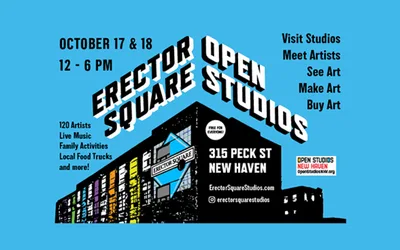
For most of the year, the studios tucked inside the brick buildings at 315 Peck Street are private places — rooms where painters stretch canvas, printmakers run presses, and sculptors wrestle with materials, all behind doors the public never opens. On October 18, 2026, that changes. Erector Square Open Studios returns to the Fair Haven complex, and artists, designers, and craftspeople will swing their doors open and let the city wander through.
It is a free event, which is part of its particular charm. You walk in off Peck Street, pick a building, climb a flight of stairs, and find yourself standing in someone's working studio, looking at half-finished work and asking questions about how it was made. Some of these studios are open to the public only during this event, so the chance to see them is genuinely rare.
The setting is as much a draw as the art. Erector Square is an eleven-building, three-story brick industrial complex at the corner of Blatchley Avenue and Peck Street, and it began life as a toy factory. The A. C. Gilbert Company established the site in 1923, and for decades it churned out some of the most beloved playthings in American childhood: Erector Sets, American Flyer model trains, magic sets, chemistry sets. By 1953 the factory employed around 3,000 workers and generated roughly $20 million in annual merchandise, with peak employment reaching as high as 5,000 during the mid-twentieth century. The last official toy sets were produced there in 1967, after which the company went out of business and its assets were purchased by Gabriel Toys and moved to Lancaster, Pennsylvania.
The man behind all of it was a character worth a story of his own. Alfred Carlton Gilbert won a gold medal in pole vaulting at the 1908 Olympics, then earned a medical degree at Yale in New Haven. Rather than practice medicine or take a job as a college athletic director, he started the Mysto Manufacturing Company in 1909. The Erector Set followed, introduced at the New York Toy Fair in 1913. The origin story has a nice piece of New Haven commuter logic to it: riding the train between his New Haven factory and his magic store in New York, Gilbert was inspired by the steel towers carrying the railroad's electrical lines, and imagined a toy whose magic lay not in illusion but in ingenuity — a collection of metal parts a child could assemble into bridges, cranes, and Ferris wheels. The ads said, "Hello Boys! Make Lots of Toys!" and the company sold 30 million Erector Sets in 30 years.
When the toy business left, the artists moved in. Studios began being rented in the complex in 1967, and over the decades the old factory was transformed into one of the largest artist studio communities in the region. Today Erector Square LLC is managed locally by Capp Associates LLC and is home to Erector Square Studios, a community of working artists and creative and wellness professionals. The complex holds nearly 150 studios ranging in size from 160 to 10,000 square feet, and its tenant mix runs well past visual art: established and emerging artists, researchers, architects, designers, and dance, theater, yoga, and pilates professionals all share the buildings. Well-known visual artists have made studios there, and a growing number of recognized names have recently made New Haven home.
The open studios event itself has evolved. It originated as a key component of Artspace New Haven's City-Wide Open Studios festival, which began in 1998 to foster direct public engagement with local artists. More recently it has become an artist-led affair in its own right — by October 2025, organizers were describing it as the third annual artist-led Open Studios weekend, and it drew a steady stream of visitors through the Fair Haven hub that so many makers call home. That year's edition added a color-coded wayfinding system to help visitors navigate the sprawling, multi-building complex, a practical touch for a site where it is genuinely easy to get happily lost.
What visitors find inside is a mix of career stages and disciplines. Some artists at Erector Square are decades into their working lives; others treat the weekend as a launchpad, using the foot traffic and conversation to introduce themselves to the public for the first time. The 2025 weekend offered a good sample of the range: paper artist Jennifer Davies working over a pile of bright, delicate kozo lace paper while a cast of a millstone glowed in the afternoon light against a studio wall; printmaker Jeff Mueller of Dexterity Press at work at his press. Visitors moved between studios, gathered around works in progress, and talked with the people who made them.
That conversational quality is the point. An open studio is not a gallery visit. There is no wall text, no guard, no velvet rope — just a maker, a workspace, and whoever happens to walk in. You can ask why a piece is unfinished, what a particular tool does, how long a process takes. You can buy work directly from the person who made it, or simply look and leave. The complex's other cultural tenants add to the day: Music Haven, which is based at Erector Square, has tied programming to the Open Studios weekend, including a wellness concert with movement and sound healing alongside live classical music, and the Ely Center of Contemporary Art has hosted exhibitions and community programs in the complex.
For 2026, the event runs Sunday, October 18, at 315 Peck Street. Admission is free. The address sits in Fair Haven, an easy drive or bus ride from downtown New Haven, and the scale of the place — eleven buildings, three stories — means it rewards a few hours rather than a quick stop. Wear comfortable shoes for the stairs, plan to talk to strangers, and expect to leave with a better sense of who is actually making things in this city, and where.