


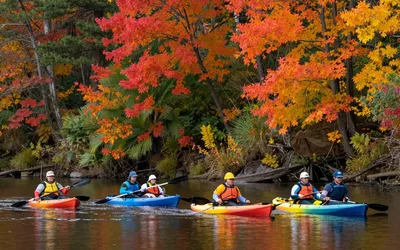
By mid-October, the floodplain forest along the Mattabesset River has turned into a color chart, and Janet Cunningham intends to read it out loud. On Oct. 17, 2026, from 2 to 4:30 p.m., her company Wanderlust Ecotours will lead a Leaf Peeping Paddle down the river out of Cromwell, a slow, beginner-friendly kayak trip built around a simple idea: that the brightest season of the year is also the easiest time to learn which tree is which.
The trip meets at 24 Shunpike Rd in Cromwell, where the Mattabesset widens into the flat, sheltered water of the Cromwell Meadows. Cunningham, a former earth science teacher, supplies everything: Wilderness Systems Pungo 120 sit-inside kayaks, paddles, life jackets, dry bags, cell phone pouches, and custom field guides written for this specific stretch of river. The pace is deliberately unhurried. "We don't go far," she told the Middletown Press in a profile of her fledgling business. "We poke around, I give out the field guides and we stop and we look."
What they look at, in autumn, is a wetland edge doing its annual fireworks display. Cunningham's own description of the route reads like a botany lecture delivered from the water: the fiery reds of silky dogwood, winterberry, and Virginia creeper; red, silver, and sugar maples burning above the bank; golden yellows from catalpas, shagbark hickories, and sycamores glowing against the oranges of buttonbush and wild grape. The point of the tour is that these colors are diagnostic. A paddler who learns to tell a shagbark hickory's gold from a sycamore's can identify the same trees in July, when everything is green and much harder to sort out. Fall foliage, in other words, is not just scenery here. It is the teaching tool.
The river itself rewards a slow approach. The Mattabesset rises out of Harts Ponds in Berlin and runs roughly 16 miles east to the Connecticut River, passing through Kensington before forming the boundary between Middletown and Cromwell. Near its mouth it picks up the Coginchaug River, which flows north out of Durham. The name is older than any of the towns along it: the Mattabeseck were the Indigenous people of this stretch of the Connecticut River valley. The river has carried other names over the centuries, including the West River and, for reasons no one has satisfactorily explained, the Sebethe and the Arrawanna. The Mattabesset River Watershed Association now works as an advocate for the river.
Wanderlust Ecotours is a young operation, and Cunningham is candid about how it started. She began thinking about the business in 2024 and started buying kayaks off Facebook Marketplace in January, assembling a fleet one used boat at a time. The name, she has said, comes from her own traveler's and wanderer's instincts. She is also a naturalist, and her tours lean on that background as much as on her classroom years. On the water she points out great blue herons, painted turtles, and the other residents of the marsh, and she frames the whole enterprise as an antidote to screen-lit, indoor life. "There's something about being in nature and moving through it that is really good for people," she said. "I love nature so much, and I love science. It's wonderful to see people appreciating it and being able to point out things they may not have noticed. We all get to see nature together."
That philosophy shapes the logistics. The Cromwell tours are rated for first-time kayakers, and the Mattabesset is a forgiving place to learn: minimal current, calm water, and a route that stays close to the launch. Cunningham's other Cromwell-area outings run through the Cromwell Meadows Wildlife Area, hundreds of acres of wild rice, river bulrush, and other wetland plants, while her coastal trips head for brackish marshes and tidal mudflats. The inland routes are the ones she recommends for people who have never paddled before.
There is one piece of practical advice worth heeding before booking: you will need to step into the river to get into your kayak. Cunningham asks participants to wear shoes that can get wet. Beyond that, the barrier to entry is close to zero, which is rather the point. The tour is designed for people who do not own a kayak, cannot transport one, or have simply never tried. Everything needed to float, paddle, and identify a sugar maple from a silver one is waiting at the Shunpike Road launch.
Mid-October is a reasonable bet for peak color in central Connecticut, though the exact timing shifts year to year with temperature and rainfall. Cunningham's Cromwell calendar lists leaf-peeping paddles on consecutive days that weekend, and she also runs private tours for groups of four to ten, including sessions timed for photographers chasing good light. For anyone who has driven past the Mattabesset on Route 9 a hundred times without ever seeing it from water level, the trip offers a different kind of leaf-peeping: not a scenic overlook, but a seat inside the canopy's reflection, with a naturalist alongside to name what you're looking at.