


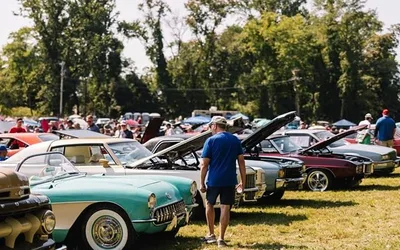
On a Sunday each September, the rolling green acres along the Brandywine Creek fill with a kind of time machine. More than 500 antique and restored cars — spanning the early 1900s through the early 2000s — will spread across the grounds of the Hagley Museum and Library on Sept. 20, turning a site built for 19th-century industry into a sprawling gallery of 20th-century motion.
The Hagley Car Show runs from 10 a.m. to 3 p.m. at 200 Hagley Creek Road in Wilmington, and it has earned a reputation its organizers don't mind repeating: "The Best Car Show in Delaware." A vehicle parade will roll through the grounds during the day, with motoring music and food trucks scattered among the fields. The show is held rain or shine.
What sets Hagley apart from the parking-lot gatherings that define most car shows is the setting itself. The museum occupies 235 acres along the Brandywine, the site of the gunpowder works founded by E. I. du Pont in 1802 — the beginning of what became the DuPont Company, and the place where the du Pont family built its first American home. Restored mills, a workers' community, and a 19th-century machine shop still stand among the trees. As John McCoy, the museum's curator of mechanical exhibitions, put it to the News Journal in 2014, "I hate to use the word 'classier,' but this show has that feeling. The setting is the thing."
That setting is also the reason the show exists at all. Hagley held its first car show in 1996, billing it "100 Years of Cars" to honor a century of America's automotive heritage — a nod to the fact that the museum's own history is bound up with the machines. The annual event has continued ever since, traditionally landing on the third Sunday in September. This year marks the 30th edition.
For 2026, the special feature turns to American independent automakers — the marques that once challenged Detroit's giants and, in many cases, lost. Three dedicated "feature fields" will gather dozens of cars celebrating the theme, with manufacturers such as Hudson, Nash, Packard, and Studebaker highlighted. The choice is a deliberate tie-in to the nation's 250th anniversary, framing the scrappy independents as part of a broader story about American ingenuity.
That story is native to this ground. The du Pont family didn't just make gunpowder; it made cars. E. Paul du Pont founded Du Pont Motors in 1919, initially to build marine engines for the Allied nations during World War I. After the war, the company turned to extremely high-end automobiles, hand-built in Wilmington rather than on a production line — a point of pride the company advertised. The first model, the Model A, was unveiled at the 1919 International Salon at the Commodore Hotel in New York City, an invitation-only affair for the wealthy alongside the finest coachbuilders of the day. The Model G arrived in 1928, powered by a 5.3-liter side-valve straight-eight producing 125 horsepower. Across roughly a dozen years, Du Pont Motors built only a few hundred cars before the enterprise was merged into the Indian Motorcycle Company and automobile production was dropped.
One of those rare machines sits at the heart of Hagley's own collection. The museum's 1928 DuPont Motors Model G Phaeton was the very first Model G ever produced — and it was built for E. Paul du Pont himself, who used it as his personal vehicle while also testing new parts on it for later models. Curators researching the car discovered from its original build sheet that it was not always the black it appears today; it left the factory in a trio of DuPont Duco paint colors — "Sea Fog Grey," "Vendome Grey," and "Cape Smoke." The car is now a centerpiece of the museum's exhibition "Du Ponts Down the Road," housed in an 1844 barn, which traces the family's ride from horse-drawn carriage to early electric car to a World War II-era Indian motorcycle, with vehicles dating from 1890 to 1941. Among the highlights are a 1918 Cadillac and that 1928 Model G Phaeton.
Visitors who come for the show can step into that barn and find the deeper roots of the hobby on display — the transition from horsepower of the literal kind to the mechanical sort, told through the very family whose name is on the grounds.
Admission to the Hagley Car Show works differently from most events. Tickets aren't sold per person; instead, a single parking pass admits a carload of up to eight people. Passes cost $30 for the general public and $25 for Hagley members, and advance purchase is required — online or in person at Hagley's Visitor Center or Museum Store. Sales end at 11:59 p.m. Saturday, Sept. 19, or earlier if the event sells out. Registration for display cars has already closed, and the show fields are full. Dogs are not permitted.
Proceeds support Hagley Museum and Library, a 501(c)(3) nonprofit, in its mission to "inspire all people to be innovative in their own lives" — a fitting purpose for an event that, three decades in, still draws its power from the same thing that drew E. I. du Pont to the Brandywine in 1802: the sight of something well made, set against a river.