


For one weekend every October, a town of roughly 2,500 people in western Sussex County swells to more than eight times its size. They come for the scrapple. They come for the apples. Mostly, they come because Bridgeville has spent three decades turning its two most famous agricultural products into a party that nobody else in America could throw.
The 34th annual Apple-Scrapple Festival runs Friday, October 9 and Saturday, October 10, 2026, in downtown Bridgeville. Admission is free, the gates open at 4 p.m. Friday and 9 a.m. Saturday, and the whole thing is run by volunteers who hold down regular jobs and organize the entertainment, food court, and vendor rows on their own time.
The origin story is almost comically modest. According to the festival's own history, a group of Bridgeville residents got together more than three decades ago to talk about ways of promoting their town and the agriculture industry that dominates western Sussex County. They tossed around ideas. What they landed on was a festival — and then came the harder question of what to build it around.
The answer was sitting in plain sight. Some of the best apples anywhere were grown just up the road at T.S. Smith and Sons Farm, a Delaware Century Farm. And in the middle of town stood the RAPA Scrapple plant, its sign board visible to anyone driving through, churning out blocks of the region's most divisive breakfast meat. Apples plus scrapple. The festival was born.
That first gathering in 1992 drew about 2,500 visitors. Today it averages more than 20,000. The event was incorporated in 2002, and it has become a major fundraiser for local community organizations while raising the profile of agriculture in lower Delaware. It has also been named one of the top 100 events in North America by the American Bus Association.
The 2026 edition carries an extra weight. RAPA Scrapple is marking its centennial. Brothers Ralph and Paul Adams — the initials of their first names gave the company its name — started a manufacturing plant in Bridgeville in 1926, and the original scrapple recipes they created are still the ones the company uses today. The plant remains in Bridgeville, where it is the leading-selling scrapple producer in the United States and, by the festival's reckoning, the largest producer of scrapple in the world.
Scrapple itself is older than any of that by a wide margin. In the 16th century, German cooks used the scraps from a butchered hog to make a similar dish, stretching every part of the animal into something worth eating. German settlers carried the practice to Pennsylvania, where they became known as the Pennsylvania Dutch, and introduced cornmeal to the mixture. The result — pork and offal boiled and minced, bound with cornmeal, flour, and spices, cooked thick, poured into loaf pans, sliced, and fried — became a staple of the Delaware Valley, Philadelphia, and Delaware. In agriculturally rich Sussex County, where thrifty farmers abounded, it never left the table.
To outsiders, a slice of browned scrapple can look like shoe leather. To the faithful, it is the crisp-edged, soft-centered centerpiece of a proper breakfast, served alongside eggs with marigold-colored yolks. Donna Seefried, vice president and general manager of RAPA, is a native of northern Indiana who had never eaten scrapple before joining the company about 34 years ago. "The passion that everybody has for scrapple is pretty amazing," she told Delaware Today.
That passion has a geography. RAPA's own surveys have identified a dividing line in northern Delaware. "North of Naamans Road is definitely Habbersett," Seefried said. "South of Naamans is RAPA."
The festival leans into all of it. The food court serves old-fashioned scrapple on white bread alongside apple dumplings, pies, barbecue, and funnel cakes. Friday's schedule includes the opening ceremony, the Little Miss Apple Scrapple Pageant, a Kids Apple Toss, and an 8:30 p.m. street dance. Saturday brings hundreds of crafters and vendors, a car show, a Kids Zone, live music on the bandstand, and the Bridgeville Historical Society Museum open on Williams Street. The Kiwanis home decorating contest, the apple baking contest judged at Union Methodist Church, the Schoolhouse Craft Show at Woodbridge Middle School, and a quilt display and luncheon at St. Mary's Episcopal Church round out a weekend that sprawls across the whole town.
Then there are the contests, which are the festival's true signature. At 1 p.m. Saturday, women line up in the Union Methodist Church lot for the Ladies Skillet Toss, a heave of cast iron that has become one of the event's most photographed moments. At 2 p.m., behind the fire hall, the Invitational Scrapple Sling pits local and state representatives against one another — Sussex County Council members, local mayors, pageant queens, county and state officials — all competing for the coveted Scrapple Sling trophy. You never quite know who will be slinging scrapple.
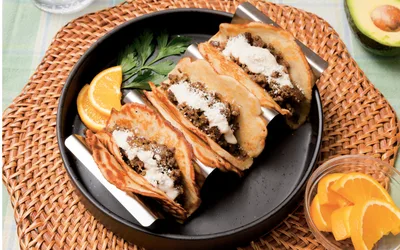
New this year is RAPA's Scrapple Centennial Serving, a ticketed event Saturday from 11 a.m. to 1 p.m. at the company's Cannon Street gate entrance. The chef-inspired menu steps well beyond the frying pan: scrapple smash burgers, scrapple tacos, scrapple breakfast bake, and scrapple cinnamon buns. It is a fitting capstone for a company that has spent the past several years trying to reach younger consumers who may not know how to cook scrapple or think to use it as an ingredient. RAPA has been producing instructional videos for social media and encouraging home cooks to treat scrapple as a protein that can slide into dishes traditionally made with chicken or other meat. Hot 'n Spicy scrapple, Seefried suggests, works well in tacos.
The Food Bank of Delaware has gotten in on the act too. Its 14-week culinary training program holds a scrapple competition twice a year, with students turning blocks of RAPA into lasagna, stuffed peppers, tacos, and scrapple-and-sweet-potato muffins topped with a hot honey crumble. Scrapple French toast took a first-place prize.
For the uninitiated, Seefried's advice is to focus on texture. "It's the crispiness, soft center, and spice profile, really," she said. Start with a quarter-inch slice, which generally yields a crisp exterior and a softer middle. A griddle or skillet works; so does an air fryer or oven. RAPA's tip for first-timers is to lay a slice in a shallow waffle iron rather than a deep Belgian-style model and run the crisping cycle. The result comes out ridged and pocketed, ready to catch maple syrup, yum yum sauce, or hot sauce.
Not every diner will be converted, and that is fine. Scrapple has survived for centuries and RAPA for a hundred years without universal approval. In Delaware, the arguments over brands, thickness, toppings, and texture are not a threat to its popularity. They are the proof of it.
And once a year, in a small town in Sussex County, all of that argument turns into a street party — free to enter, run by neighbors, and built on the two things Bridgeville has always grown best.