


Every October, a quiet stretch of southern New Castle County stops being a place people drive through and becomes a place they drive to. The Blackbird Creek Fall Festival, held at the Blackbird Creek Reserve in Townsend, is the annual open house for one of Delaware's least-known but most important pieces of protected coastland. In 2026 it falls on Saturday, October 17, running from 10 a.m. to 4 p.m., free and open to anyone who shows up.
The festival is hosted by the Delaware National Estuarine Research Reserve, known as DNERR, the state-federal partnership that manages the site. Its stated purpose is stewardship of the Delaware Bayshore, and it pursues that goal the way good outreach usually does: by making a marsh interesting enough that people want to protect it. Recent festivals have offered tractor-pulled hayrides through the reserve, informational booths and displays, wares from local artisans and vendors, kid-focused crafts built around the outdoors and autumn, and an estuary scavenger hunt along the trails. There is also a great deal of running and playing in the open air.
What makes the setting worth the trip is what the reserve actually is. Blackbird Creek Reserve occupies more than 400 acres of tidal marsh, uplands and woodlands along Blackbird Creek, upstream from Delaware Route 9 at Taylors Bridge. It sits on the Delaware Bayshore Byway and includes several miles of trails through uplands and along the marsh, a pavilion, and a canoe and kayak launch. It is also a working laboratory: the reserve hosts restoration demonstration areas, including a living shoreline, a native pollinator garden and native tree plots, and supports ongoing research, monitoring, field studies and citizen science. The grounds are open dawn to dusk, seven days a week, free of charge, though hunting-season closures occasionally shut some areas.
The reserve's backstory explains why a state would build a festival around a creek. DNERR is a cooperative program between the State of Delaware and the National Oceanic and Atmospheric Administration, and it is one of roughly 30 National Estuarine Research Reserves around the country. Delaware's reserve has two main components: the St. Jones Reserve near Dover and Blackbird Creek near Townsend. DNREC manages the reserve under a five-year management plan, most recently updated for 2022 through 2027.
That dual identity, part public park and part research station, is what the fall festival is designed to communicate. A marsh can look like empty land to a passerby. The festival's bet is that a child who takes a hayride, makes a craft and hunts for estuary clues will grow up understanding that the same ground is habitat for birds and fish, a filter for cleaner water, and a buffer against rising seas.
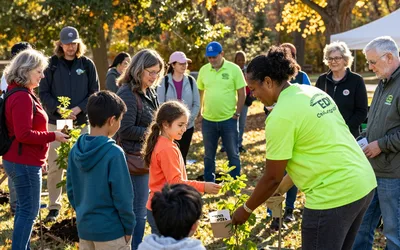
This year's festival adds a second, more tangible piece of stewardship. The Tree for Every Delawarean Initiative, or TEDI, will be on hand to distribute 200 free native trees for recipients to plant in Delaware. TEDI is part of the state's broader climate response. Governor John Carney launched the program, and it was written into Delaware's Climate Action Plan as a strategy for expanding urban greenspace. The program formally launched with a tree planting at Lieutenant Joseph L. Szczerba Memorial Park near New Castle, where Carney, DNREC Secretary Shawn Garvin and Department of Agriculture Secretary Michael Scuse put shovels in the ground. Its goal is disarmingly literal: plant at least one tree for every Delawarean. The state's small size, leaders argued, makes the ambition plausible even with a population near one million. TEDI is a partnership that includes DNREC's Division of Climate, Coastal and Energy and the Urban and Community Forestry programs of the Delaware Forest Service, and residents who plant trees can log them in a public TEDI tracker.
Handing out 200 native trees at a fall festival is a small gesture next to that statewide goal, but it fits the occasion. The trees go home with families who will plant them in Delaware soil, extending the reserve's work past its own boundary lines and into backyards across the state. It is the same logic the festival runs on: bring people onto the land, show them why it matters, and send them home with something that keeps growing.
For anyone planning to attend, the practical details are simple. The festival is free, and it happens rain or shine. It is held on the third Saturday of October each year, which places it on October 17 in 2026. The reserve is at 801 Blackbird Landing Road in Townsend. Questions go to the Delaware National Estuarine Research Reserve at [email protected] or 302-739-6377. The tree giveaway is first come, first served, so arriving early is the safer bet for anyone who wants to leave with a sapling.
There is a certain symmetry to the timing. October is when Townsend briefly fills up, when the roads that normally carry local traffic and the occasional tractor pick up cars with out-of-state plates. The Blackbird Creek Fall Festival is the first of those weekends, and it is the quietest and most local of them. It is also the one that asks the least of visitors and offers, in return, a hayride through a marsh, a scavenger hunt, and a free tree to take home and plant.