


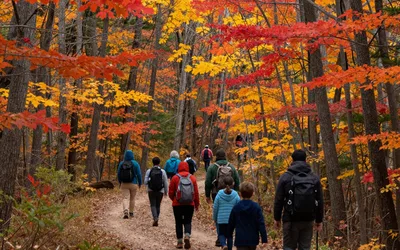
On the evening of Tuesday, Oct. 20, 2026, a small group will gather in a gravel lot off Blackbird Landing Road in Townsend, spray themselves down with bug repellent, and walk into the woods. The occasion is DNREC's Fall into the Forest Hike at Blackbird Creek Reserve, a free, hour-long guided walk that begins at 5 p.m. and is timed, more or less, to the moment when the tidewater woods of southern New Castle County start to turn.
The premise is simple: participants are invited to look at the changing trees and landscape while learning about native plants, the local estuary, and some of the reserve's resident wildlife. Bug spray is recommended, and pre-registration is required, with registration opening Sept. 1, 2026.
What makes the walk worth more than a pleasant hour outdoors is where it happens. Blackbird Creek Reserve is one of two components of the Delaware National Estuarine Research Reserve, the other being the St. Jones Reserve near Dover. The Delaware reserve was designated in 1993 and is managed by DNREC in partnership with NOAA as part of the National Estuarine Research Reserve System, a national network of protected coastal areas used for research, monitoring, education and stewardship. The system as a whole protects more than a million acres of estuarine land and water; the Delaware reserve accounts for roughly 6,364 acres of that total.
The two halves of the Delaware reserve are deliberately different. The St. Jones component is dominated by the salt marsh and open water of the Delaware Bay. Blackbird Creek, by contrast, is a freshwater-influenced system of wetlands, ponds and forest land, which is precisely why a fall tree walk makes sense there. The creek itself rises near Dexter Corners and runs about 16 miles before emptying into Delaware Bay roughly two miles north of Taylors Bridge. Along the way it passes through the reserve's tidal marshes, uplands and woodlands, a mix that supports bald eagles, great blue herons, otters and deer, among much else.
The reserve is also a working landscape rather than a fenced-off exhibit. Its Blackbird Creek component hosts a series of restoration projects, including a living shoreline, a native pollinator garden and native tree plots. That matters for a hike billed around native plants: the things participants will be looking at are, in several cases, the deliberate result of years of replanting and habitat work rather than whatever happened to grow there. A reserve master plan prepared for the site notes that the land has been valued since it was originally granted to settlers in the 1600s, and that the goal now is to restore and preserve it for the coming decades.
The setting is easy to reach and easy to miss. The reserve sits in southern New Castle County along the Delaware Bayshore Byway, a designated National Scenic Byway, and it is open daily with no entry fee, no ticket booth and no long lines. The parking area is modest. For a state-run research reserve, the operation is notably low-key, which is part of the appeal for a program like this one.
There is also a bit of local lore attached to the creek, which tends to surface in any long conversation about the place. Stories hold that an infamous pirate once traveled Blackbird Creek and perhaps left something behind. Treat that as folklore rather than fact, but it fits the character of a tidal creek system that has been used and worked for centuries and still feels remote a few minutes off the highway.
The timing of the hike is worth noting for anyone planning to go. A 5 p.m. start on Oct. 20 puts the walk in late afternoon light, with sunset coming roughly an hour after the hike is scheduled to end. That is a good window for seeing the landscape change, and a good window for mosquitoes and other insects, which is why the bug spray advice is not boilerplate. Participants should plan on about an hour on the trails, wear shoes they don't mind getting damp, and register in advance once the Sept. 1 window opens.
For Delawareans, the Fall into the Forest Hike is a low-stakes way into a place that functions as a laboratory, a restoration site and a public park at once. The reserve's education team runs guided walks through the year, but this one is built around the season itself, when the forest over a tidal creek does the thing it does every autumn. All it asks is an hour, a registration, and a willingness to look up.