


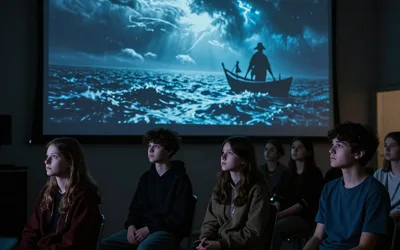
The DuPont Nature Center sits at the end of Lighthouse Road, east of Milford, where the Mispillion River and Cedar Creek meet before sliding out into the Delaware Bay. For most of the year it is a place people come to look at living things: horseshoe crabs crowding the shallows in spring, red knots dropping out of the sky after a 9,000-mile flight, ospreys on a live camera feed, diamondback terrapins in indoor tanks. On the afternoon of Friday, October 23, 2026, the center will turn its attention to the dead instead.
"Dark Tales of the Delaware Coast" is a special Halloween program, scheduled for 2 p.m. According to DNREC's event listing, it covers "stormy seas, disappearing sailors and harrowing historic tales from our long-lost past," and promises "a much different perspective of this 'quiet' coastline." The framing is a deliberate provocation. The Delaware coast has a reputation for stillness, at least in the popular imagination, and the program's opening line is a challenge to it: "So, you think the Delaware coast is a quiet place?"
The program is recommended for ages 12 and older because of what the state describes as complex material and themes. There is no admission charge and no registration requirement listed; the center's general number, 302-422-1329, is the contact for questions. Admission to the DuPont Nature Center is free and it is open to the public, operated by the DNREC Division of Fish and Wildlife.
That the talk happens here, rather than at a historical society or a museum, is part of what makes it worth the drive. The center's own staff have been digging into this history. In September 2024, the Slaughter Beach Historical Society published a piece on the lighting of the Mispillion Lighthouse written by two guest authors from the DuPont Nature Center: manager Patrick Ruhl, who studied history at Flagler College and UC San Diego, and Joseph Linsenmeyer, then a student at Johns Hopkins University and the center's 2024 summer historical intern. Their article, drawn from Delaware Archives material, is a compact demonstration of how much trouble the supposedly quiet coast has seen.
Congress authorized $1,500 for a lighthouse at the Mispillion River on March 3, 1831, to guide vessels into the inland port of Milford, where more than 400 ships, mostly sloops and two- and three-masted schooners, had been built and christened over the years. Prolific lighthouse builder Winslow Lewis signed the contract that August; the land was bought from Governor Charles Polk and his wife Mary Elizabeth for the token sum of $5. The light was completed by October 19, 1831, with Thomas Carlisle as its first keeper. It did not last. An 1838 inspection by William D. Porter found the structure, like so many of Lewis's, "badly built and nearly in ruins." Porter's report also sketched the navigational nightmare the light was meant to solve: Mispillion Creek could only be entered around high tide, when it held about nine feet of water at its mouth. At low tide there were two feet, and the shoals running two miles offshore had barely more.
A second light followed, then was torn down in 1859 after a report to Congress judged it unnecessary given the shallow entrance. For thirteen years mariners had no light at the mouth of the Mispillion at all. After years of complaints, Congress approved $5,000 for a third lighthouse, which was lit on June 27, 1873, and served for more than fifty years. It was replaced by a steel tower beacon in 1929 and sold to a private owner in 1932 for $400. It stood at the mouth of the Mispillion for another seven decades, until lightning struck it and it burned on May 2, 2002. What remained was sold again, and portions were eventually restored and moved to Shipcarpenter's Square in Lewes, where the structure stands today, a lighthouse that outlived its own harbor.
The wider Delaware Bay has its own catalog of disasters. The most famous is HMS De Braak, which entered the bay on May 25, 1798, with a captured Spanish prize alongside. A pilot came aboard to take the warship up the Delaware River, thick with shoals and shifting currents. Captain James Drew reportedly told the pilot, "I've had luck." A sudden storm then threw the De Braak onto its side and waves swallowed it; more than 45 men died, including the captain. Over the next century, efforts to find the wreck failed, and some blamed a "bad weather witch" said to use storms to thwart treasure hunters. Disasters off the state's coast were common enough in the 19th century that the federal government commissioned lifesaving stations, lighthouses and breakwaters in response.
Even the place names along this shore carry a chill. Slaughter Beach, the town nearest the nature center, dates to the 1681 and was incorporated in 1931; its own website does not state an official origin for the name, which has kept speculation alive for generations. It is the kind of unresolved detail that a program like this one exists to play with.
And the setting itself is a reminder that the coast is not tame. The DuPont Nature Center opened in May 2007, a $2.1 million wildlife observatory and interpretive center at the Mispillion Harbor Reserve, built to support the estuary's ecology and the creatures that depend on it. Its deck overlooks a harbor that has silted, shifted and swallowed ships; its tanks hold animals that live in water that has, on many occasions, killed people. The center's live cameras point at ospreys and at the harbor, a form of watching that is usually cheerful. In October, for an hour, the watching turns to what the harbor has taken.
For anyone who has only seen the Delaware coast in summer, the program's premise is the draw: the same water, the same marsh, the same low horizon, read against a record of wrecks, fires, failed lighthouses and men who went out and did not come back. The state's own description keeps the specifics close, promising only stormy seas and disappearing sailors, which leaves room for the stories the staff have turned up in the archives. What is certain is the date, the time and the room: 2 p.m. on Friday, October 23, 2026, at 2992 Lighthouse Road, Milford. The rest is history, and the darker parts of it are the point.