


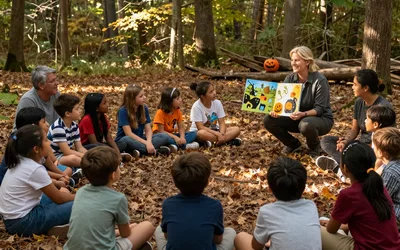
By late October, the DuPont Nature Center at the Mispillion Harbor Reserve has gone quiet. The center's regular public season ends in September, and from October through March the building is closed to general admission, opening only for special events and programs. That makes the center's Storybook Saturday (Spooky Edition!) something of a rare invitation: on Saturday, October 24, 2026, at 11 a.m., the doors open for story time with the center's naturalists, followed by a hands-on activity pitched at kids and their grown-ups alike.
The event is small and simple by design. There is no ticketing gauntlet described in the state's listing, no cost attached, and no requirement beyond showing up at 2992 Lighthouse Road with children in tow. The naturalists read a Halloween-themed story, then lead an activity. That is the whole of it, and it is enough.
What makes the setting worth the drive is the place itself. The DuPont Nature Center sits on the edge of Mispillion Harbor, and it exists because of one of the strangest and most consequential wildlife spectacles on the East Coast. Each spring, Delaware Bay hosts a major spawning aggregation of horseshoe crabs. The crabs haul themselves onto the bay beaches to lay their eggs, and those eggs in turn fuel one of the great migrations in the bird world: red knots, shorebirds that fly roughly 9,000 miles from wintering grounds in South America to breeding grounds in the Arctic, arrive on these beaches at dangerously low weights and depend on horseshoe crab eggs to double their body mass before the final leg north.
The center's own history is bound up in that cycle. State environmental officials recognized the value of the bird-and-crab spectacle and in 2005 purchased an old restaurant and marina overlooking the harbor, using money from a wetland restoration fund, and converted the property into an interpretive facility. The building's large deck, looking out over the harbor, offers an unparalleled view of the spring spectacle of spawning horseshoe crabs and migrating shorebirds, including federally-listed threatened red knots. Inside, exhibits explain the environmental and historical importance of the Mispillion Harbor, and saltwater tanks hold live species including horseshoe crabs and diamondback terrapins. A statue of a red knot stands at the entrance.
The center is managed by DNREC's Division of Fish and Wildlife. Its seasonal rhythm is set by the wildlife: it reopens each spring, typically on April 1, with April hours of 9 a.m. to 4 p.m. Wednesdays and Saturdays; expands to Tuesday through Saturday from May through August; contracts back to Wednesdays and Saturdays in September; and then goes dark for general admission from October through March. In 2026 the center also unveiled a new environmental art exhibit created with community help, part of an effort to connect visitors to the local environment with the center at its heart.
That seasonal shutdown is precisely what makes an October program notable. The spooky edition of Storybook Saturday is not a festival or a fair; it is a state nature center using its off-season to bring families back onto the deck and into the exhibits for an hour. The timing is fitting in its own way. Halloween is a holiday built on things that scuttle and lurk, and the Delaware Bay's most famous resident is a creature that looks prehistoric because, in a sense, it is — a living fossil whose lineage long predates the dinosaurs and whose eggs hold up an entire hemisphere's worth of migrating birds.
For families in Milford and the surrounding towns, the practical appeal is straightforward. The program is free, it is indoors and outdoors at once, and it gives kids a reason to be in a nature center in a month when the nature center would otherwise be locked. The center asks only that grown-ups come along with the kids. Anyone planning to attend can find the listing on DNREC's events calendar, where the state posts its seasonal programs at the Mispillion Harbor Reserve.
What the story will be, the state has not said. The listing promises only "a special Halloween-themed story" and "a fun activity that is great for kids (and their grown-ups)." Given the venue, it is a fair bet the naturalists will find a way to work in something with claws.