


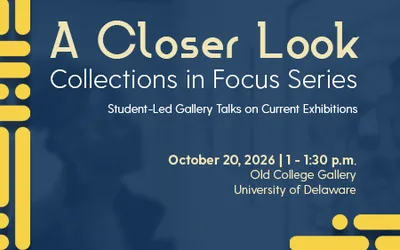
For half an hour on an October afternoon, the University of Delaware Museums are asking visitors to do something that museums rarely ask of them: stop moving. A Closer Look: Collections in Focus is a new series built around a single object at a time, and its first installment runs from 1 to 1:30 p.m. on October 20, 2026, in Old College Hall on the university's Newark campus. The premise is deliberately modest. An undergraduate gallery attendant leads an informal conversation about one work of art or mineral specimen currently on view. No prior knowledge is required, and the museum's own invitation is simply curiosity and a willingness to look a little closer.
The inaugural conversation will be led by Laurel Huntley, a junior majoring in art history, and it centers on Daybreak in Alabama by Phoebe Beasley. The piece is on view in the Old College West Gallery as part of The People Could Fly: Black Religion, Spirituality and Liberation, an exhibition on view from September 1 through December 8, 2026, and guest curated by Qiaira Riley, a graduate research assistant with the Museums. Registration is encouraged but not required, and the program is open to students, faculty, staff and community members alike.
The Beasley work rewards exactly the kind of slow attention the series is designed to produce, because its backstory is layered. Daybreak in Alabama corresponds to a Langston Hughes poem of the same name. In the poem, Hughes describes the type of music he would write about if he were a composer, writing of 'white hands and black hands and brown and yellow hands and red clay earth hands in it, touching everybody with kind fingers.' Beasley interpreted those lines as a cluster of embracing figures, using various colors of collage material to show variation in skin tone and patterned papers for the figures' garments. The figure on the right, in purple overalls, might be Hughes himself, shown holding a pencil and writing music notes on a page.
The collages were made for a collaboration with Maya Angelou, a close friend and mentor to Beasley. In 1998 the two completed a limited-edition book titled Sunrise is Coming After While, for which Angelou selected a series of Hughes poems and wrote a foreword while Beasley illustrated them with a corresponding series of collages. Those images were then printed as serigraphs, or silkscreens, for the book. Beasley also printed her six serigraphs as an unbound collection, and an edition of that set is held in the University of Delaware Museums Collections. A copy of the book itself lives in the library's Special Collections. The version on the gallery wall, then, is the visible end of a chain that runs from a Hughes poem through an Angelou anthology to a Beasley collage and finally into a print portfolio that the university owns.
Beasley's larger career gives the picture additional weight. The Los Angeles-based collage artist is the only artist to have received the Presidential Seal on her work twice: she was commissioned to create official artwork for the 1989 inauguration of George H.W. Bush, and in 1993 President Clinton presented ambassadors of the Diplomatic Corps with her monoprint Clinton Inaugural, which carried the seal. In 2012 she was one of forty-four artists commissioned to make a collage on a life-size bust of Barack Obama. Her work has appeared in the Smithsonian's In the Spirit of Martin, honoring the legacy of Martin Luther King Jr., and in the touring exhibition Portraying Lincoln: Man of Many Faces.
The exhibition around the work is equally considered. The People Could Fly takes its title from the title story in Virginia Hamilton's 1985 collection The People Could Fly: American Black Folktales, which explores the legend of the flying Africans, figures who recur across the African diaspora and are often read as an expression of longing to return home, whether that home is an ancestral land, the afterlife, or a space associated with the possibility of freedom. The show surveys art representing American, Caribbean and African spiritual traditions, moving across indigenous African spirituality, Voodoo, Islam and Christianity, and reads Black religious traditions as journeys toward a present or eventual spiritual home where freedom is shared.
The setting for all of this is itself a piece of history. Old College Hall, at 18 East Main Street in Newark, is the historic heart of the university. The school traces its origins to Francis Alison, who established the Newark Academy in 1765 after transplanting a free school he had begun in New London, Pennsylvania, in 1743. Alison wanted the academy to become a full college, but it took until 1833, half a century after his death, for the trustees to secure a charter for Newark College. The trustees hired Winslow Lewis of Boston, better known today for building more than a hundred lighthouses, on the strength of architectural designs Harvard had commissioned from him. Lewis chose a Greek Revival design influenced by William Strickland's United States Naval Asylum in Philadelphia. According to Delaware historian John A. Munroe, the groundbreaking was notably short on ceremony: Manlove Hayes, then a student at the academy and later a college trustee, was playing around the open trenches for the foundation when the mason handed him a brick, showed him how to set it in the corner, and told him he could always remember that he had laid the first one.
That a junior art history major will stand in that building and guide strangers through a single print is the small innovation here. The series is free, drop-in in spirit, and short enough to fit between classes, and future installments will turn the same format on mineral specimens as readily as on artworks. The museum's pitch is a question rather than a promise: what happens when we slow down and spend a little more time with a single work of art? On October 20, the answer begins with a group of embracing figures drawn from a Langston Hughes poem, and thirty minutes to notice them.