


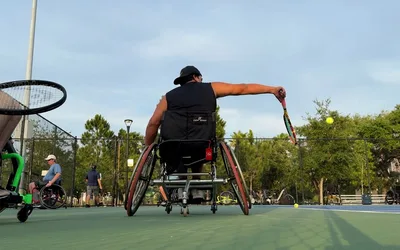
The sun is dropping behind the Hillsborough River, and the downtown Tampa skyline is beginning to glow across the water. On the tennis courts at Julian B. Lane Riverfront Park, a familiar Monday night ritual is underway. Chairs spin, racquets swing, and yellow balls arc through the humid Florida air. This is wheelchair tennis night, and for the athletes who roll onto these courts week after week, it is far more than a workout.
"It's a big part of everyone's life and even mine," said Andrew Sheets, the site supervisor who has led the program for a decade. "It's the one thing that I really look forward to every week."
The City of Tampa Parks and Recreation Department has offered this free wheelchair tennis class for more than ten years, and what began with just two or three participants has grown into what Sheets calls the biggest program of its kind in the state of Florida. On any given Monday, between eight and thirteen athletes roll through the gates, some traveling more than an hour from communities like Valrico and Riverview to get here. They come for the sport, but they stay for something harder to name.
Kylie Schalz knows that feeling well. A former Division I softball player at Oakland University, Schalz spent her childhood battling scoliosis that worsened during her college years. When she went in for back surgery, she woke up to a life she never expected. "In the middle of it, my surgeon paralyzed me from the chest down," she said. "I was told I could never walk again. I woke up, couldn't move or feel anything."
The hardest part, she remembers, was watching her college teammates still compete while she sat on the sidelines. "Seeing my teammates still go out and compete every day, and losing that, it was like losing who I was." After five years of legal battles, a court ruled her case medical malpractice. Fifteen years later, she can walk with a cane, but the competitive fire never left. She has been coming to this class for two years now, and it has given her back something she thought she had lost forever. "To be able to get back on a court and compete and just be competitive with people in the same community as me and same situation that I'm in," she said, "it's just a really awesome opportunity that Tampa provides."
David Corredor's path here was different. A recreational lobstering trip in the Florida Keys took a terrifying turn when chest pains sent him to an emergency room. Doctors discovered his aorta had ruptured, and he was flown to Jackson Memorial in Miami for open heart surgery. During the procedure, he suffered a spinal stroke that left him paralyzed from the T4 level down. That was three and a half years ago. Tennis, he said, felt like a natural sport to return to, and this program gave him a way to keep playing. "It's not every day that you get to interact with other wheelchair users in your area," Corredor said. "This program has been a great way to meet people who understand similar challenges and experiences. It connects us through sport, but it also builds a sense of community and support."
The class runs from 7 to 9 PM, with the first hour devoted to drills and the second to competitive games. Players need only a Rec Card, which costs $15 annually, and the city provides everything else: sports wheelchairs, racquets, and tennis balls. Six sports chairs are available for those who don't have their own. All skill levels are welcome, and Sheets is evangelical about recruiting new players. "We lose, sadly, a lot of wheelchair athletes to other sports," he said, "but I want to tell anyone who's new and thinking of doing this class to please just try it out once, and I know I can get you hooked."
For Sheets, who has kept the program growing for a decade and has sought out wheelchair training, clinics, and classes from the USTA, the work is personal. "The best part is seeing the smiles on everyone's faces," he said. "We've become close friends, almost like a family." Tampa Parks and Recreation Director Ted Fowler praised Sheets's commitment, calling him "another example of the staffers we have who are committed to helping others."
The group doesn't just practice together. They have traveled around the country to compete in wheelchair tennis tournaments, strengthening their team chemistry and bringing home trophies. In March, they host a tournament at Julian B. Lane, where players compete in singles, doubles, or both, across four skill levels. For athletes like Tracy Wilkerson, a Valrico resident who has been a regular for years, the program is a lifeline. For Corredor, it's a mission. "Every time I see somebody in a wheelchair or somebody that's an amputee," he said, "I try to get them to come out here just by saying, 'Hey, you should join our wheelchair tennis.'"
On a recent Monday night, Sheets watched as new players fit right in with the veterans, the group's easy camaraderie on full display. "Just the appreciation, they don't have to say it; I just feel it," he said. "It's an honor to do this class."
Monday nights at the park started as just a class. But it has become something more. A place where athletes who lost so much can find themselves again, one bounce at a time.