


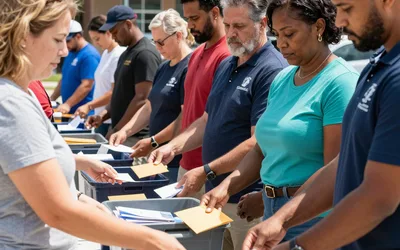
On a Saturday morning in October, the parking lot of the Broward Sheriff's Office district station on North Dixie Highway will fill with the quiet evidence of modern life: shoeboxes of bank statements, grocery bags of expired pill bottles, the odd accordion folder of tax returns from a decade nobody wants to revisit. From 10 a.m. to 1 p.m. on October 10, 2026, the City of Oakland Park and the Broward Sheriff's Office will host a free Shred-A-Thon and Operation Medicine Cabinet, a drive-up drop-off that lets residents destroy sensitive documents and surrender unwanted medication in a single trip.
The premise is simple and the stakes are not. Identity theft and prescription drug misuse are two of the more persistent hazards of ordinary household clutter, and both tend to hide in plain sight. A discarded credit card offer can be enough to open a fraudulent account. A half-empty bottle of painkillers left in a bathroom cabinet can find its way into the hands of a teenager, a houseguest, or someone struggling with addiction. The event is designed to close both doors at once.
What makes the pairing notable is that it grew out of a genuine crisis. Broward County had become, in the words of one former sheriff, "ground zero for prescription drug abuse." The county found itself a destination for out-of-town visitors who came for the sole purpose of buying and abusing powerful pain medication, drawn by a proliferation of illegitimate pain clinics known as pill mills. The supply of dangerous narcotics flowing through South Florida was enormous, and the consequences were measured in overdose deaths and the criminal activity that trailed them.
The response was not a single raid or a single law. The Broward Sheriff's Office built a three-pronged program it called Operation Medicine Cabinet. One arm targeted pill mills and prescription drug traffickers through law enforcement. A second delivered educational presentations to schools and community groups about the dangers of prescription drugs. The third, and the one that still shows up in church parking lots and flea market lots across the county, was the drug take-back event, a recurring invitation to empty the medicine cabinet safely.
The scale of the problem the program was built to address is hard to overstate. Federal prosecutors in Miami announced in August 2011 that thirty-two defendants, including thirteen doctors, had been charged in a coordinated pill mill takedown involving clinics in Broward and Palm Beach counties that had prescribed more than 20 million pills and profited by more than $40 million. The indictment described a system in which Schedule II painkillers such as oxycodone caused more overdose deaths than cocaine and heroin combined. Florida's toll was grim and specific: on average, eight people in the state died every day as a result of prescription drug abuse, and many of the victims were young.
Over time, the aggressive law enforcement push worked. Many of the pill mills that once plagued the community were shut down, and the title that had haunted Broward County no longer stuck. But the take-back events never stopped, because the medicine cabinet problem did not disappear with the clinics. Prescriptions still accumulate in homes. Patients still stop taking medications before the bottle is empty. And the safest place for those leftovers is not the trash, the toilet, or the back of a drawer.
The Shred-A-Thon half of the event has a parallel logic. It is run in partnership with the Sheriff's Foundation of Broward County, a 501(c)(3) nonprofit founded in 1999 whose mission rests on four pillars: anti-terrorism, fallen heroes, training, and crime prevention and civic education. The foundation's stated goal for the shredding events is blunt: prevent identity theft. Residents are invited to bring personal documents, check stubs, credit card offers, receipts, and any other material containing sensitive information, and to watch it be destroyed on site rather than trusting it to a curbside recycling bin.
The events are held regularly across Broward County, rotating through cities and venues. Past editions have taken place at the Festival Flea Market Mall and the Parkland Equestrian Center, among other locations, and the format has stayed remarkably consistent. At some events, participants who turn in prescription drugs receive a $5 gift card courtesy of the Sheriff's Foundation, while supplies last and limited to one per family. Organizers typically cap the shredding at a set number of boxes per person so the line keeps moving, and they routinely remind attendees that needles, sharps, and other medical items cannot be accepted, for the safety of the staff handling the collection.
The Oakland Park edition will run at the BSO district office at 5399 North Dixie Highway, a stretch of road that has itself been part of the region's story. Old Dixie Highway runs through a corridor that has seen Oakland Park evolve from a quieter bedroom community into a denser, busier city, and the sheriff's district station sits along it as a visible county presence. Hosting the event there is a small statement: the same agency that once chased traffickers down the highway now opens its parking lot on a Saturday so residents can hand over the things they no longer want and no longer know how to safely get rid of.
There is no ticket, no reservation, and no fee. The event is open to the public and runs for three hours. Residents can bring documents to shred and medications to dispose of, or just one or the other. The sheriff's office and the city frame it as a partnership, and the framing is accurate in a practical sense: the city promotes it, the county provides the site and the personnel, and the foundation helps underwrite the incentives that draw people in.
For anyone who has ever stared at a filing cabinet or a bathroom shelf and felt the low-grade guilt of not dealing with it, the appeal is obvious. But the event's real value is cumulative. A single shredding event does not end identity theft, and a single take-back day does not end an overdose epidemic. What they do is remove a specific, tangible risk from a specific, tangible place, one car at a time, and repeat the exercise often enough that it becomes a habit rather than a chore. On October 10, the habit is available again, free of charge, from 10 a.m. to 1 p.m. at 5399 North Dixie Highway.