


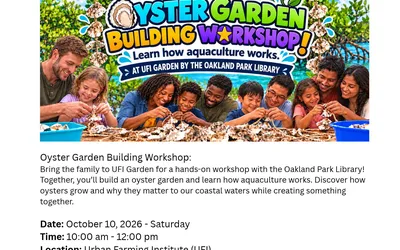
On a Saturday morning in October, a small patch of green in Oakland Park will host a workshop about the sea. The Urban Farming Institute's garden at 1101 NE 40th Court, tucked just north of Jaco Pastorius Park, will welcome families from 10 a.m. to 12 p.m. on October 10, 2026, for a hands-on session with the Oakland Park Library. Together, participants will build an oyster garden and learn how aquaculture works — how oysters grow, and why they matter to the coastal waters that define this stretch of South Florida. No registration is required. Anyone can simply show up.
The premise is unusual for an inland city garden, and it is the kind of thing that only makes sense once you know the history of the place hosting it. The Urban Farming Institute is a 501(c)(3) nonprofit founded in 2012 by Jon Albee, a man who, as one tribute put it, could grow anything. Albee died in September at 78, but the institute he started has spent more than a decade turning underused land into community gardens and turning curious visitors into gardeners, farmers, and, in a few notable cases, marine scientists.
The institute's mission is broad: hands-on education in agroecology, nutrition, science, and environmental stewardship. It builds gardens in schools, teaches hydroponics and aquaponics, and runs free classes every Saturday morning for community gardeners, families, and anyone who wants to learn about gardening, healthy eating, and the local environment. It describes itself as a regional education, demonstration, and resource center for people interested in growing food in an urban setting. But the thread that runs through its programming has always been a willingness to follow curiosity wherever it leads — including out to sea.
That marine streak is not incidental. Stacy Brown, a marine biologist and UFI educator, discovered the institute in 2015. She recalled that it did not take long before everyone there was trying to find ways to add ocean sciences and a coral garden to the already expanding aquaponics, hydroponic, and raised-bed garden programming. One of Albee's favorite projects was installing marine labs to grow algae and corals, and to give a local high school student a place to study Karenia brevis, the marine microbe that causes red tide. Another graduate student used the same lab to study the nutritional components of seaweed. Albee himself talked up plans for seaweed farming at the facility.
So an oyster garden workshop is less a departure for UFI than a continuation. The institute has long treated the boundary between land and water as something worth crossing, and the Oakland Park Library's partnership extends that instinct into a public, family-friendly program.
For anyone who has never encountered the idea, an oyster garden is exactly what it sounds like: a small, personal oyster reef, usually grown from juvenile oysters attached to shell and suspended off a dock or piling. The practice has become a mainstay of coastal restoration efforts around the country. In the Chesapeake Bay, the Chesapeake Bay Foundation trains hundreds of community members to grow native Eastern oysters, Crassostrea virginica, alongside their docks and then helps plant them on restoration reefs. Closer to home, the Restore Our Shores program in Florida's Indian River Lagoon trains lagoon-front residents to become oyster gardeners, giving them shell covered in juvenile oysters — known as spat — to grow off their docks and pilings for roughly six to nine months. The data those volunteers collect helps identify the best locations for building new reefs, and the oysters themselves are later collected and used to establish populations on restoration reefs. That program has grown more than 500,000 live oysters.
The reason oysters attract this kind of effort is that they are, functionally, living water filters. A single oyster pumps water across its gills, straining out algae, sediment, and other particles. Dense concentrations of them — reefs — filter enormous volumes of water and, in the process, remove nutrients that would otherwise fuel algal blooms and cloud coastal waters. Reefs also provide hard, structured habitat in estuaries that are otherwise dominated by soft bottom and fine sediment, giving fish, crabs, and other organisms places to feed and hide. In an era of nutrient pollution and declining water clarity, restoring oyster populations is one of the few interventions that improves water quality and biodiversity at the same time.
That is the lesson the October workshop is built around. Participants will learn how oysters grow — the arc from free-swimming larvae to spat settling on shell to the clustered reefs that once lined so many Florida estuaries — and why those reefs matter. Then they will build something together, which is the part that tends to stick. The institute's own story is full of people who arrived for one reason and stayed for another: an educator who came to a hops-growing conference and within a year was tending more than 60 hop plants; a marine biologist who came in 2015 and helped push the farm toward ocean science; a founder who answered backyard gardening questions and kept marine labs running in the same compact patch of green.
The workshop is free, open to families, and requires no sign-up. The garden sits at 1101 NE 40th Court in Oakland Park, and the city asks that anyone seeking more information call 954-630-4372. For a couple of hours on a Saturday morning, an urban farm will teach its visitors to think about the coast — and to build a small piece of it themselves.