


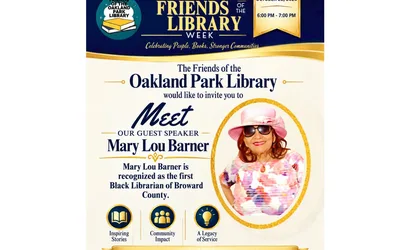
On a Thursday evening in late October, the Oakland Park Library at City Centennial Park will hand over its meeting room to Mary Lou Barner, the guest of honor at an hour-long program titled "Meet Mary Lou Barner: Library Pioneer," scheduled for 6 to 7 p.m. on October 22, 2026, at 3900 NE 3rd Avenue.
The event is free and open to the public, with no ticket and no stated capacity limit, which is worth noting. Library history talks tend to be small, quiet affairs, the kind of thing that fills a room with people who already know why they are there. This one is a little different, because the subject is not a building or a collection but a person the city is presenting as a library pioneer.
That distinction carries more weight in South Florida than it might in a place with a longer and more visible record of integration. Broward County was created in 1915, carved out of Dade and Palm Beach counties, and for most of its early decades it was a small, agricultural, and rigidly segregated place. Its public library service grew up inside those rules. Across the South, the standard arrangement was a main library for white patrons and a separate branch, often a converted house or a room in a community center, for Black residents, usually staffed by Black librarians who had trained elsewhere because Florida's library schools would not have them. The people who ran those branches were, by necessity, both administrators and advocates, fighting for book budgets and building space from institutions that treated them as an afterthought.
Barner's career belongs to that generation. The city's event listing does not go into detail about which branch she led, when she started, or how she came to the job, and this article will not guess. What is documented is the recognition itself: Oakland Park, a city of roughly 45,000 just north of Fort Lauderdale, is presenting her as a pioneer of the county's library system, and the framing is deliberate. The word "pioneer" in a library context usually means someone who arrived before the infrastructure was ready for them.
The venue fits the theme in its own way. The Oakland Park Library sits inside City Centennial Park, a nine-acre complex at NE 38th Street and Third Avenue that the city has been rebuilding in stages as part of a long-range plan tied to its 2029 centennial. In June 2021, Oakland Park broke ground on the first phase of the park project, a $5.9 million effort that added a splash pad, playground, and basketball courts and renovated the pickleball courts and concession stand. A second phase was designed to bring a new city library and community center, along with an urban forest, butterfly garden, exercise area, and jogging trail. The library hosting Barner is thus a work in progress in a city that is actively rewriting its civic spaces, which makes an evening devoted to institutional memory feel less like nostalgia and more like a marker dropped for the next generation to find.
For anyone who has spent time in Broward's libraries, the appeal of the program is the chance to hear the story from the source rather than from a plaque. Library desegregation in Florida was not a single dramatic moment but a slow unwinding, branch by branch, budget by budget, often driven by Black librarians who built collections and programs that the system later absorbed and claimed. The people who did that work are now in their eighties and nineties, and the opportunities to hear them speak in public are finite. An hour on a Thursday evening in October is not a lot of time, but it is more than most counties have bothered to set aside.
The program runs from 6 to 7 p.m. at the Oakland Park Library, 3900 NE 3rd Avenue, Oakland Park, Florida 33334. It is free, and no registration is mentioned in the city's listing. Anyone curious about how Broward County's libraries came to look the way they do, or about the woman the city is honoring, can simply show up.