


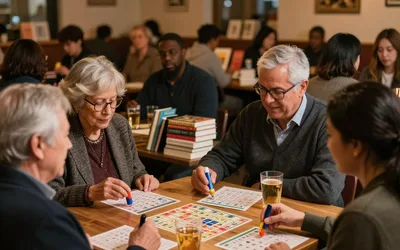
On a Tuesday evening in late October, the taproom at 1170 Manchester Street will smell of apples and sound like a church basement — in the best way. Book BINGO! with International Book Project takes over Wise Bird Cider from 6 to 9 p.m. on October 27, 2026, and the premise is exactly what it sounds like: cider, daubers, a stack of prizes, and a pop-up book fair where nothing costs more than $6.
The mechanics are simple and deliberately low-barrier. Admission is free, bingo sheets are pay-what-you-will, and every round comes with prizes. Two of the rounds are reserved for kids only, which matters more than it might seem at a bar event — Wise Bird's own tasting room is described on its website as a place where children play between tables and dogs stretch out in the sun, so a family-friendly bingo night fits the room's existing personality rather than fighting it. Ten percent of all cider and cocktail sales during the evening go to the International Book Project, and IBP staff and volunteers will be on hand running the book fair.
The pairing is less odd than it first appears, because both institutions were built by people who decided a hobby was worth taking seriously.
Wise Bird is Kentucky's first cidery, founded in Lexington in 2019 by Tim and Greta Wright. He is from Virginia, she from Georgia, and they met — according to the company's own account — over craft cider, Scrabble games, and long road trips through Appalachia. At the time they were living in Washington, D.C., working demanding jobs and spending more time in traffic than at home. Cider-making began as an evening hobby, then turned into an obsession: family vacations became cider pilgrimages, one book on fermentation became a shelf, one cabinet of equipment became a kitchen overtaken by carboys, tubing, and apples. Then came the medals, and eventually a cidery. Wise Bird makes small-batch cider from real apples rather than concentrate, sources fruit as locally and responsibly as it can, and is naturally gluten-free.
The International Book Project has a longer and stranger origin story, and it starts with a woman who went to India and came home with 400 letters.
Harriet Van Meter traveled to India in 1965 with a group of foreign student advisors, by invitation of the U.S. State Department. What she saw there — depending on which account you read, long lines of people waiting simply to borrow a book to study from — convinced her that books and education were the same problem. Back home in Lexington, she wrote a letter to the editor of The Hindu offering to send books to anyone who wrote to her. Within weeks, 400 letters arrived. Her house on Mentelle Park became a collection, storage, and packing center, shipping first to families and then to schools, colleges, and libraries in India, and — as word spread — to countries around the world.
The organization she founded in 1966 is now a registered 501(c)(3) that has sent more than 7 million books abroad and ships roughly 300,000 a year to schools, libraries, churches, and Peace Corps volunteers in the developing world and in the United States. It has operated out of a warehouse it has owned since 1983. In its early decades it also served as a clearinghouse for requests from beyond Lexington: individuals could join for $10 a year and receive a monthly newsletter, and the "Can You Help" column read like a classified page for the whole planet — methane gas production in India, water resources planning in Iraq, marine biology in Tonga, park management in Ghana. A 1980 request from China asked for multiple copies of novels including Lord of the Flies and The Grapes of Wrath, with a note to avoid sex, violence, and anti-communism. Van Meter was nominated for the Nobel Peace Prize in 1986 and was a finalist; Kentucky Educational Television aired a documentary about her, "Harriet Van Meter: A Life Extraordinary," in 2006.
That history is the reason a bingo night in a cidery is a fundraiser and not just a party. IBP's stated mission is to develop lasting relationships with partners worldwide to increase literacy, promote cultural understanding, and open doors to opportunity, and one of its core values is giving books a second life through reuse and redistribution. The pop-up fair at Wise Bird is that value in miniature: cheap books, moving from one set of hands to another, with the proceeds pointed back at the shipping operation.
For anyone planning to go, the practical details are straightforward. The event runs 6 to 9 p.m. on Tuesday, October 27, 2026, at Wise Bird Cider Co., 1170 Manchester St., Ste 140, Lexington. Admission is free and there is no capacity cap mentioned, so the main constraint is arriving early enough to claim a table. Bingo sheets are pay-what-you-will, which means the cost of the evening is essentially whatever you decide it is, plus whatever you spend on cider — a tenth of which goes to the books.
One note for careful planners: the event's own promotional copy says 6 to 9 p.m., while at least one regional calendar listing has shown a 2 to 5 p.m. window in its structured data. The organizer's description is the safer guide, but it is worth confirming on the Facebook event page before making the drive.
What the evening actually offers, beyond the fundraiser math, is a rare kind of civic evening: a bar full of people playing a game whose prizes are books, with two rounds set aside so that the kids in the room get to win something too. Van Meter's 400 letters turned into seven million books. A Tuesday in October at a cidery on Manchester Street is a small, loud, cider-scented installment on that ledger.