


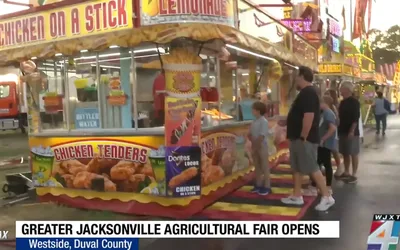
For seven decades, the Greater Jacksonville Agricultural Fair has been a fall ritual with a very particular backdrop: a 14-acre patch of pavement and grass wedged between EverBank Stadium and the baseball park, hemmed in by the traffic and tailgates of the downtown sports complex. This November, that changes. The 71st edition of the fair opened Thursday evening with a ribbon-cutting at the Jacksonville Festival & Fairgrounds off Normandy Boulevard on the city's Westside, beginning an 11-day run through Nov. 15 on a site roughly five times the size of the old one.
The new grounds span 82 acres, with a freshly built road connecting the property directly to the POW/MIA Parkway. State and local dignitaries joined fair leadership and special guests for the ceremony. For Bill Olson, the fair's president and CEO, the moment carried the weight of a long campaign. "It's been a long road to get here, but we're here, and we're open, and we couldn't be more excited," he said.
The contrast with the old site is the story. "The old fairgrounds were crammed in the sports complex, and between some stadiums, it was a little crowded," Olson said. "Here, wide open, room to walk, room to get some food, sit down and eat it." That extra room shows up in the programming: organizers say the number of food vendors has doubled compared with previous years, with options spanning budget-friendly bites to more premium offerings. There are more rides, more animals, more free shows and live music on a new stage.
The move itself was years in the making and was never purely the fair's decision. In 2023, the Jacksonville City Council took up a proposal to relocate the fairgrounds to city property on Normandy Boulevard, next to the Jacksonville Equestrian Center. The Fair Association would lease about 82.37 acres for $200 a year under an initial 40-year term, with three optional 10-year renewals covering an additional 60 acres if the fair needed room to grow. The city was to handle infrastructure improvements, and the relocation was projected at roughly $27 million. The impetus was nearby: Jaguars owner Shad Khan's development company, Iguana Investments, had bought land next to the sports complex, and part of the purchase agreement called for moving the fairgrounds to the Westside. The old downtown property, home to the fair since 1990, is slated to become surface parking to support Jaguars games.
That timeline slipped — the agreement targeted 2025 — but the 2025 fair, the 70th, served as a last hurrah at the downtown site before the gates closed there for good.
The fair's roots run deeper than either location. It was founded in 1955, when the first edition drew more than 45,000 visitors, and it operated for a time as the Duval County Fair. The Greater Jacksonville Agricultural Fair Association, the nonprofit that runs it, received its state charter in 1957 and has been governed by an unpaid board of directors ever since; its first leader was Bill Birchfield, a lawyer and civic figure from the small town of Mayo who majored in agriculture at the University of Florida and later served a term in the Florida House of Representatives. The fair's original home was the Gator Bowl, the stadium now known as EverBank Stadium — meaning this year's move is, in a sense, the second great relocation in its history, and the first time the fair has left the sports complex footprint entirely.
What has not changed is the mission. The fair describes itself as the largest fair or festival in Northeast Florida, with an estimated economic impact on Duval County in excess of $10 million, and it remains an agricultural fair at heart — livestock shows, horticulture, and an education program, AgVentures, built around teaching visitors where their food comes from. The association also awards scholarships. It runs on a small staff and a large volunteer corps; recent figures put staffing at seven and volunteers at about 500.
The new campus is designed to be more than an 11-day fairground. It includes Duval Hall, a large indoor venue built to host concerts, expos, festivals, conventions and community gatherings year-round, and the JAX Amphitheatre, an open-air venue with capacity for nearly 10,000 that makes its debut this year. The fair's 2026 concert lineup leans on that stage, with a different national or regional act each night of the run. Organizers have framed the whole project as a bet that Northeast Florida deserves a year-round entertainment destination on the Westside, next to the equestrian center and Cecil Aquatics Center, rather than a fair that packs up and disappears each November.
Olson, for his part, is measured about the verdict. "We really wanted to build something that Jacksonville and Northeast Florida could be proud of. I think we did that," he said. "We're going to find out here after these 11 days."
General admission tickets are on sale through the fair's website and at the gate, with discounted early-bird pricing offered in advance and daily deal days during the run. Children five and under are admitted free. For anyone who remembers squeezing between stadiums to find the funnel cakes, the appeal of the new arrangement is easy to state: "You can have the animals, the rides, the music, the food, the free shows. Everybody likes something," Olson said. "We just hope they can have multiple things to come to enjoy at the fair."