


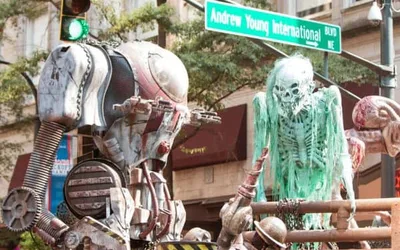
On the first Saturday morning of September, before the Georgia sun fully clears the glass towers of downtown Atlanta, the crowds start to arrive along Peachtree Street. They come carrying strollers and lawn chairs, camera straps around their necks, and children perched on shoulders. By the time the hour strikes ten, the sidewalks are wall-to-wall with tens of thousands of people who have staked their spots since dawn. What they have gathered to see is one of the strangest and most beloved rituals of Labor Day Weekend in the South: the Dragon Con Parade.
The 2026 edition steps off at 10 a.m. on Saturday, September 5, and it arrives with special weight. This is the 40th anniversary of Dragon Con itself, the pop-culture convention founded in Atlanta in 1987 that has grown into one of the largest multigenre fan gatherings in North America. More than 75,000 fans are expected to pack the five host hotels and surrounding streets over the five-day weekend, and the free, public parade is the moment when that vast and gloriously costumed community pours out onto the street for everyone to see. It is, as the convention's own organizers put it, Atlanta's most colorful Labor Day tradition.
The parade's origin is a small, almost throwaway story that has become part of convention lore. In 2000, Dragon Con co-founder Pat Henry watched a modest Salvation Army procession in downtown Atlanta and turned to the idea that became an institution: "We could do that!" The following year he gathered groups — Star Wars and Star Trek fans, performers from the Netherworld Haunted House, and the Rocky Horror Picture Show troupe Lips Down on Dixie — and marched them from Centennial Olympic Park to the Marriott Marquis on a Saturday morning. About a hundred people took part. The parade covered four blocks and lasted twenty minutes. The Star Trek crew good-naturedly tossed Beanie Babies at the Star Wars contingent while hollering "Ewok attack!" Drag queens did the "Time Warp." Spectators were largely incidental to the whole affair.
Henry has admitted the endeavor was never a carefully planned business venture. "I would love to tell you this was very scientifically and business based," he told the Atlanta Journal-Constitution. "It wasn't. We shoot from the hip a lot." That improvisational spirit proved durable. Each year the parade grew in size, length, and ambition, gradually becoming a distinctly Atlanta institution that now draws thousands of costumed marchers and tens of thousands of spectators. The route settled into a familiar course: beginning at the corner of Peachtree Street and Linden Avenue, heading south along the city's grandest thoroughfare, turning east onto Andrew Young International Boulevard, then north on Peachtree Center Avenue to end in front of the Atlanta Marriott Marquis.
The logistics behind that cheerful chaos are anything but accidental. For many years the parade was held together by Jan Price, the beloved original parade coordinator who ran the event for a decade before succumbing to cancer in 2021. Her successor, Annie Carter, a native Atlantan who works in television and film production, spent years absorbing Price's calm and wisdom before taking over. Among the traditions Carter preserves is the parade's ending, which has become a quiet signature: a final phalanx of Star Wars characters, always followed by a man dressed as Santa Claus from the animated series Futurama. "Jan loved ending the parade with a Santa," Carter said.
The only tangible celebrity presence is the Grand Marshal, and over the years that honor has gone to some of the most recognizable figures in geek culture: Ghostbusters star Ernie Hudson, classic film legend Mickey Rooney, Marvel impresario Stan Lee, and Star Trek's Nichelle Nichols. The bulk of the parade, though, belongs to the fans themselves. Dozens of clubs and volunteer armies march every year — the Georgia Ghostbusters, with their lovingly rebuilt packs and proton blasters; the Star Wars costuming legions of the 501st, Rebel, and Mando Mercs; the bodybuilder-philosophers of the Muscle Nerdz, who have blended weightlifting with cosplay pageants; and the Cage Crew, devotees of actor Nicolas Cage who walk beneath oversized masks. Netherworld, the storied metro-Atlanta haunted house, has marched in essentially every edition of the parade since it began.
The parade has weathered its share of interruptions. The COVID-19 pandemic forced the parade's cancellation in 2020 — the only summer in recent memory without it. When the convention returned in 2021, health protocols meant that only badge-holders could watch the parade in person. By 2022, the parade was again open to the public without restrictions, its first such outing in three years, and the sidewalks filled once more with families cheering their heroes. The lesson of those years, participants say, is how rare it is to have a fan parade at all. "I've done conventions all over the country," Chace Ambrose of the Georgia Ghostbusters told the AJC. "Not a lot of them do parades. It's kind of rare. Not every convention has the financial backing of Dragon Con or such a good relationship with the city."
For the convention's organizers, the appeal has always been the joy of the crowd itself. "I love seeing the little kids' faces light up," said Muscle Nerdz organizer Jerry Peacock. "They see their heroes in person. It's magical." The 2026 parade promises that magic on an extra-large scale, not only as the centerpiece of Dragon Con's 40th anniversary celebration but as a milestone for the parade itself. This year's procession will be televised live on CBS Atlanta beginning at 10 a.m., and will also stream on the convention's own channels, bringing the spectacle beyond the street and into living rooms across the country.
Getting to the parade is part of the experience. With downtown parking notoriously tight during Dragon Con, the convention strongly suggests riding MARTA; the route is convenient to the North Avenue, Civic Center, and Peachtree Center stations. The organizers also note that spectators need not limit themselves to the parade route. From Friday through Sunday, costumed convention-goers wander the downtown sidewalks and fill the soaring lobbies of the Hyatt Regency, the Marriott Marquis, the Hilton, the Courtland Grand, and the Westin Peachtree Plaza — a roaming, year-round-style costume exhibition that has made Dragon Con famous among both insiders and casual gawkers.
The parade's real magic, though, is its remarkable accessibility. It requires no badge, no ticket, and no fee; it is free and open to anyone willing to stake out a spot along Peachtree. In that way it echoes the convention's founding spirit. Dragon Con debuted in 1987 as a project of a local science fiction and gaming club called the Dragon Alliance of Gamers and Role-Players, named for a bulletin-board computer nicknamed "The Dragon," and its first gathering at an Atlanta hotel drew just 1,400 people. Over nearly four decades that number has grown by a factor of more than fifty, and the little parade that Pat Henry improvised from a Salvation Army march has grown with it — from a four-block, twenty-minute lark into one of the most photographed, most anticipated, and most purely joyful events on the American fandom calendar. When the first costumed marchers turn onto Peachtree Street on the morning of September 5, they'll be carrying a quarter century of that tradition with them, and an entire city will be watching.