


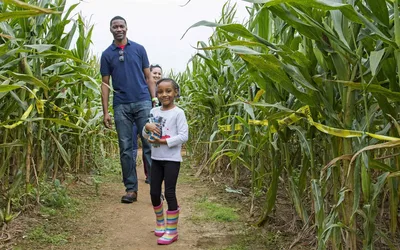
On the morning of Friday, September 11, 2026, the gates at 4470 Bennett Road in Buford will swing open once more, and the low, green walls of a three-and-a-half-acre cornfield will begin swallowing visitors by the hundreds. It is the nineteenth season of the Buford Corn Maze, a South Hall County institution that has, for nearly two decades, marked the unofficial start of autumn for families across metro Atlanta. This year, the maze opens with a theme that feels especially fitting for a farm with roots stretching back to the early 1800s: "Celebrating Country and Farms," a tribute to America's 250th birthday, with a giant tractor design and the numerals "250" cut into the standing corn.
The opening day itself is a small ritual of its own. The maze runs Fridays through Sundays in September, expands to seven days a week through October, and settles back to weekends in November, so the first Friday of the season carries a particular weight. It is the day the hayrides start rolling, the day the farm animals begin greeting visitors again, the day the smell of concessions drifts across the field. Tickets for the maze run $18.52, with a combo ticket covering both the maze and the Scream Zone haunted forest for $32.41, and children two and under get in free. Season passes are available for the devoted, and a WSB-TV promo code, FAM2FAM, shaves two dollars off admission.
But the story of the Buford Corn Maze is far older than its opening day, and far stranger than a field of corn. The land itself, at the intersection of Friendship Road and Hog Mountain Road, was once part of the Winnie Roberts Tutton Farm, a property whose documented history begins with Hardin Roberts, born in Laurens, South Carolina, in 1777. Roberts enlisted in the United States Army on July 4, 1814, served through the War of 1812, and was discharged in New Orleans in April 1815 before moving his family to Hall County, Georgia, near what is now Flowery Branch. In 1832, when the state of Georgia held its last land lottery of former Cherokee territory, Roberts was chosen and acquired more land. His son James, a colonel in the Hall County Militia, bought a log cabin that had been built by a Cherokee chief and moved it to the intersection of Hog Mountain Road and what is now Bennett Road, erecting it on the property around 1840. That cabin, fully restored, now stands in Cherokee Bluff Park in Flowery Branch, a few miles from its original home.
The farm passed down through the generations, eventually to Winnie Lee Roberts, who married Clarence Newton Tutton and remained on her father's land. Miss Winnie, as she was known, lived to be nearly a hundred, dying in March 1992 just three months shy of the milestone. Her daughter Julia and son-in-law Cal Watford inherited the farm and cared for it for decades. It was Cal Watford's vision for agritourism and farm education on the old home site that ultimately gave rise to the corn maze, and the Watford family heirs still own the land today.
The modern chapter began in 2008, when Rodney Miller, a southern Illinois farm boy who had long dreamed of starting an agritourism venue, discovered the property. In the midst of a heavily developed area, he found 35 acres of the former family farm, worked out an agreement with the owner, and reached out to close friends Jerome and Tina Beggs to help start and operate the maze. With his wife Kendra, Miller grew the business from what he later described as a "broken-down pick-up and tent" into one of the most popular corn maze entertainment venues in the state. The farm's history page notes that Miss Winnie, who loved children, "would be so excited and happy to see the smiles and laughter of families having such a good time at the corn maze area on her beloved farm."
In recent years, the maze has passed into new hands. Billy and Cindy Sachse, a couple who split their time between Gwinnett County and Dahlonega, where they own the Dahlonega Butterfly Farm and Winery, took over operations in 2023. Under their leadership, the property is evolving into a year-round outdoor destination filled with seasonal fun for all ages.
The 2026 season arrives, however, under a cloud of uncertainty that has nothing to do with the weather. Rumors have swirled on social media that the beloved maze is closing, and the owners have had to address them head-on. The underlying property, owned separately from the maze business, has been sold by its landowner for future commercial development. The reassurance is grounded in a lease that runs through January 2028, guaranteeing at least two more full seasons, this fall and the fall of 2027. Beyond that, the owners say they are actively exploring relocation options to keep the tradition alive, though no new site has been confirmed. For now, the message to the community is simple: this year's maze, festivals, and events are proceeding as planned.
And there is plenty to plan for. Beyond the maze itself, the farm offers the Scream Zone, a haunted forest that opens at dark on the last weekend of September and expands to daily hours in October, aimed at families and kids ten and up. The pumpkin patch, free to enter, generally opens on the third weekend of September with carving pumpkins, pie pumpkins, and minis starting at a dollar. There are unlimited hayrides, the Kids' CORNer play area, farm animals, a jumping pillow, slide, and concessions. In November, the property transforms again into a Christmas tree lot selling Frazier Firs, wreaths, and garland, and in past years has featured a mid-December visit from Santa. The maze has been recognized by Country Living magazine as one of the top corn mazes in America, a distinction its founders have long treasured.
The maze's designers cut a new pattern into the corn every year, and this season's "Celebrating Country and Farms" design, sponsored by Country Financial, honors the nation's semiquincentennial with a tractor and the number 250 carved into the field. Nine miles of corn paths wind through the three-and-a-half-acre plot, and the Gainesville Times captured the appeal in a single phrase: "Nine miles of corn, one way out." For a community that has watched this patch of farmland evolve from a Cherokee chief's cabin site to a War of 1812 veteran's homestead to a beloved fall destination, the opening day on September 11 is more than a date on a calendar. It is a chance to get lost in the corn again, to hear the laughter of children, and to hope that a tradition nearly two centuries in the making will find a way to keep growing.