


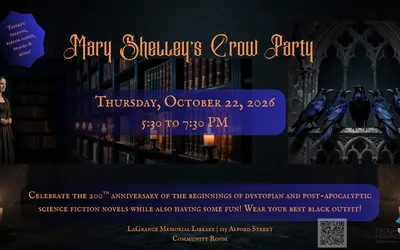
Two hundred years ago, on January 23, 1826, a London publisher named Henry Colburn released a three-volume novel about the end of the world. Its author was Mary Shelley, who eight years earlier had published Frankenstein; or, The Modern Prometheus. The new book was called The Last Man, and it imagined Europe in the late twenty-first century being emptied out by a bubonic plague pandemic that sweeps the globe and leaves humanity on the edge of extinction. It was not a success. It is, however, one of the first works of dystopian and post-apocalyptic science fiction in the language, and on the evening of October 22, 2026, the LaGrange Memorial Library will mark its bicentennial the only way a public library reasonably can: with a crow party.
The event runs from 5:30 to 7:30 p.m. at 115 Alford Street in LaGrange, part of the Troup-Harris Regional Library system. Attendees are asked to wear their best black outfit. The library promises refreshments, a photo area, a trinket trading table, and a round of vintage parlor games, along with a short education session on The Last Man and the origins of dystopian and post-apocalyptic science fiction. Guests are encouraged to bring shiny objects: marbles, cool bottle caps, shiny rocks, or homemade surprise items. The program is recommended for teens and adults.
The crow conceit is the library's own invention, a bit of whimsy hung on a very dark book. Crows are famously drawn to shiny things, and The Last Man is famously a book about everything shining going out. The pairing works better than it might first appear. Shelley's novel is not a monster story; it is a slow, elegiac account of loss, and its final pages leave one survivor walking alone through a depopulated world. Dressing up in black and trading trinkets is a gentler way into that material than a straight lecture would be, and it gives teenagers a reason to pick up a two-century-old three-decker novel that almost nobody reads for pleasure.
What makes the book worth the fuss is the company it keeps. The Last Man is thick with portraits. Shelley drew on her husband, Percy Bysshe Shelley, who had drowned in a shipwreck four years before the novel appeared, and on their close friend Lord Byron, who had died two years earlier. The characters Adrian and Lord Raymond are generally read as fictionalized versions of the two poets, which means the novel doubles as a memorial to the two most charismatic men in Shelley's life, written by a woman who had already lost her mother, three of her four children, and her husband. The book also carries a political strand: Shelley sat in the gallery of the House of Commons to study the workings of the British state, and the novel discusses Britain as a republic.
Its reception was brutal. Contemporary critics savaged it, and it remained largely obscure for more than a century. Until the 1970s, Mary Shelley was known mainly as the author of Frankenstein and as the editor and promoter of Percy Shelley's posthumous works. Modern scholarship has since taken a far more comprehensive view of her output, and The Last Man has moved from curiosity to canonical text. Its reputation got another jolt during the COVID-19 pandemic, when readers went looking for a plague novel written by the woman who invented science fiction and found one that had been sitting there since 1826.
That arc, from savaged to rediscovered, is the real story the LaGrange program is celebrating. The library's own framing is modest: learn about the book, learn where dystopian fiction came from, eat something, play some parlor games, take a photo. But the underlying claim is a large one. Before there were zombie movies, before there were pandemic thrillers, before the entire shelf of post-apocalyptic fiction that now fills bookstores, there was a grieving Englishwoman in her late twenties writing about the last person alive. The crow party is a birthday for that.
For anyone planning to attend, the library's only instruction beyond the dress code is a gentle nudge: don't forget to read The Last Man. It is in the public domain and freely available through Project Gutenberg. The library also notes that staff often photograph programs for publicity and social media, so anyone who would rather not appear should tell staff at the start. Food is served, and the library cannot guarantee it has not come into contact with tree nuts, soy, or other allergens.
Details are small but the premise is not: a regional library in west Georgia, on a Thursday evening in October, asking teenagers to dress like crows and bring a shiny rock in honor of a novel that failed in 1826 and took a hundred and fifty years to be taken seriously. It is an oddball way to mark a bicentennial, and it is hard to imagine where else one could do it.