


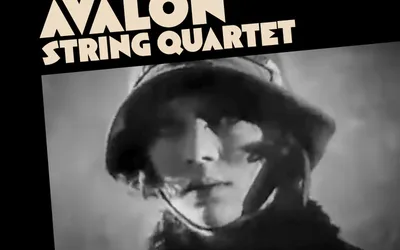
On the evening of October 1, the NIU Recital Hall will go dark for a film that has been silent for a century — and, for the first time, it will have a voice of its own. The Avalon String Quartet, Northern Illinois University's resident ensemble, will perform the world premiere of a newly composed score by their own first violinist, Blaise Magnière, set live against a screening of Dmitri Kirsanoff's 1926 film Ménilmontant. The concert begins at 7 p.m. in the Music Building at 550 Lucinda Ave. in DeKalb.
The pairing is unusual for a university recital hall, and it is deliberately so. Ménilmontant runs just 38 minutes, and in that time it tells the story of two Parisian sisters in the aftermath of a shattering act of violence, set in the working-class neighborhood on the eastern edge of Paris that gives the film its name. It was written and directed by Kirsanoff, a Russian-French filmmaker who emigrated to Paris in the early 1920s and fell in with the circle of young avant-garde "impressionist" directors then reshaping French cinema. The film has since become a touchstone for anyone who cares about what silent film could do.
What makes Ménilmontant endure is not its plot but its method. The film contains no intertitles at all — no title cards to explain the action, no dialogue, no narrative signposts. The story unfolds entirely through image and editing, a radical choice for a feature-length narrative in 1926. The film opens with a flurry of quick shots depicting the axe murder of the sisters' parents, a sequence whose ferocity was startling for audiences of the day and remains startling now. Kirsanoff built the whole film on that principle: montage and striking imagery carry the meaning, and the viewer is left to assemble it. Critics have long noted that the film arrived on the heels of Sergei Eisenstein's Battleship Potemkin and pushed the language of montage in its own, more intimate direction. The scholar P. Adams Sitney observed that Ménilmontant "seems an autonomous creation, as sophisticated and demanding as any narrative film of the silent period, without obvious imitators."
The film's own history is nearly as dramatic as its plot. It was shot during the winter of 1924–25, largely on location in the Ménilmontant neighborhood, on a tiny budget. Kirsanoff originally titled it Les cent pas — "The Hundred Steps" — and Paris distributors initially rejected it. The lead role of the younger sister was played by Nadia Sibirskaïa, born Jeanne Brunet, who was Kirsanoff's first wife and the principal actress in most of his early films. Kirsanoff himself had trained as a musician, studying cello at the École Normale de Musique in Paris and playing music for silent films before he ever picked up a camera. That biographical detail lends a certain symmetry to the October 1 event: a film made by a working silent-film musician is being given a new score by a working chamber musician.
That musician is Blaise Magnière, a French violinist who is a founding member of the Avalon String Quartet and holds the Richard O'Ryan Endowed Chair in Violin at NIU. Magnière studied at the Yehudi Menuhin School in England during his high-school years, then at McGill University in Montreal with Mauricio Fuks, and at the Cleveland Institute of Music with Donald Weilerstein. He served as an assistant to the Juilliard String Quartet, coaching chamber music at the Juilliard School, and has performed at festivals including Caramoor, Mostly Mozart, La Jolla, Ravinia, Bath, and Aldeburgh. His playing and conversation have been broadcast on the BBC, CBC, ABC, and France-Musique, and he has recorded for the Cedille, New Tangent, Albany, and Channel Classics labels, earning the 2002 Chamber Music America/WQXR Record Award. Composing a full score for a silent film is a departure from his usual work as an interpreter, and it is the kind of project that only a player with deep roots in both the French repertoire and the chamber tradition would attempt.
The quartet he founded has been concertizing since 1995 and has established itself among the country's leading chamber ensembles. The Chicago Tribune described the group as "an ensemble that invites you — ears, mind, and spirit — into its music." The Avalon has performed at Carnegie Hall, Alice Tully Hall, the 92nd Street Y, Merkin Hall, and Bargemusic in New York; at the Library of Congress and the National Gallery of Art in Washington; at Wigmore Hall in London; and at the Herkulessaal in Munich. It has appeared at the Bath International Music Festival, the Aldeburgh Festival, Caramoor, the La Jolla Chamber Music Society, and the Ravinia Festival, and has presented complete quartet cycles of Beethoven, Bartók, and Brahms at Fullerton Hall at the Art Institute of Chicago. In 2018 the quartet released a recording of the complete quartets of Matthew Quayle for Naxos, and its recording of Harold Meltzer's "Aqua" for Bridge Records received a Grammy nomination for Best Classical Compendium.
The Avalon's residency at NIU places it in a lineage that stretches back more than half a century. The quartet-in-residence position was formerly held by the Vermeer Quartet, which served as NIU's resident string quartet until its retirement in 2007. When the Avalon took up the residency, it inherited a tradition of chamber music at DeKalb that predates most of its members' careers. The quartet's current lineup — Magnière and Marie Wang on violin, Anthony Devroye on viola, and Cheng-Hou Lee on cello — includes two founding members, Magnière and Wang, who have carried the ensemble from its earliest days.
The October 1 program is a collaboration between the quartet and the university's broader arts ecosystem; the concert is supported by the NIU Fine Arts Activity Fee, the mechanism that helps fund student-facing performances across the campus. Tickets must be purchased online in advance, and they will not be available at the door — a detail worth noting for anyone accustomed to walking up to a recital hall on the night of a show. General public admission is $15; non-NIU students, seniors, and staff pay $10; and NIU students are admitted free, with a limit of two tickets each.
There is something fitting about the choice of venue. The NIU Recital Hall is an intimate room inside the Music Building, the kind of space built for unamplified chamber music rather than spectacle. A 38-minute silent film projected on a screen, with four string players seated below it, is a format closer to the earliest days of cinema than to a modern movie theater — and that is precisely the point. In the 1920s, silent films were never truly silent; they were accompanied by pianists, small orchestras, or, in Kirsanoff's own case, musicians who understood the medium from the inside. Live scoring was the norm, not a novelty. The world premiere on October 1 restores that condition for a single evening, and gives a century-old film a score written by a musician who has spent his life in the same tradition Kirsanoff came out of.
For a film that has survived for a hundred years without a single word of dialogue, Ménilmontant will, for one night in DeKalb, have something new to say.