


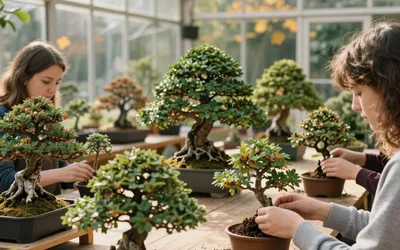
On the first Saturday of October, the Magnolia Room at the Foellinger-Freimann Botanical Conservatory will hold something that looks less like a garden and more like a forest that has been quietly shrunk down to tabletop size. Members of the Fort Wayne Bonsai Club will fill the space with trees — junipers, weigela, tropical species and more — each one trained over years into the shape of a full-grown tree living in a pot. The Fall Bonsai Show runs from 10 a.m. to 5 p.m. on Saturday, October 3, 2026, at 1100 S. Calhoun St., and entry is included with the Conservatory's general admission.
It is a show built on patience. Bonsai, as the club likes to explain on its website, literally means "tree in a pot," and the practice combines horticulture, artistic design and specific training techniques to keep a tree growing in a container for its entire life. The trees on display are groomed and wired from the time they are saplings, their branches bent and their roots pruned to create the illusion of age and scale. Many are accented by shitakusa, small companion plants set beside a tree to suggest a season or a landscape, and by suiseki, naturally formed stones displayed for their resemblance to mountains or distant scenery. Together the elements turn a single potted tree into a small, complete world.
The club behind the show has been doing this in Fort Wayne for a long time. A Journal Gazette account of the club's spring show noted that the event had been hosted annually for more than 24 years, drawing visitors from across the region. The club itself meets on the third Saturday of most months at 10:30 a.m., rotating among library branches, members' homes and the Botanical Conservatory, with educational programs, workshops and the occasional road trip to a nursery or another club's show. Dues are modest — $25 a year for an individual, $30 for a family, $20 for seniors, students and people with disabilities — and the club's stated mission is to cultivate both knowledge and artistic talent, to encourage the use of many species, and to teach sound horticultural technique.
For years the club's public face was Darlene Kittle, a Huntertown resident who served as its president for roughly a quarter-century. Kittle came to bonsai the way many people do: by accident. Already a Master Gardener who checked out houseplant books from the library, she picked up a bonsai book more than twenty years ago and, as she told the Kendallville News Sun, it became "an addiction." Her oldest tree, she said, began as a weed in her mother-in-law's flower bed in Florida around 1981. Her home eventually resembled a forest, with evergreens in the barn and tropical bonsai overwintering in a 1911 basement she and her husband excavated to give the trees more height. She also cared for the bonsai collection on the corporate campus of Petroleum Traders, visiting twice a week to water and prune.
Kittle's recurring message — one the club still carries — was that bonsai is not as forbidding as it looks. "People are afraid of bonsai and think it's a lot more complicated than it is," she told the Journal Gazette. "If you can grow a houseplant, you can grow a bonsai tree." She noted that bonsai keepers aren't limited to evergreens; any plant that produces a woody trunk can be trained, and club shows have featured everything from shimpaku juniper to flowering weigela. The appeal, she said, is partly social: "It's nice to talk to people and see their fascination. Some aren't real familiar with it, some are. Some have been doing it on their own for years but didn't realize there's this much variety, and didn't realize there's a club."
That spirit of accessibility shapes the fall show. Club members will be on hand throughout the day to answer questions about repotting, grooming, styling and choosing species — the practical, unglamorous work that keeps a bonsai alive through an Indiana winter. And for visitors who leave wanting to try it themselves, the club will sell a selection of beginner bonsai specimens and pots. The catch is a small one: the sale is cash-only.
The setting suits the subject. The Foellinger-Freimann Botanical Conservatory opened in November 1983 after two years of construction, the result of a shared vision that began with Esther Foellinger, who was inspired by plants she had seen on her travels and wanted to share them with people in Fort Wayne who might not have the chance to see them otherwise. Her daughter Helene Foellinger, then publisher of the Fort Wayne News-Sentinel, and attorney Bill Sowers helped bring the idea to life. The roughly $4.5 million building was funded by the city, the Freimann Charitable Trust, the Foellinger Foundation and Sowers, with Lincoln National creating an endowment to help maintain it. Today it is owned and operated by Fort Wayne Parks and Recreation, and it holds a cafe, a gift shop, art, hundreds of plants and dozens of types of cacti — a year-round oasis in the middle of downtown.
General admission to the Conservatory is $7 for adults and $5 for youth ages 3 to 17, with children age 2 and under free; the bonsai show costs nothing beyond that. The club's own history suggests the show is as much a recruiting event as an exhibition. After a past spring show, Kittle reported that a handful of visitors had signed up or expressed interest in joining. The trees, after all, can outlive the people who shape them — bonsai are often handed down between family members — and someone has to learn to care for them next.
For a few hours on an October Saturday, that quiet, generational craft will be on full display in a room full of very small trees. The club's invitation is simple: come look, ask questions, and if something takes root, take a beginner tree home in a pot.