


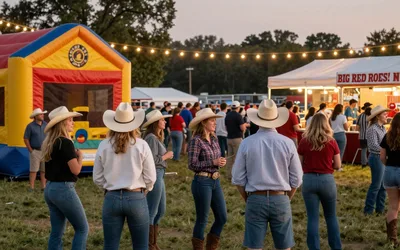
On the evening of October 2, a twenty-acre patch of green at the heart of Indiana University's Bloomington campus will be overrun with bounce houses, food vendors, live country and folk music, crafts, and games. Cowboy hats and boots are encouraged. The event is called the Big Red Rodeo, and it is, by any reasonable measure, an odd thing to find in southern Indiana: a rodeo-themed campus festival with no actual rodeo, staged on a meadow better known for protests and frisbee games than for livestock.
But the name is the point. The Big Red Rodeo is the signature event of Hoosier Welcome, a new first-year experience that Indiana University is rolling out in the fall of 2026, and its full official title is Hoosier the Bison's Big Red Rodeo. The bison in question is the university's mascot, a shaggy, newly resurrected symbol with a history that stretches back further than the state itself.
That history is the reason a rodeo makes a certain kind of sense. The bison has been used as an emblem of Indiana for more than two centuries, longer than Indiana has been a state. According to IU Athletics, the animal first appeared on official court documents signed by William Henry Harrison in 1801, when Harrison was governor of the Indiana Territory and fifteen years before Indiana achieved statehood.
Indiana University's first bison mascot was formally adopted on October 14, 1965, at the recommendation of the IU Student Athletic Board and with confirmation from the student senate. The resulting mascot was, by the standards of the era, a fairly brutish-looking beast. It appeared during a brief stretch of football success for the Hoosiers, including the 1967 Rose Bowl season.
For nearly six decades, the bison sat dormant. Then, on December 16, 2024, the Indiana University Student Body Congress passed the Bring Back the Bison Act, a student-government bill arguing that reinstating the animal would strengthen "the sense of pride and unity amongst students and supporters of the university." IU Athletics embraced the vote, and on July 14, 2025, the department announced that Hoosier the Bison would return as the official IU-Bloomington mascot. His public debut came on August 30, 2025, before the Hoosiers' season opener against Old Dominion at Memorial Stadium, where the mascot descended onto the field by parachute minutes before kickoff. Indiana Public Media reported that the stunt drew a roar from the crowd, and quoted one student, Chris, who declined to give a last name: "I think bringing back the bison is awesome. I mean, it's a historic thing for the university. Who doesn't love a bison, right? I mean, come on, the logo is awesome."
A mascot needs traditions to inhabit, and that is where the rodeo comes in. In May 2026, IU Today reported that the university was replacing its short-term Welcome Week model with Hoosier Welcome, described as a comprehensive, eight-week transition experience designed to integrate academic and student life, strengthen belonging, and improve student success outcomes from the moment a student arrives through the critical first weeks of the semester. The program is meant to serve all student populations, including domestic, transfer, and international students. Among the new events and initiatives under its umbrella, IU Today noted, is a signature First-Year Experience event called Hoosier the Bison's Big Red Rodeo — a high-energy, community-building celebration designed to reinforce what it means to be a Hoosier, introduce shared traditions, and integrate elements of the Indiana Promise, the university's affordability and support commitment for Indiana families.
The rodeo is hosted by First Year and Family Experience Programs, the office behind the broader Hoosier Welcome slate. The university's Student Life pages list the event at 7 to 10 p.m. at Dunn Meadow, with live country and folk music, games, bounce houses, crafts, and vendors. The event listing adds food to that roster and notes that Western dress is "definitely encouraged." Admission is free, and the gate is open — the event is listed as open to all, meaning students, families, and anyone else who wanders past the meadow can walk in.
Dunn Meadow itself carries its own weight in the story. The 20-acre green is, as Visit Bloomington puts it, a place for both celebration and demonstration, and over the decades it has hosted concerts, festivals, rallies, protests, and outdoor classes alongside impromptu frisbee games and students soaking up sun. It is one of the most heavily used and most symbolically loaded pieces of ground on campus. Staging a rodeo there — even a rodeo without livestock — places the new mascot squarely in the middle of that tradition, on the same grass where the university's public life has played out for generations.
There is a certain logic to the timing, too. The rodeo is scheduled for October 2, roughly five weeks into the fall semester, well past the first-day orientation rush that the old Welcome Week model concentrated into a single stretch. Under the new eight-week framework, the rodeo functions as a mid-semester anchor rather than a kickoff — a moment for students who have been on campus long enough to be tired, homesick, or simply unimpressed to be gathered back together and reminded, with music and food and a large plush bison, what they signed up for.
Whether the mascot will actually appear at his own rodeo is not something the public listings specify. What is clear is that the event is built around him: a bison-themed, Western-dress, free-admission evening in a meadow that has seen nearly everything else. For a university that spent almost sixty years without an official mascot, throwing a rodeo for the one it just brought back is a fittingly loud way to start a new tradition.