


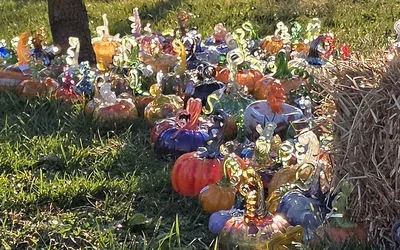
By the time the sun clears the courthouse dome, the line is already curling down the sidewalk. Some years it starts forming around 5:45 in the morning, hours before the first pumpkin is even unwrapped. On one homecoming weekend years ago, Abby Gitlitz arrived early to find a cluster of people waiting on the lawn and assumed they were stragglers from the night before. "And I said, 'Can I help you?'" she recalled. "And they said, 'Oh yeah, we're here for the pumpkin patch.'"
That is the particular hold the Great Glass Pumpkin Patch has on Bloomington. On Saturday, October 10, the Bloomington Creative Glass Center will stage its 17th annual patch on the Monroe County Courthouse lawn, spreading more than a thousand hand-blown glass pumpkins across the grass from 10 a.m. to 3 p.m. — or until they are gone, whichever comes first. It is free to walk among them; you pay only if you want to carry one home. The event happens rain or shine.
The pumpkins are not merchandise churned out by a factory. They are the year's work of the center's glassblowing apprentices, made one at a time in the hot shop. Each one is a small collaboration: Gitlitz estimates that three people are typically involved in the making of a single pumpkin, one gathering molten glass, another shaping, another finishing. They come in every color and size, priced by size, complexity and technique. In recent years prices have started around $25 and climbed to $390 for the most elaborate pieces. Cash, check and credit card are accepted.
The patch is also the center's single largest fundraiser of the year, and that is by design. When Gitlitz set out to build a glass studio in southern Indiana, she ran straight into the central problem of the craft: glassblowing demands specialized, expensive equipment. "It's not the sort of thing you can just do in your basement," she said, "so I needed to raise a lot of money. That is where the pumpkins come in." The pumpkins, in other words, came first. The institution followed.
Gitlitz began making glass pumpkins in 2000. In 2010 she hosted the first Great Glass Pumpkin Patch on the courthouse lawn, and every one of the 108 pumpkins that year was made by her alone. The following year, 2011, she formally founded the Bloomington Creative Glass Center, which grew into a 501(c)(3) nonprofit educational center. Classes in those early days were held out of GRT Glass Design in Indianapolis. With the patch proving itself as a moneymaker, the center launched the apprenticeship program that still supplies the pumpkins today.
That program is the quiet engine behind the whole event. Apprentices learn to blow glass essentially for free, in exchange for making pumpkins — once or twice a week, every month except July and August, when the hot shop takes its break. The arrangement opens a door that is otherwise closed to most people. "These people are learning how to blow glass on the job, either for free or close to free, because glass blowing is crazy expensive," Gitlitz said. "To have somebody else foot the bill makes it accessible to people." Apprentices have ranged in age from 13 to 76. Hours spent on pumpkin crews earn credit toward reduced-cost classes, and the skills accumulate year over year.
The scale has grown enormously since that first solo patch. By 2018 the display had passed a thousand pumpkins. The 2025 patch, the 16th, put 1,625 pumpkins on the lawn, crafted by 48 apprentices over the preceding year. Gitlitz has said the event draws around 2,000 visitors. Getting it there is its own small feat of logistics: pricing the pumpkins has taken 15 volunteers more than four hours, and wrapping the priced pieces for transport has taken over a day. On the morning of the event, volunteers unload the whole fragile harvest from a box truck onto the grass.
All of the money raised goes back into the center's educational programming, including work in elementary schools and free or reduced-cost programs for the public. Gitlitz is blunt about why that matters. "We are aware that there's a real lack of arts education happening in Southern Indiana and that budgets are being cut all the time," she said. "It feels like there's less every day so we're trying to help fill that void and help meet that need." The center describes its mission as bringing affordable, high-quality education about glass to people across southern Indiana, open to anyone regardless of age or experience.
For those who would rather not gamble on the morning line, the center holds a Pumpkin Preview on Saturday, September 26, from 6 to 8 p.m. at its own studio, where donors who give $50 can buy two pumpkins ahead of the crush. For everyone else, the ritual is the lawn itself: the hay bales, the autumn air, and a thousand small glass objects catching the light. Gitlitz calls the making of them community building, and the event has the feel of a town tradition rather than a sale — a fundraiser that happens to look like a fall festival, and a fall festival that happens to fund a year of art classes.
The center sits a little more than a mile off the Indiana University campus, on the number 7 bus line, and keeps programming running at all hours of the day and evening to work around people's schedules. "Our goal is to get people in to have those art experiences," Gitlitz said. The pumpkin patch is the largest of those experiences, and the one that pays for the rest. It is also, for one Saturday each October, the strangest and prettiest pumpkin patch in Indiana — no vines, no mud, no carving knives, just glass, and a line of people who got up before dawn to see it shine.