


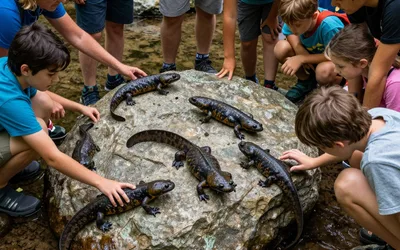
The eastern hellbender is not an animal most Hoosiers have ever laid eyes on. It is North America's largest salamander, a flattened, mottled, fully aquatic creature that can grow to about two feet long and spends nearly its whole life wedged under large flat rocks in cool, fast-moving rivers. It breathes through its skin, which is why it needs clean, oxygen-rich water and why its presence is treated as a sign of a healthy stream. In Indiana, the species survives in a single stretch of the Blue River in the south-central part of the state, and even there it has been in long decline.
That is the story Harmonie State Park plans to tell when it hosts Help the Hellbenders, a free family program at the Outdoor Education Pavilion behind the park's Nature Center. The park describes it as a short program that explores the past, present and future of the endangered hellbender, paired with a fun game. The program itself is free; the normal gate fee applies unless visitors hold an annual pass.
The name of the program is borrowed from a real conservation campaign. Purdue University's Help the Hellbender initiative, led by wildlife science professor Rod Williams, has spent well over a decade researching the eastern hellbender, coordinating regional recovery work and pushing forward captive propagation of the species. In 2022 the Hoosier Outdoor Writers honored the team with its Bayou Bill Conservation Award, given in memory of the longtime Indianapolis Star outdoors columnist Bayou Bill Scifres. The group's executive director, Tom Berg, said that members had first encountered Williams at their 2019 conference and were struck by the scale of the partnership behind the work, with Purdue, the Indiana Department of Natural Resources and other groups building management plans to reintroduce hellbenders across much of their historical range.
The stakes are easy to understate. Hellbenders do not reach sexual maturity until they are seven or eight years old, and they need very specific river conditions to reproduce at all. Indiana's decline has been documented since the early-to-mid 1900s, driven by habitat loss and poor water quality. Captive breeding is slow and delicate work. Mesker Park Zoo and Botanic Garden in Evansville built an indoor stream designed to mimic the Blue River and, following the lead of the highly successful Ozark hellbender program at the Saint Louis Zoo, began working with Purdue to captive-breed the eastern subspecies. The hope is that a captive population will eventually supply young hellbenders for release, reducing the need to spend countless hours searching the river for increasingly rare nests, and allowing biologists to expand releases into other southern Indiana rivers with suitable habitat.
There have been encouraging signs. In June 2023, DNR state herpetologist Nate Engbrecht and Purdue hellbender program coordinator Nick Burgmeier found a gilled larva in the Blue River, roughly 6.5 centimeters long and estimated at about eight months old. It was the first larval hellbender officially documented in Indiana since at least the 1980s; over the preceding three or four decades, only adults had been recorded there. "Finding hellbender larvae is a huge benchmark of the program's success," Engbrecht said. "It tells us that there has been successful breeding, hatching, and recruitment in the wild."
The wider picture remains unsettled. The U.S. Fish and Wildlife Service listed eastern hellbender populations in Missouri as endangered in 2021 and in 2024 proposed listing the eastern hellbender as endangered across its entire range, citing sedimentation, water quality degradation, habitat destruction, disease and direct mortality. Of 626 known historical populations, the agency estimates 41 percent are believed to be gone and another 36 percent are declining.
That is a lot of biology and policy to compress into a short program at a picnic pavilion, which is part of why the format leans on a game. The hellbender's life is essentially a survival gauntlet: eggs and larvae hidden in gravel, juveniles dodging predators, adults dependent on rocks that do not silt over and water that stays cold and clean. Letting kids play out those odds is a more memorable lesson than a slide of population figures.
Harmonie State Park itself sits a few miles south of New Harmony, the early-1800s utopian village on the Wabash River, and covers roughly 3,400 acres of wooded river country with trails, campsites and cabins. It is a fitting setting for a program about a river animal that most people never see: the park's own woods and bluffs drain toward the Wabash, a reminder that what happens on the land determines what survives in the water.
For families in Posey County and the surrounding region, the program is a low-cost way to meet an animal that is equal parts obscure and consequential. The hellbender has picked up a roster of unflattering nicknames over the years, among them "snot otter," but its role is serious: it is an indicator species, a living measure of whether a stream is clean enough to support everything else. The program meets at the Outdoor Education Pavilion behind the Nature Center at Harmonie State Park, 3451 Harmonie State Park Road, New Harmony, Indiana.