


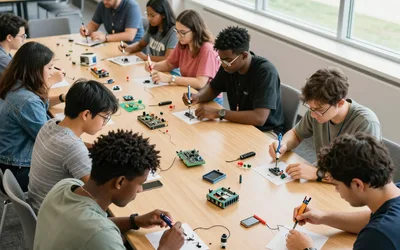
There is a particular smell to a room where people are learning to solder for the first time: rosin flux warming, a faint metallic tang, and the sharp little snap of a hot iron touching fresh wire. On the evening of October 20, 2026, that smell will drift through the meeting room of the North Side Library at 3516 Fifth Avenue in Des Moines, when the Science Center of Iowa brings its soldering crash course to the neighborhood branch. The event runs from 6:00 to 7:00 p.m., it is free, and the promise is simple and a little audacious for a single hour: participants start with the basics and leave with a completed project, a pin they made with their own hands.
The session will be led by Lindy Trout Turnis, the Science Center of Iowa's Innovation Manager. Her job, as she has described it, is designing and facilitating both high-tech and low-tech hands-on experiences for visitors in the museum's Innovation Lab, the makerspace-style learning environment tucked inside the Science Center. That phrase, "high-tech and low-tech," is something of a philosophy at the Lab. As the Science Center has explained it, the space intentionally blends the two because innovation isn't about the fanciest tool, it's about what you create with it. On any given day, visitors might find families coding a robot, designing a laser-cut puzzle, running a sewing machine, building a skyscraper out of plastic straws, or experimenting with electronics.
Soldering fits that ethos precisely. It is a skill that looks intimidating from the outside and turns out to be mostly patience, a steady hand, and a willingness to let the metal tell you when it's ready. It is also one of the foundational skills of the modern maker world, the thing that stands between a pile of components and a working gadget. Most adults have never been taught it. The North Side class is aimed squarely at them; the library lists the program for adults, and registration requires participants to select the correct age group.
The Science Center of Iowa has been teaching this particular lesson in other settings for some time. At the Des Moines Mini Maker Faire, the museum has run a workshop described as learning "how to use a real soldering iron to make a light-up pin," open to ages eight and up. The pin format is a deliberate choice. It is small, it is achievable in a short session, and it produces something wearable, which means the lesson goes home on a lapel rather than into a drawer. The North Side program is a more grown-up version of the same idea, with an hour set aside for adults to try a tool they may have spent decades avoiding.
What makes the setting interesting is the venue itself. The North Side Library sits on the corner of East Euclid Avenue and Sixth Avenue, bordering the Highland Park and Oak Park neighborhoods and near Union Park. Inside, it holds the Heritage Collection, a trove of local history artifacts from Highland Park and the surrounding neighborhoods, with vintage photographs and memorabilia displayed in the meeting room telling the story of the park's past. It is a fitting room for a class about old technology made new: the same walls that hold century-old photographs of the neighborhood will host the smell of flux and the small triumph of a first good joint.
The Science Center of Iowa's own history gives the evening a certain symmetry. The museum opened in 1970 as the Des Moines Center of Science and Industry, in Greenwood-Ashworth Park. It was renamed the Science Center of Iowa in 1985, and it moved to its current home at 401 West Martin Luther King Jr. Parkway in 2005. The institution's founding was sponsored by the Junior League of Des Moines, with fundraising beginning in earnest in 1965 behind an anonymous $100,000 donation and $30,000 from the Junior League.
That outreach is the part that matters here. A science center's mission does not stop at its front door, and the partnership with the Des Moines Public Library system is a way of carrying hands-on science into neighborhoods that may not make the trip downtown. The North Side branch is one of the system's community libraries, and its programming calendar mixes storytimes and craft afternoons with events like this one. Bringing a soldering iron into a library meeting room is a small statement: that making things is not a specialized pursuit for engineers, but a general skill, available to anyone who shows up.
For anyone who has ever looked at a circuit board and wondered how the parts stay on, an hour is enough to find out. The class is free, it requires no prior experience, and it ends with something in hand. The details are straightforward: Learn to Solder: Make & Take Pin, North Side Library, 3516 Fifth Avenue, Des Moines, October 20, 2026, 6:00 to 7:00 p.m., led by Lindy Trout Turnis of the Science Center of Iowa. Participants should check the library's event listing for registration and age requirements, since the program asks attendees to select the correct age group when signing up.
There is something quietly satisfying about the format. A pin is not a robot or a computer. It is a small, bright, slightly imperfect object that proves a person can melt metal on purpose and make it do something. For an hour on a Tuesday evening in October, in a room full of neighborhood history, a group of adults will learn that the intimidating tool is not so intimidating after all, and they will walk out wearing the evidence.