


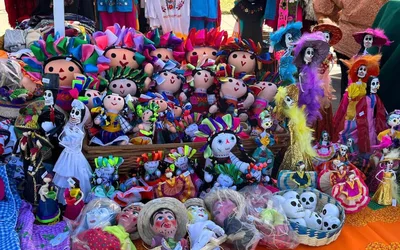
For one night each October, a stretch of downtown Emporia stops being a street and becomes something closer to an altar. On Saturday, Oct. 17, the 600 and 700 blocks of Commercial Street will close to traffic and fill with sugar skulls, marigold colors, papel picado, and battery-powered light for the H.O.T.T. Día de los Muertos celebration, running from 5 to 10 p.m.
The event is hosted jointly by Emporia Main Street and Hispanics of Today and Tomorrow, the nonprofit known around town simply as H.O.T.T. This year the festival moves fully into the dark: instead of a daytime street fair, organizers are staging what they call a "Light Up the Night" evening, encouraging everyone — attendees, parade walkers, and vendors alike — to bring glow sticks, LED candles, string lights, lanterns, and illuminated decorations. Vendor booths are being asked to decorate and light up their displays, turning the blocks into a corridor of color after sunset.
The centerpiece is a walking parade at 7 p.m., with line-up beginning at 6 p.m. It is a procession on foot only — no motorized vehicles are allowed, though bicycles are welcome. Participants are invited to walk with family, bring a friend, or simply show up alone, and to dress in their brightest colors and most elaborate Día de los Muertos looks. A La Catrina contest will name a "Best in Show" for the most creative interpretation of the elegant skeletal figure that has become the holiday's most recognizable image.
Live entertainment runs throughout the evening, with performances announced from DJ Mostro, the Emporia Middle School Band, and Raíces Hispanas. That last act is not an outside booking: Raíces Hispanas Grupo Folklórico is H.O.T.T.'s own dance group, performing Mexican folklórico dances and other styles at local and out-of-town events throughout the year.
At the heart of the festival is the community ofrenda, the shared altar where anyone can place an offering or a photograph to honor someone who has died. Organizers ask that people bring copies rather than originals, since the display is public and they cannot guarantee that items will not be lost or damaged. It is a small logistical note that carries the whole point of the holiday: Día de los Muertos, celebrated primarily in Mexico on Nov. 1 and 2, is less a mourning ritual than a family reunion in which the ancestors are the guests of honor. Families build altars at home adorned with photos, candles, flowers, and the favorite foods of the departed; in rural areas, graves are decorated with candles and marigolds. Emporia's festival borrows the urban version of that tradition — the part that spills into the streets with food, music, and costumes — and compresses it into a single evening.
That the festival exists at all is the work of a small group that started with almost nothing. H.O.T.T. was founded in 1998 by just six members, with the intention of providing scholarships to high school students of Hispanic heritage. Its stated mission is to preserve Hispanic heritage for future generations, strengthen bridges of communication and understanding among diverse cultures, ensure Hispanic participation in the mainstream, and work together to help the Hispanic community. The organization reports having awarded more than $104,000 in scholarships to help students of Hispanic heritage pursue a college degree.
The money comes from local sponsorships and from the proceeds of the two cultural events H.O.T.T. hosts each year: Cinco de Mayo in May and Día de los Muertos in October. The scholarship program awards funds annually to eligible graduating high school seniors of Hispanic descent who live in the Emporia area. Scholarship recipients from the prior year are recognized each May at the Cinco de Mayo celebration on Commercial Street.
The context for all of this is a town that has been shaped by its Latino residents for more than a century. Emporia's population has held steady at roughly 24,000 for the past decade, but about a third of residents are Hispanic, and the city has been home to a significant Latino community since the early 1900s, drawn in part by the railroad. H.O.T.T.'s own materials describe its events as reaching a surrounding Lyon County population of about 77,000, and the organization estimates that as many as 3,000 people attend the Día de los Muertos festival. Emporia Main Street, which co-hosts, is an organization of more than 200 local businesses and hundreds of volunteers that has been working on downtown revitalization since 1991.
For vendors, the mechanics are specific: spaces are 12 feet wide by 15 feet deep, measured from the curb out into the street. Setup begins at 3:30 p.m. and must be finished before 5 p.m., and all vehicles — including those pulling trailers — must be off the street by 4:30 p.m. and cannot return until the event concludes. The festival is rain or shine, and no refunds are issued for cancellations. Vendors selling food, handmade goods, art, and merchandise are all welcome, with the added encouragement to dress up and decorate their booths.
What the evening offers, in the end, is a rare thing in a small Kansas town: a free, open, genuinely distinctive cultural festival that happens after dark, on foot, in the middle of a main street — and one whose proceeds go directly to local students. The parade is open to anyone willing to show up and walk. The ofrenda is open to anyone with a photograph to place. And the lights, as the organizers keep repeating, are up to you.