


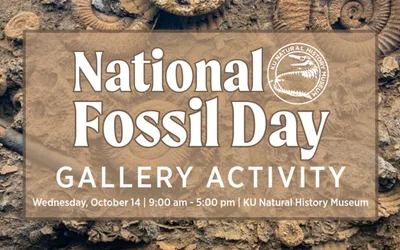
On the second Wednesday of October each year, museums and parks across the country mark National Fossil Day, a celebration the National Park Service and the American Geosciences Institute launched in 2010 to draw public attention to the science of paleontology. This year the date falls on October 14, and in Lawrence the KU Natural History Museum will observe it the way it knows best: by throwing open the doors of its Fossil Hall and letting visitors go looking for monsters.
The event is simple and free. From 9 a.m. to 5 p.m., anyone who walks into Dyche Hall at 1345 Jayhawk Blvd can stop at the Visitor Services desk and ask for a gallery guide. The guide turns a normal museum visit into a scavenger hunt through the Fossil Hall, where visitors are invited to track down ancient fauna from the Pleistocene and Holocene epochs — the saber-toothed cat, the giant ground sloth and their long-vanished neighbors. It is a self-guided activity, which means no tickets, no timed entry and no capacity limit; families can move at whatever pace suits them, and the museum notes the hunt is designed to be fun for visitors of all ages.
That the museum can stage such a hunt at all is a product of Kansas's unusually deep paleontological history. The state's western half is underlain by the Niobrara Chalk, the fossilized floor of the Western Interior Seaway, a vast body of water that split North America during the Cretaceous period. Those chalk beds have yielded thousands of scientifically important specimens — giant marine reptiles, fish and flying reptiles — and the KU collections built around them are among the finest of their kind anywhere. But the Fossil Hall's Pleistocene and Holocene mammals tell a more recent chapter, the story of the ice-age beasts that roamed the continent not long before humans arrived, and of the world that replaced them.
The building housing the hunt has a story of its own. The University of Kansas was chartered in 1864 with a legislative mandate to assemble "a cabinet of natural history," and for four decades the collection grew under the naturalist Francis Huntington Snow. At the turn of the last century the Kansas legislature funded a dedicated building to hold it. Dyche Hall was completed in 1903 and named for Lewis Lindsay Dyche, the explorer, taxidermist and showman who had become one of the university's most famous figures. It has since been listed on the National Register of Historic Places, and it remains the museum's home more than a century later.
Dyche is the reason the building exists in the form it does. In 1882, while still an undergraduate, he began collecting mammals for scientific study, and his skill with a rifle kept a steady stream of skeletons, skulls and skins flowing into Lawrence for the next three decades. He went on to study taxidermy in New York under the conservationist William T. Hornaday, and in 1893 he assembled an exhibit of North American mammals for the Kansas Pavilion at the World's Columbian Exposition in Chicago. That display, known as the Panorama, was revolutionary: at a time when natural history museums typically mounted animals alone on bare pedestals, Dyche posed them in groups, in their natural surroundings, in scenes of struggle and survival — wolves and moose locked in battle among them. It drew crowds from the fair's opening day and brought Kansas international attention. Dyche Hall was built a few years later specifically to house it.
Dyche's appetite for collecting was not confined to the plains. In 1894 and 1895 he joined Arctic expeditions to Greenland, first with Frederick Cook and later with Robert Peary, serving as official naturalist in pursuit of reindeer, caribou, polar bears, seals and walrus. On the first trip the ship sank near the end of the expedition, taking his cache of 450 birds, 65 mammal skins and assorted bones to the bottom; the party was rescued by another vessel. He considered the second trip, on which he collected six walrus bulls, the more successful of the two. The Panorama he created still occupies the museum today, expanded over the years to include more environments and species, and it remains one of the few large displays from the 1893 fair to survive intact.
All of this sits behind a single afternoon's activity. A visitor who picks up a gallery guide on October 14 is walking through a building whose founding purpose was to put the natural world on display, in a state whose fossils helped establish American paleontology, looking for the remains of animals that were alive when the first people reached this continent. The museum's collections now number roughly 11 million plant, animal and fossil specimens, plus more than 2 million archaeological artifacts, distributed across eight buildings and administered by the Biodiversity Institute — a research operation that grew out of that original 1864 "cabinet."
National Fossil Day itself has a similarly institutional origin. It was established in 2010 by the National Park Service and the American Geosciences Institute, timed to fall within Earth Science Week, and the first observance was held on October 13 of that year. It has since become an annual fixture, with parks, museums and fossil sites around the country offering programs on the same day. The KU event is one of the quieter versions — no lectures, no ticketed tours, just a guide sheet and a hall full of bones — but it is also the most accessible, requiring nothing more than showing up during open hours.
The museum is open Tuesday through Saturday from 9 a.m. to 5 p.m. and Sunday from noon to 4 p.m., and is closed on Mondays; October 14, 2026 falls on a Wednesday. Admission is a suggested contribution of $7 for adults and $4 for children, with KU students and members free, and proceeds support the museum. Visitors who need a reasonable accommodation to participate are asked to contact Natalie Vondrak at [email protected] in advance.