


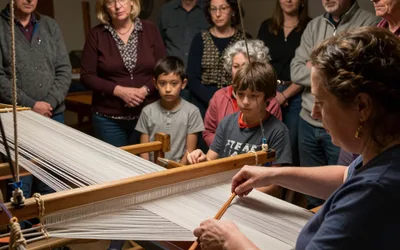
The basement meeting room of Louisville's Western Library is not where you would expect to find a production loom. But on the evening of October 19, 2026, from 6 to 7 p.m., fiber artist Briana Frederick will haul one in, thread it up, and hand the shuttle to whoever shows up. The program, "Briana Frederick: Weaver Storytime," is free, open to drop-in visitors, and built around a simple idea: the loom is a weaver's primary partner, but it is far from the only tool.
Frederick is the weaver behind Bri Weaves, the Louisville studio she opened in 2018. Her work is functional and wearable — cowls, scarves, neckerchiefs, and the occasional "rage vest" — made from varied fibers, textures, and colors. Each warp she dresses gets its own name, and the pieces that come off it are, in her words, much like siblings: the same yarns running in one direction, different yarns in the other, each finished work one of a kind but part of the same handwoven family.
Her path to the loom was not a straight line. Frederick earned a BFA in Fiber from the Kansas City Art Institute in 2007, then served in the Peace Corps in Morocco, working with rural women weavers. She farmed in the Northeast before settling in Kentucky. After a long hiatus from weaving, she returned to it in 2014, after her first child was born and she wanted to wear him. Rather than buy a baby wrap, she bought an old loom and wove her own. She fell back in love with the craft quickly, rediscovering her joy in small studies of color, fiber, and texture. In 2019 she was accepted into the Kentucky Arts Council's Kentucky Crafted program, the state's mark of artistic excellence and quality craftsmanship.
Frederick is also a goat mama, and that is not a decorative detail. She keeps two Nigora goats, Betty and Boon, whose fiber goes into many of her pieces. The pair have become local celebrities of a sort, appearing at library events to help teach people where clothing fibers actually come from and how materials like cashmere are collected and turned into fabric. That educational work ran into trouble in early 2026, when a Louisville Metro ordinance passed the previous October — requiring animals such as goats, ponies, and miniature horses to be kept on at least a half-acre — threatened the hands-on demonstrations. Frederick told Spectrum News 1 that the change came as a surprise after a friend was cited under the new rules in December, and that there had been no notification and no public comment or input. She added that even Metro Council members appeared not to have known about the change they voted in. "I want to keep being able to do this," she said at the time. The goats will not be at the Western Library program, but the impulse behind it — showing people, up close, how cloth gets made — is the same one that put Betty and Boon in front of library crowds.
At Western, Frederick will talk about what it means to be both an artist and a production weaver, demonstrate the loom in action, and let attendees weave some themselves. The session includes a reading of "The Weaver's Surprise," the children's book by master weaver Tom Knisely. Published by Stackpole Books and illustrated by Megan Lloyd, the story follows a family of mice who move into a weaver's cottage for the winter and consider tucking into his woven cloth for a long nap — and what happens when the weaver discovers them. Lloyd is a weaver as well as an experienced children's book illustrator, which is why the tools in the pictures are rendered accurately. Knisely, who has taught spinning and weaving for more than thirty years, is an instructor at the Red Stone Glen Fiber Arts Center in York Haven, Pennsylvania, and the author of instructional books including "Weaving Rag Rugs," "Handwoven Table Linens," "Handwoven Baby Blankets," and "Huck Lace Weaving Patterns with Color and Weave Effects." The book is a natural fit for a program that wants children to see the loom as something real and touchable rather than a picture in a story.
If time allows, the group will pull off a whole weaving together — the kind of collective, slightly chaotic making that turns a demonstration into a memory. The program is funded by PNC Grow Up Great, the bank's early-learning initiative, which has supported expanded storytimes and hands-on learning across the Louisville Free Public Library system. In February 2026, the PNC Foundation announced a $250,000, two-year grant to the Library Foundation to expand early literacy programs at LFPL, with programming at Fairdale, Iroquois, Main, Newburg, Parkland, Portland, Shawnee, Shively, and Western libraries. The grant also supported a renovated children's area at the Portland Library. A weaving storytime at Western is one of the more unusual fruits of that investment: not a performer on a stage, but a working artist with a working loom and a room full of people invited to try.
The setting adds its own layer. The Western Library at 604 South Tenth Street is a Carnegie library built in 1907, designed by McDonald & Dodd in the Beaux Arts style, and listed on the National Register of Historic Places in 1975. It began in September 1905 as the Western Colored Branch, originally at 1125 West Chestnut Street, and is recognized as the first public library built for African Americans staffed entirely by African Americans. Thomas F. Blue, its pioneering librarian, gave the opening address at the first Negro Library Conference at Hampton Institute in Virginia in 1927. A craft that has been passed hand to hand for millennia, taught in a building that has been passing knowledge hand to hand for more than a century, is a fitting pairing.
Frederick's own studio sits at 107 N. Jane St. in Louisville, open by appointment, and her calendar stays busy: the LVA Studio Weekend in November, Christkindlmarkt at the German-American Club, the Lexington Art League Holiday Market, Feral Folk and the Crafted Social Winter Market at Greyline Station, and the sixth annual Bri Weaves Open Studio on December 12 and 13, 2026, with a weaving studio, guest makers, food, and, yes, the famous Clifton goats. But the October evening at Western is the rare chance to meet the loom first, in a library basement, with a book about mice and a shuttle in your hand.