


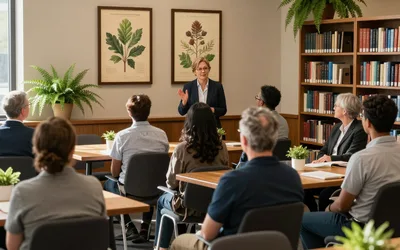
On an October evening in Frankfort, Jocelyne Waddle plans to talk about flowers that mean one thing and do another. Her illustrated program, "Botany, Poison, and the Victorian Imagination," runs from 6 to 7 p.m. on Tuesday, October 20, 2026, at the Paul Sawyier Public Library, 319 Wapping St. Admission is free, and a book signing follows, with copies available for purchase.
The talk starts from a simple premise: in the 1880s, plants were never just ornament. They were medicine, they were code, they were instruments of power, and occasionally they were murder weapons. Waddle, a Frankfort resident and the author of the Lady Aurora Mysteries, draws on the research behind her fiction to show how real nineteenth-century botanical knowledge shaped daily life, women's agency, and the era's darker imagination.
Among the subjects on the program: the Victorian language of flowers, particularly as it was used in mourning and remembrance; the medicinal plants nearly every household relied on, and the toxic look-alikes that could turn a remedy fatal; and the ways women used botanical expertise as influence, resistance, and survival. Waddle will also point to the specific historical plants that inspired scenes in her novels "Death Comes at First Light" and "A Mermaid's Drowning." She closes with the question of why the Victorians were so captivated by poisons, antidotes, and the thin line between healing and harm.
The floriography material has deep roots. Small bouquets called tussie-mussies, or nosegays, became a fashionable accessory during Queen Victoria's reign, and the practice of assigning meanings to individual blooms grew into a full-blown parlor language. The BBC has noted that the code ran both directions: the sweet pea meant gratitude, the zinnia everlasting friendship, while other flowers carried deliberate slights. In an era when a young woman's correspondence might be read by others, a bouquet could say what a letter could not, which is precisely the kind of quiet leverage Waddle's talk is built around.
Waddle's own path to the subject is transatlantic. According to her author biography, she was born on the French Mediterranean coast, and her passion for world languages, botany, and floriography flourished when she crossed the Atlantic. She is a former high school teacher and has published articles on gardening and floral symbolism; that work led to her debut historical mystery. She now lives in Frankfort with her husband.
Her series follows Lady Aurora, a French countess and botanist navigating the shadowed parlors and glass-roofed conservatories of 1880s England and France. In the first book, set in 1885, Aurora returns to society as a widow after years in a brutal marriage and is drawn into a murder investigation at the Grand Hotel in Dover, alongside her childhood friend Viscount Beaulieu and the enigmatic Earl of Sommerset. The second, "A Mermaid's Drowning," moves the action to Newport, Rhode Island, where Aurora searches for her missing brother at a mist-drenched estate called Cottonwood and a poisoning lands in her own room.
That is the pattern her library talk describes: the garden as a place where careful observation pays off, and where the same knowledge that heals can be turned. Waddle has described gardening as the place where she breathes, observes, and listens, and as teaching her the same lessons as storytelling, patience, curiosity, and the courage to return to the soil after every storm.
The setting suits the subject. The Paul Sawyier Public Library traces its origins to December 12, 1908, when Frankfort's first public library opened; in 1965 the bookmobile and library combined under the name the institution carries today, and a Kentucky Historical Marker stands at the Wapping Street site. A century and more after the era Waddle writes about, the same building hosts an evening devoted to what the Victorians knew about the plants in their parlors and gardens, and what some of them did with that knowledge.
The program is aimed at adults and is listed as an author event. No ticket is required. Whether the draw is gardening, historical fiction, or a well-constructed suspense story, the library promises something to savor, and the format is as low-stakes as it gets: an hour, a walk-in seat, and a signing afterward for anyone who wants a book signed on the way out.