


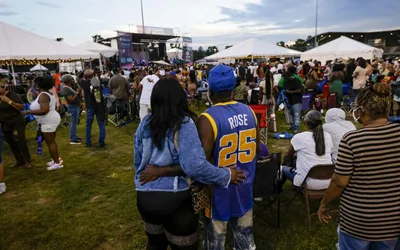
The Mississippi River has always been a dividing line in southeast Louisiana. East of it, the lights of New Orleans. West of it, the bedroom communities of Jefferson Parish — Westwego, Marrero, Harvey, Gretna — where generations have worked shipyards, raised families, and watched the city's culture from across the water. For years, that meant crossing the Crescent City Connection for festivals, concerts, and a proper Saturday night. Jonathan Stewart wanted to change that.
The result is the Westbank Heritage Fest, a free two-day celebration that returns Sept. 19-20 for its 10th edition at the Alario Center's Segnette Field in Westwego. What began as a modest Labor Day weekend gathering in 2016 has grown into a bona fide festival with national headliners, a larger stage, more than 20 food vendors, a sprawling vendor market, and enough bounce houses to wear out any child before sundown.
“It has really taken off,” said Stewart, president of the New Growth Economic Development Association, the organization that founded the festival. He pointed to this year's expansion — a bigger stage, more vendors, and national acts — as evidence of how far it's come.
The festival's origin story is one of civic frustration turned into opportunity. Jefferson Parish Councilman Byron Lee, who represents District 3 on the West Bank, helped champion the event alongside NGEDA. The organization was built to promote cultural, educational, civic, and economic development for small and independently owned businesses on the West Bank. But beyond economic development, there was a cultural gap. The East Bank had its festivals, its music halls, its concentration of venues. The West Bank — a community of roughly 200,000 people — deserved its own celebration, its own stage, its own moment in the sun.
That first festival in 2016 was held over Labor Day weekend, a deliberately free event meant to be accessible to everyone. No ticket booth, no velvet rope. Just music, food, and community on the grounds of the Alario Center, a 2,400-seat arena that opened in 1999 and once served as the practice facility for the NBA's New Orleans Hornets. The venue's namesake — John A. Alario Sr., a longtime Louisiana politician — would likely appreciate the building hosting a celebration of the region's working-class culture.
By the seventh year, with inflation squeezing household budgets, Lee doubled down on the free-admission model. “When you deal with the stresses, when you deal with the inflation, the cost of living now that sometimes you can't seem to make everything work financially, so what we do is see what we can do so they can benefit off of what we do,” he told WDSU in 2023.
For vendors, the festival has become more than a weekend market. It's a launching pad. “We put our locals first because we need a launching pad for them to get them and their product in the stream of commerce,” said Sharlayne Jackson Prevost, vice president of the economic development association. Local cooks, artisans, and small businesses get face time with thousands of attendees — a chance to graduate from the festival circuit to larger platforms.
This year's lineup reflects the festival's dual identity: national draw and local flavor, secular Saturday and sacred Sunday.
Saturday is headlined by Joe — Joseph Lewis Thomas — the R&B crooner whose 1990s hits like “I Wanna Know” and “Good Girls” made him a staple of slow jams across the country. He left Jive Records in 2007 to release music independently, and this past June he performed a Tiny Desk concert for NPR, revisiting the throwback hits that put him on the charts. Also on Saturday's bill is the Renaissance Orchestra, an Atlanta ensemble that blends violins, cellos, and brass with hip-hop, trap, R&B, and pop. The group is only a couple of years old but has already collaborated with rapper Boosie and gospel singer Fred Hammond, and their viral covers of Ginuwine's “Pony” and Gnarls Barkley's “Crazy” have racked up millions of views.
Saturday also features trumpeter Donte Allen, the teenage son of New Orleans brass mainstay Shamarr Allen. Donte joined his father and Cyril Neville on stage at Jazz Fest in April and appeared on Neville's latest album. This will be his first billed festival appearance.
Sunday turns toward gospel. A 10 a.m. worship service inside the Alario Center opens the day, followed by gospel performances beginning at 1 p.m., including the women's choir Jessica Harvey and the Difference, and Geismar's Joel Jones and 3MC, who have performed at Jazz Fest. The Sunday headliner is King George, a former rapper turned blues and soul singer. Rapper Baby Boy da Prince — whose 2007 single “The Way I Live” climbed into the Billboard Hot 100 top 25 — also performs. Gospel star Jonathan Nelson, who has spent more than two decades in contemporary Christian music and written songs for Donald Lawrence & Company, closes out the weekend.
Between sets, the festival grounds fill with the smells of Creole seafood from Daddy & Me Catering and Young Johnson & Dnola's Kitchen, ribs and fries from Food Symphony Restaurant, Caribbean dishes from Numada, tacos from Z-Tecas, and desserts like beignet bites, Italian ice, and snowballs. The vendor market showcases handmade goods and local businesses, while the kids' area offers inflatables, a video gaming trailer, and arts and crafts.
Admission remains free. Parking is $15 on site, and there's a clear bag policy. Attendees can bring folding chairs, but ice chests and outside food are prohibited. VIP packages are available for those who want a climate-controlled lounge with catered food and premium drinks.
For ten years, the festival has done more than entertain — it has reframed what the West Bank can be. NGEDA reports its initiatives have generated more than $4 million in economic impact, supporting restaurants, businesses, and musicians. The Heritage Fest is the flagship of that mission: a weekend where the West Bank doesn't have to cross the river for culture, because the culture is already home.