


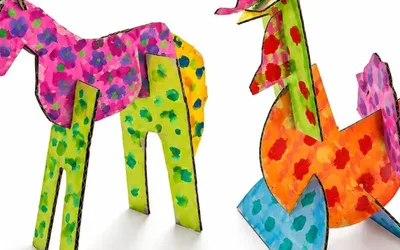
On most Saturday afternoons, the fifth floor of 100 Lafayette Street is a quiet place to look at art. On October 24, from 1 to 4 p.m., it becomes a workshop. The LSU Museum of Art's Art Break program hands visitors sheets of material, scissors and paint and asks them to make something with their hands — a butterfly magnet, a cardboard animal — in the spirit of an artist who turned scrap tin into birds, animals, angels and whirligigs.
The program is called "Art as an act of FREEDOM," and the emphasis is the museum's. David Butler, the self-taught artist whose work anchors the session, was born in 1898 in Good Hope, Louisiana. He grew up drawing, whittling and shaping toys and figures — the kind of making that happens without a classroom, a teacher or a supply budget.
As an adult he cut grass and sugarcane, drove a buggy and worked in a sawmill. In the early 1960s an accident at the mill left him partially disabled. He bought a house in Patterson, Louisiana, and began in earnest the work that made his name: yard sculpture cut from corrugated tin roofing panels that children and friends collected for him. He sketched his ideas in chalk on the panels, laid them on the ground and flattened them with a hammer, then cut shapes with ax heads, chisels, knives, meat cleavers and shears. He folded and bent the metal into three dimensions, perforated the surfaces with patterns and painted them in red, white, black, silver, green and blue house paint. Buttons, marbles, bicycle reflectors, bits of plastic toys, tinfoil and light bulbs went on last, wired into place.
Some of it moved. Butler made whirligigs and other kinetic pieces alongside stationary work, and he made window covers and awnings that sheltered his house from the south Louisiana heat — and, he said, from spirits. After his wife Elnora died in 1968, during a period of anxiety, he felt compelled to make what he called "spirit shields." The phrase is a reminder that the freedom in the program's title was not abstract for Butler. His materials were free, scavenged, and his subjects came from dreams. He drew on his own interior life because there was no institution telling him what to draw.
That is the thread the museum is pulling. "[Folk artists] create with whatever they can find," Michelle Schulte, the museum's chief curator of exhibitions and collections, told inRegister. "I think that's also something the average visitor can come in and sort of see these works and go, I can do this too … It doesn't have to look perfect. It doesn't have to look realistic. It's just about my inspiration."
Butler's work now sits in the Smithsonian American Art Museum and the Philadelphia Museum of Art, a long way from a Patterson yard. At the LSU Museum of Art it hangs in the Folk Art Gallery, which opened June 30 and is built around a one-year loan of six works from the American Folk Art Museum in New York — pieces by Jimmy Lee Sudduth, Mose Tolliver, David Butler, Sam Doyle, Purvis Young and Mary T. Smith. The loan came through Art Bridges' Partner Loan Network. Art Bridges, the nonprofit foundation Alice Walton established in 2017 to widen access to American art, supports museums in lending and borrowing from one another's collections, moving objects out of storage and into public view. The network requires borrowers to build programming around the loans, and the museum backed that up with a $25,000 Learning and Engagement Grant from Art Bridges.
That grant is why Art Break exists at all. It funds five connected programs running from September 2026 through April 2027: Art Break at the Museum, outreach on the LSU campus, artmaking through Baton Rouge General's Arts in Medicine Program, Tiger Chill Nights for LSU students and Educator Chill Nights for K-12 and university teachers. The framing throughout is wellness rather than art history. These are sessions built around reflection and connection, with a docent stationed in the Folk Art Gallery so visitors can learn about the works and the people who made them while they work.
October's edition is free, drop-in and open to teens and adults — no experience necessary, and no ticket. Admission to the museum is free all day on Art Break days, which means the galleries are open to anyone who wanders in, whether or not they pick up a pair of scissors. Minors under 18 must be accompanied by an adult.
Music comes from vocalist Rayne Jackson, performing jazz and R&B with pianist Corey Hatfield. It is a pairing that suits the material: Butler's tin figures were made to be lived with, outdoors, in motion, in a yard where sound and weather were part of the experience. A gallery with a singer in it is closer to his original setting than a silent vitrine.
The museum sits on the fifth floor of 100 Lafayette Street in downtown Baton Rouge. The session runs Saturday, October 24, 2026, from 1 to 4 p.m. Visitors can stay ten minutes or the full three hours, make a magnet or a sculpture, listen, and leave. The only requirement is the willingness to try, which is roughly the deal Butler made with himself every time he flattened a sheet of roofing tin.