


When the Portland Press Herald announced the very first Common Ground Country Fair on September 2, 1977, it did so in 102 words. The headline was "Fair to Have Extra Features," and the extra features in question were modest: "a roster of speakers that includes Helen and Scott Nearing, renowned homesteaders and authors." The paper's editors clearly expected little of the thing. Nearly half a century later, the fair they barely noticed has become one of the most distinctive agricultural gatherings in the country, and this year it marks its 50th annual edition.
The 2026 Common Ground Country Fair runs Friday, September 25 through Sunday, September 27 at the Common Ground Education Center in Unity, Maine. Gates are open 9 a.m. to 6 p.m. Friday and Saturday and 9 a.m. to 5 p.m. Sunday.
To understand why a fair in a small Maine town draws tens of thousands of visitors, it helps to go back to where it started. The Maine Organic Farmers and Gardeners Association was born in 1971, when a Cooperative Extension agent named Charlie Gould grew tired of fielding the same questions about organic growing and decided to gather everyone in one room. He invited the callers to meet on August 12, 1971, with Scott and Helen Nearing, authors of the 1970 back-to-the-land classic "Living the Good Life," as guest speakers. Out of that meeting came MOFGA. The organization certified its first organic farm the following year, launched its quarterly publication, The Maine Organic Farmer & Gardener, in 1974, and formalized an apprenticeship program in 1975.
Then came the fair. Conceived as a harvest celebration and a fundraiser, the first Common Ground Country Fair was held at the Litchfield Fairgrounds in 1977 and drew 10,000 people. It raised $22,000 for the young organization. The next year, attendance doubled, and a movement had found its annual gathering. As the fair outgrew its early homes, it moved to Windsor in 1981, and in 1996 MOFGA purchased 200 acres in Unity, where the fair has been held ever since, on land that now serves as the organization's permanent headquarters and education center.
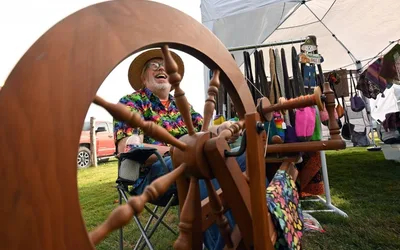
What sets Common Ground apart from the fairs that dot Maine's autumn calendar is what it deliberately leaves out. There is no midway, no ferris wheel, no cotton candy. In their place are craft demonstrations, heirloom crops, organic farming exhibits, livestock, local food, live music, and hundreds of vendors. Children who might otherwise be lining up for carnival rides instead clamor for wagon rides pulled by 1,300-pound draft horses. Sheepdog demonstrations put border collies to work moving flocks while handlers explain what the dogs are thinking and why herding instincts matter to livestock owners. And the food sold on the grounds must be organic, a rule that turns the fairgrounds into something closer to a farmers' market than a concession strip.
The scale is hard to overstate. The fair regularly hosts 50,000 to 60,000 people across its three days and features more than 1,000 exhibitors and speakers. MOFGA describes it as an annual celebration of rural living that emphasizes vibrant communities, sustainable living, and local economies while highlighting organic agriculture. The programming leans heavily on education and hands-on learning, a departure from the passive spectacle of a traditional agricultural fair.
This year's milestone has prompted MOFGA to stretch the celebration across the calendar rather than confine it to a single weekend. The centerpiece is "Fifty Years of Common Ground," a traveling exhibition of five decades of the fair's posters. The posters, MOFGA notes, were never merely announcements of dates and locations; they were calls to action reflecting shared values of care for the soil, respect for labor, mutual aid, creativity, and joy. Many of the artists behind them were themselves farmers, activists, or craftspeople embedded in the MOFGA community. The anniversary programming also includes a 50 years of Common Ground T-shirts parade and a special display in the Exhibition Hall.
The fair's poster tradition is one of the small rituals that has accumulated over five decades. Each year's artwork becomes a kind of visual record of the movement's evolving concerns, tracing the arc of Maine's organic community through moments of urgency and hope, resistance and celebration. Seen together, the posters form a portrait of a community that was imagining a different way of living with the land long before sustainability became a common word.
For all its growth, the fair has kept faith with the impulse that produced it: a group of people who wanted to learn from one another. That spirit shows up in the fair's structure, which treats every visitor as a potential student. The exhibition hall fills with prize-worthy produce, a farmers' market flanks each gate, and speakers and demonstrators occupy stages and tents throughout the grounds. It is a fair where the attractions are things you might actually take home and use, whether that is a technique for saving seed, a better way to keep chickens, or a conversation with someone who has been farming the same plot for decades.
Fifty years after a 102-word newspaper item predicted a fair with "extra features," the features have multiplied well beyond anything those editors imagined. The Common Ground Country Fair has become the most famous Maine fair this side of the one E. B. White modeled on the Blue Hill Fair, and it has done so without a single carnival ride. What it offers instead is a version of the harvest celebration that its founders had in mind: a place where organic agriculture, rural skills, and the people who practice them are the main event.
The fair takes place rain or shine on the Unity fairgrounds, and it remains a show-up-and-walk-in affair. For anyone curious about where Maine's organic movement came from and where it is going, the 50th annual gathering is as good an introduction as the state offers.