


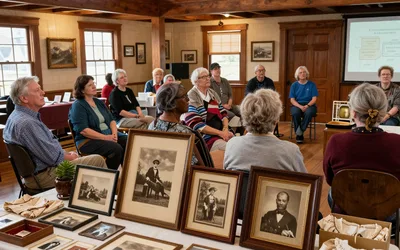
The wedding dress in the attic. The shoebox of sepia photographs. The oil portrait that has hung in the same hallway for three generations. Most families have them, and most families quietly assume the worst will never happen -- that the dress will hold its shape, that the photographs will keep their faces, that the canvas will stay whole. Barbara Moore has spent a career knowing better, and on Friday, Oct. 16, she will bring that knowledge to a room full of people who have something they cannot bear to lose.
Moore, a professional conservator, will present "Preserving Treasures" from 3 to 5 p.m. at the Town Hall Building at the Boothbay Railway Village. The program is a collaboration among three of the region's history-minded organizations: the Boothbay Region Historical Society, the Friends of the Southport Historical Society, and the Railway Village itself. Admission details were not stated in the announcement, but the event is open to the public.
Her subject is the quiet, unglamorous enemy of every heirloom: the ordinary conditions of an ordinary house. Moore will talk about the surprising things that speed up the aging of family treasures -- from beloved photographs to paintings to a great-grandmother's wedding dress -- and about simple, practical steps that can slow the damage and keep an object's story alive for the next generation. It is the kind of advice that tends to land hardest in coastal Maine, where summer humidity, winter woodstoves, and a century of attic storage have done their patient work on objects that were meant to last.
Moore's credentials are not those of a hobbyist. She has directed conservation laboratories at the Pitt Rivers Museum at Oxford, the Arizona State Museum, the Peabody Museum of Natural History at Yale University, and the Strong Museum in Rochester, New York. She has consulted on collection storage and long-range planning for institutions including the Genesee Country Village and Museum, where she and curator Patricia Tice conducted a detailed space-needs survey of collections spread across ten storage locations. In other words, she has spent decades thinking about exactly the questions a family faces when it opens a trunk: what is this made of, what is it doing to itself, and what can I do about it.
The setting for the talk is itself an argument for preservation. The Boothbay Railway Village is a re-created 19th-century Maine town, its grounds filled with historic structures and artifacts from the mid-1800s and early 1900s -- a village shop, a schoolhouse, a homestead, and a working train that circles the property. The Town Hall Building where Moore will speak is one of those rescued structures, the sort of building that exists today only because someone decided it was worth saving.
That instinct runs deep here. The Railway Village was the work of George McEvoy, a schoolteacher and railroad enthusiast who, by late 1963, had filled his family's home in Grafton, Massachusetts with railroad memorabilia and was running out of room at the family's Southport summer cottage. Teaching in Bowdoinham at the time, McEvoy often spent his days off visiting Phillip Carr, the station agent at Freeport, and on one of those visits he found a sign on the door announcing the station would close. When Carr told him the station building itself was for sale, the idea of a museum took hold.
McEvoy bought Freeport Station. He was later gifted Thorndike Station by the Belfast & Moosehead Railroad. In the summer of 1964, he and his friends laid three-quarters of a mile of track around what would become the museum's site. On Memorial Day weekend of 1965, the Boothbay Railway Museum opened to the public -- the first public railroad museum in Maine. It became a nonprofit in 1981 and has since grown into the village visitors know today. Freeport Station, moved whole from its original home, marked its 50th year in Boothbay in 2014.
The two historical societies co-hosting the Oct. 16 program carry their own long memories. The Boothbay Region Historical Society was founded in 1967 and moved in 1984 into the Elizabeth F. Reed House and its grounds at Fullerton Park, where it collects, preserves, and promotes the history of Boothbay, Boothbay Harbor, and Southport through research, exhibits, and programs. Southport, once represented within the regional society, now has its own museum as well: the Hendricks Hill Museum, operated with the support of the Friends of the Southport Historical Society, which preserves and displays items relating to life on Southport Island between 1800 and 1950 -- seagoing tools of the schooner trades, ice-harvesting equipment, navigational instruments and charts, carpenters' tools, kitchen and household goods, china both dressy and everyday, furniture, clothing, and photographs of the island's old hotels and boarding houses.
That is the world Moore's audience will be drawing from. The objects in those collections -- and the ones in family closets across the Boothbay region -- are not merely old. They are evidence. A wedding dress carries the shape of a particular body on a particular day. A photograph holds a face that no living person remembers. A painting records a house that no longer stands. All of them are, in a physical sense, decaying, and the difference between an heirloom that survives another century and one that does not often comes down to a handful of decisions made by whoever happens to be holding it now.
Moore's presentation is aimed at exactly that person. She will cover the everyday hazards that accelerate deterioration and the practical, low-cost measures that prevent further damage -- the kind of guidance that turns a vague sense of obligation into a set of things a person can actually do. The program runs two hours, from 3 to 5 p.m., in a building that is itself a survivor of the same impulse: the conviction that the past is worth the trouble of keeping.
For anyone in the Boothbay region who has ever stood in front of a trunk, a closet, or a framed portrait and wondered what to do next, the answer will be in the Town Hall Building on the afternoon of Oct. 16.