


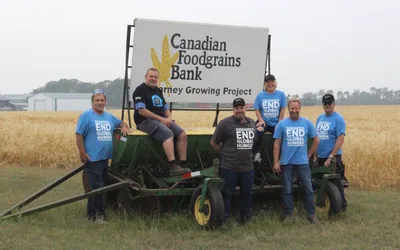
The field sits just north of the Canada-U.S. border, 160 acres of red spring wheat swaying under the September prairie sky. By Tuesday morning, if the weather cooperates, the combines will roll in from every direction — some from neighboring farms, some from towns an hour away, and at least a few from as far as Saskatchewan. They will line up at the edge of the crop, engines rumbling, and when Adrian Kroeker blows the ram's horn — a tradition that has grown over the past several years — they will move as one into the grain, cutting a golden swath that will eventually become something far more valuable than bushels of wheat.
This is the Killarney Foodgrains Grow Project's sixteenth annual harvest, an event the committee has affectionately dubbed "Sweet Sixteen." It marks sixteen years of community-driven fundraising for the Canadian Foodgrains Bank. And for the people of Killarney, a farming community in southwestern Manitoba, it has become something of a civic holiday — a day when the entire region sets aside its own harvest worries to bring in a crop that belongs to no one and everyone at once.
The project began modestly, with a small group of local farmers and church members. Field manager Myron Peters remembers the early days well. Over time, the harvest grew, drawing more combines and volunteers each year.
The model is elegantly simple: farmers and local businesses donate land, seed, fuel, equipment, and labor; volunteers plant, spray, and tend the crop; and on harvest day, the community gathers to bring it in. The grain is then sold on the Canadian market, and the proceeds fund emergency food assistance and long-term agricultural development programs around the world.
For the Killarney committee, the work has always been personal. In 2016, Dennis and Betty Turner traveled to Ethiopia with the Foodgrains Bank on a Learning Tour, visiting villages and feeding programs supported by the very funds their community raises. "When you look into those people's eyes, they are so appreciative," Betty Turner said in a recent interview. "And this is our way of making that happen, and we couldn't do it without the community support."
This year's crop has faced its share of challenges. A severe hailstorm swept through the Killarney area in early July, devastating some fields within two miles of the Foodgrains plot. Myron Peters' own farm northwest of town lost close to 50 percent of its crop. But the Foodgrains field, on Chad and Jillian Penner's land, escaped the worst of it. By mid-July, Peters was cautiously optimistic. "It's fully headed out at this stage," he said. "We got the second fungicide treatment put on. And right now, with the 6/10 of rain that we got on it, it's sitting in a very good spot." The seed, donated by Bar H Agri Seeds, had produced a crop that looked "heavy and healthy," according to Betty Turner.
As harvest day approached, the forecast turned uncertain. Rain over the September long weekend threatened to delay the event, and the committee urged supporters to tune in to CJRB Radio 1220 on Tuesday morning for confirmation. "Hopefully the harvest will take place," Turner said. "It's looking a little damp right now. But the most special part is really people coming together and out to the field that day, whether you're a volunteer or a spectator or just want to be there. We want you to come!"
When the harvest does happen — whether on the scheduled date or a makeup day — the scene will be familiar to anyone who has attended before. Combines will work the field in formation, grain carts shuttling alongside, semi-trucks waiting at the edge to haul the wheat to the elevator. The Holmfield and Willowcreek Hutterite Colonies will prepare a feast — enough to feed well over a hundred people. A special cake, decorated for the Sweet Sixteen milestone, will be cut and shared. And the field will be lined with spectators: families, retirees, schoolchildren, farmers who should be in their own fields but chose to be here instead.
Last year, for the project's fifteenth anniversary, the committee arranged something special: three young sisters from a local farming family — Annalee, Ariah, and Haley Duerksen — led the procession of combines down the road and through the wheat field on horseback, carrying Canadian flags.
What is certain is the deeper purpose that draws people back year after year. "I think when people witness the harvest and what we're trying to do — grow food here to raise money to support people that are hungry in other parts of the world — it brings it all together," Betty Turner said. "It's a way for us to show our volunteers and donors and the community that it does really make a difference."
For the farmers of Killarney, harvest is always a season of anxiety and hope, of weather watched and prayers offered. But this particular field, on this particular day, carries a different kind of weight. Every bushel that comes off it is a bushel that will never be sold for profit, never fill a local bin, never feed a family in Manitoba. Instead, it will travel — transformed into cash, then into food, then into hope — to places most of these farmers will never see. And that, perhaps, is the real harvest: not the grain in the hopper, but the knowledge that a community's generosity can reach across oceans.
Sixteen years in, the Killarney Foodgrains Grow Project has grown into something far bigger than a field of wheat. It has grown into a tradition, a gathering, a statement of what a community can do when it decides that no one should have to go hungry.